You Don't Get Knocked Out by the Punch You See
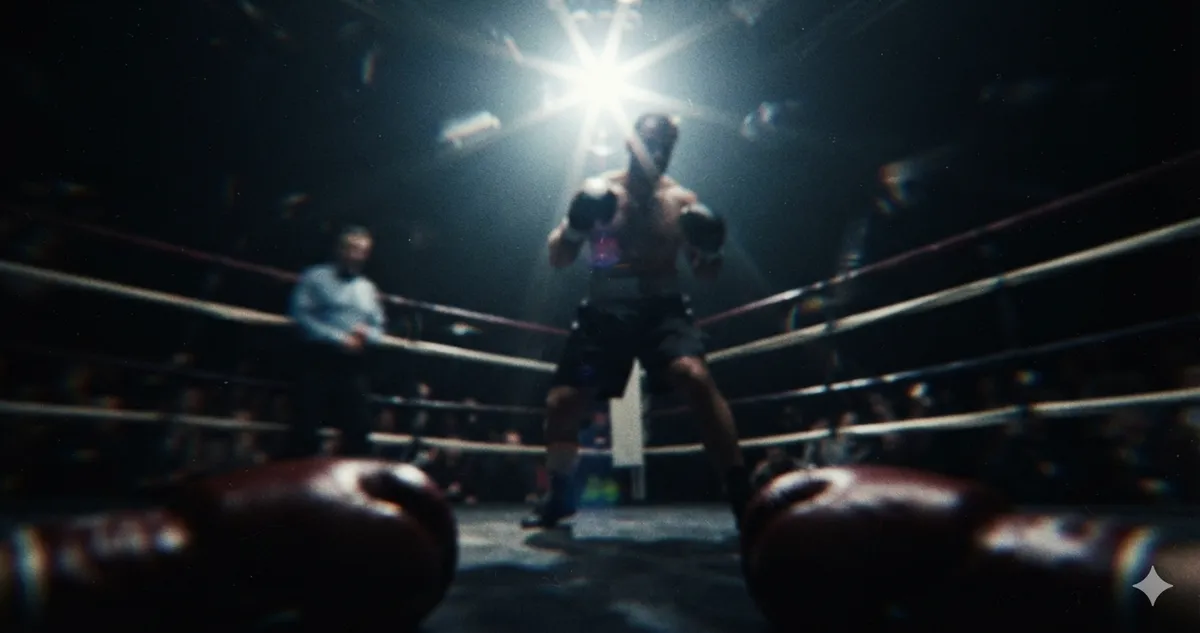
Ask a fighter which punch put them down and you will usually get a shrug. They can describe the round, the taste of the mouthguard, the ceiling lights swimming back into focus. The punch itself is missing from the record.
That absence is the whole lesson. A punch you see is a punch your body has already begun negotiating with. The chin tucks, the shoulder lifts, the knees soften to steal a little of the impact. Vision turns violence into an inconvenience. What actually ends fights is the shot that lands while your attention is elsewhere, thrown from an angle you quietly stopped covering because nothing had come from there in a while.
Corporations are worse at this than boxers, and for an unflattering reason. Boxers get hit often enough to stay honest.
Your risk register is a list of punches you have already blocked
Somewhere in your organization there is a spreadsheet with a heat map on it. Likelihood down one side, impact across the top, a column of owners who did not volunteer, and a review cadence that survives exactly two quarters past the offsite where it was born.
Nothing on it is ever green, because green invites deletion. Nothing is ever truly red, because red invites a meeting with people who have opinions about your judgement. So everything settles into a comfortable amber, the corporate colour of being technically alive.
Here is the structural problem, and it is not a failure of diligence. Every entry on that register is, by construction, a punch that somebody saw coming. The document is not a map of the world. It is a portrait of the imagination of the eleven people who happened to be free that Thursday. Its contents are the threats you are least likely to be knocked out by, precisely because they have been named, sized, and given a watcher.
The register is your guard. Useful, necessary, and completely irrelevant to the shot that gets you.
Three angles nobody in your building is covering
The punch from outside the frame
Your field of vision is drawn by your org chart. If a threat has no owner it has no watcher, and there is a long list of threats that belong to nobody. Your supplier's supplier. A rule being drafted in a jurisdiction where you book no revenue. The platform that is currently your distribution channel and is one product announcement away from being your competitor. The adjacent industry that is about to discover your customers by accident.
Nobody's objectives include the words "notice this". So nobody does.
The punch from a pattern you stopped tracking
The most dangerous metric in any company is the one that behaved so beautifully for so long that you retired its dashboard. Second-year engineering attrition. Time from signature to first support ticket. The share of revenue that depends on one integration. The competitor you dismissed in a slide in 2019 using the word "niche", which in corporate dialect means "we have decided to stop looking".
You stopped watching because watching was boring. Boring is what safety feels like immediately before it stops being safety.
The punch you walk directly into
In boxing you are at your most hittable in the instant you are throwing. The reach extends, the guard opens, the weight commits. Organizations obey the same physics. Your most vulnerable quarter is the one with the launch, the integration, the reorganization, the regulatory filing, the rebrand. Attention is a finite substance and you have just spent all of it on offense.
A counter-puncher does not need to be brilliant. They only need to read your calendar, which you publish.
Telegraphing - what you broadcast before you move
Fighters have tells. A dipped shoulder before the hook. A wider eye before the overhand. An exhale that comes half a beat early.
Organizations telegraph in higher resolution and with much better documentation.
- Job postings. A Director of Marketplace Trust and Safety in a city where you have no office is not a hire, it is a market entry announced eight months early.
- Patent and trademark filings, which are public by design and read by everyone except you.
- Domain registrations, certificate logs, app store metadata, and the staging environment somebody forgot to lock.
- The vocabulary shift on the earnings call, where three mentions of "platform" become nineteen and everyone pretends this is a coincidence.
- A conference talk by your principal engineer about a problem you do not officially have.
- Procurement trails, tenders, and a sudden institutional appetite for data centre capacity.
- The executive who quietly stops appearing on the customer roadshow.
Internal tells are even louder. Your staff know a reorganization is coming weeks before HR sends the note titled "a quick update on how we work". They know because the pattern of who is invited to what has changed. Confidentiality is rarely broken in these situations. It is simply inferred, which is cheaper and faster.
Two conclusions follow, and only one of them is comfortable. Somebody is reading you with real care. You are almost certainly not reading them, because that kind of reading takes patience and nobody has ever been promoted for patience.
Methods for locating the angle nobody is watching
Inventory assumptions rather than risks
A risk is an event. An assumption is a load-bearing wall. Write down the ten sentences that must stay true for the strategy to work, in plain language, with no hedging. Rank them by how much of the building collapses if each turns out to be false. Then give each one a named watcher and a specific tripwire.
This exercise is unpopular because it is short, cheap, and impossible to hide behind.
Write the other side's documents
Have your team draft the competitor's strategy memo about you. The activist investor's letter. The regulator's press release. The reporter's opening paragraph, the one that begins with a leaked internal email. People will confess in the third person things they will not say in the first.
Pay somebody to beat you
A red team with no budget, no mandate, and no reward for winning is theatre with worse costumes. Sparring is supposed to hurt. Give the team access, protection from retaliation, and something real to gain when they land a clean shot on your plan.
Interrogate the periphery, because that is where peripheral vision lives
The support queue. Field sales. The night shift. The analyst who is eight months in and has not yet learned which observations are unwelcome. Every layer of an organization rounds anomalies toward the mean, so by the time information reaches the top it has been sanded into a shape that fits the existing story.
Reopen the graveyard of dashboards
Keep a list of every metric you stopped watching, with the date and the reason. Review it once a quarter and ask what has been happening in the dark. This is the cheapest control you will ever build, and you will not build it.
Watch second derivatives
Levels are history. Rates are the present. Changes in rates are the future. Churn can look flat while the interval between a renewal and the first pricing question quietly halves. The number that matters is often not on the report, it is the shape of the number that is.
Fund a channel for "this is weird"
Weak signals arrive without business cases attached. If the only sanctioned way to raise a concern is a deck with a quantified impact estimate and an executive sponsor, you have built a filter that removes exactly the information you need and keeps the noise you already knew about.
Audit your own broadcast
Commission somebody to research you from the outside using nothing but public material, and have them report what they were able to infer. Then decide, deliberately, what you want to keep telegraphing. Sometimes a visible move is a feint and the broadcast is the point. Feinting on purpose is strategy. Feinting by accident is just a habit with consequences.
Post a guard while you are reaching
When the organization commits to a big move, one senior person takes no part in it. No launch workstream, no integration role, no slide in the deck. Their only job is to watch the angles while everybody else has their arm extended. This role sounds like a luxury until the first time it earns its salary in a single afternoon.
Chin, not clairvoyance
Now the uncomfortable part. You will not find every angle. Some punches genuinely arrive from outside any reasonable field of view, and a strategy built on the promise of perfect foresight is a strategy that has confused planning with prophecy.
Which is why fighters train the thing that has nothing to do with vision. Neck, core, conditioning, the discipline of breathing out on impact. A fighter with an excellent chin survives the shot they never saw. A fighter with excellent vision and a glass jaw survives until somebody gets creative.
The corporate equivalents are unglamorous and structurally underfunded, because every one of them looks like waste on a spreadsheet. Cash you are not deploying. Suppliers you are not consolidating. Slack in the schedule. Modularity that costs more than the monolith. Decision rights pushed low enough that a response does not require three committees and a steering group. Efficiency has been a religion for thirty years and it has quietly removed most of the shock absorbers from the modern firm, then billed the savings as performance.
Resilience is what you buy when you admit that your imagination has edges.
The bell
You will get hit. Not by the item sitting in amber with an owner and a mitigation plan, because that punch is already half-blocked by the fact that somebody wrote it down. It will be something adjacent, or something you retired, or something you walked into with your arm fully extended and your calendar full.
The organizations that survive are not the ones with the most elegant register. They are the ones that keep their hands up while reaching, that notice when they have stopped looking somewhere, that treat the unwelcome observation from the night shift as data rather than an attitude problem, and that can absorb a clean shot without their knees immediately consulting a lawyer.
The punch you see is not your problem. It never was.