Would You Like Some Copilot With That?
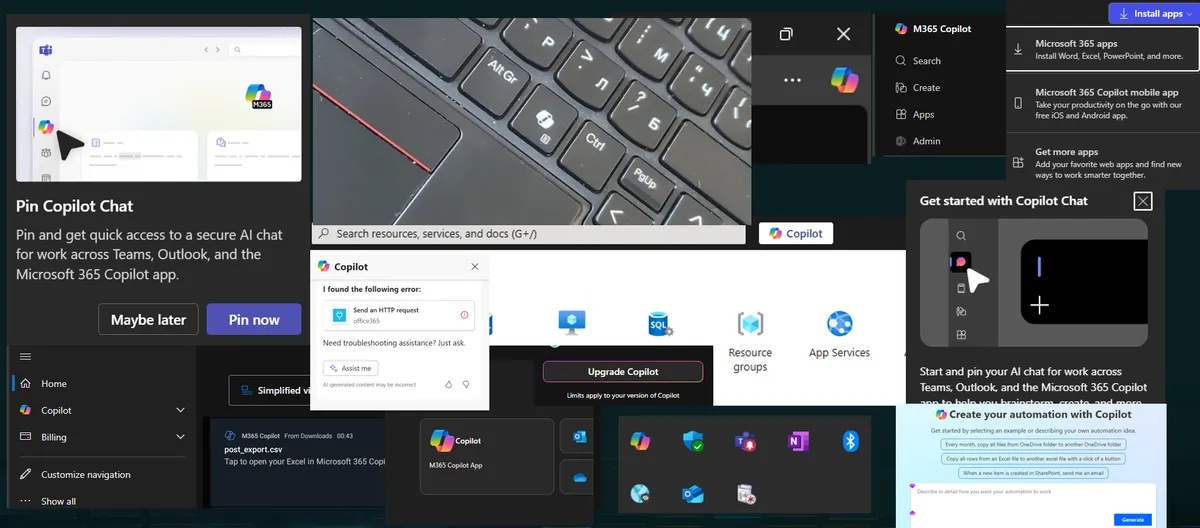
Microsoft has long been a dominant force in the tech industry, known for its enterprise software, operating systems, and productivity tools. Yet, when it comes to integrating emerging technologies like artificial intelligence into its ecosystem, the company has a recurring habit - saturate every product with the new tech in hopes that ubiquity will drive adoption.
The tactic, usually employed when you don't know how to sell something and stuff that thing into everything you sell so you can ship the maximum ammount of the merchandise.
The latest example of this strategy is Microsoft's Copilot, an AI assistant that is being inserted into virtually every corner of the Microsoft software and hardware ecosystem — from Windows 11 and Microsoft 365, to GitHub and Azure, and even hardware keyboards. This sweeping integration raises a fundamental question: has Microsoft truly identified a clear, compelling business case for Copilot, or is this another instance of experimentation by saturation, much like its earlier AI venture with Cortana?
A Pattern of Premature Saturation
The story of Cortana offers a revealing precedent. Initially launched as a digital assistant for Windows Phone, Cortana was Microsoft’s answer to Apple’s Siri and Google Assistant. But what began as a promising project quickly devolved into a confused identity crisis. Cortana was embedded into Windows 10, featured in Outlook, and even had dedicated buttons on third-party hardware like headphones and laptops (rings any bells?). Yet despite all this visibility, Cortana never became indispensable. Its voice recognition lagged behind competitors, its integrations were shallow, and its presence often felt more like a nuisance than a value add. By 2023, Microsoft had effectively retired Cortana, pulling it from Windows and other key platforms.
Fast forward to today, and we see an eerily similar approach with Copilot. From Word and Excel to Teams and Edge, Copilot is being offered as a productivity enhancer, coding assistant, and content generator. It now has its own keyboard key, giving many people a déjà vu. This physical embedding mirrors Cortana’s once-prominent button placements, and signals Microsoft’s intent to make Copilot not just a feature, but a core user interaction paradigm.
The Business Case That Isn’t There (Yet)
At the heart of this massive rollout lies a business challenge - Copilot, for all its promise, doesn’t yet have a clear-cut monetization path that justifies its cost of development and deployment. While Microsoft does offer paid Copilot services — such as Copilot Pro for individuals and Copilot for Microsoft 365 for enterprise — the actual uptake and value delivered remain ambiguous. Much of what Copilot does—summarizing emails, generating content, auto-completing code—overlaps with freely available or cheaper alternatives, including OpenAI’s own ChatGPT, which powers parts of Copilot itself.
The current integration of Copilot often feels superficial. In Word, it can summarize or generate text, but lacks deeper understanding of the context. In Teams, it can draft meeting summaries, but these are often only marginally better than standard transcription tools. While there are undeniably moments of productivity enhancement, these rarely rise to the level of transformation. As with Cortana, Microsoft appears to be pushing the technology more in hopes that people will figure out how to use it, rather than as a response to actual demand.
Implications for the Future
If Microsoft continues on this path without a clearer use case, Copilot risks becoming the next Cortana — a technology that was bolted to everything until it quietly disappeared. This could have long-term consequences. First, user fatigue is a real risk. When users are bombarded with AI features they didn’t ask for and rarely use, they become desensitized to new tools. Second, the credibility of Microsoft’s future AI initiatives could be damaged. Over-promising and under-delivering erodes trust.
However, there is a scenario, albeit less likely, where this aggressive strategy pays off. By embedding Copilot in all Microsoft products, the company is collecting vast amounts of user interaction data (subject to privacy constraints), which can be used to refine and improve the models. If breakthroughs in contextual AI or multimodal reasoning make Copilot more useful and consistent, Microsoft could eventually crystallize the killer use case that has so far eluded it.
Microsoft’s current approach to Copilot reflects a bet on ubiquity in the absence of a validated business model. By pushing Copilot across its entire product line — even into hardware — the company is attempting to create demand through presence rather than through value. The comparison to Cortana is not merely coincidental but illustrative - a cautionary tale of how deep integration without meaningful purpose can lead to eventual obsolescence. Whether Copilot becomes a revolutionary productivity tool or the next ghost in Microsoft’s software graveyard will depend on whether it can transcend novelty and deliver sustained, tangible value to users. For now, the business case for Copilot seems more aspirational than actual.