When Intelligence Is Rented, Every Intellectual Career Is a Lease
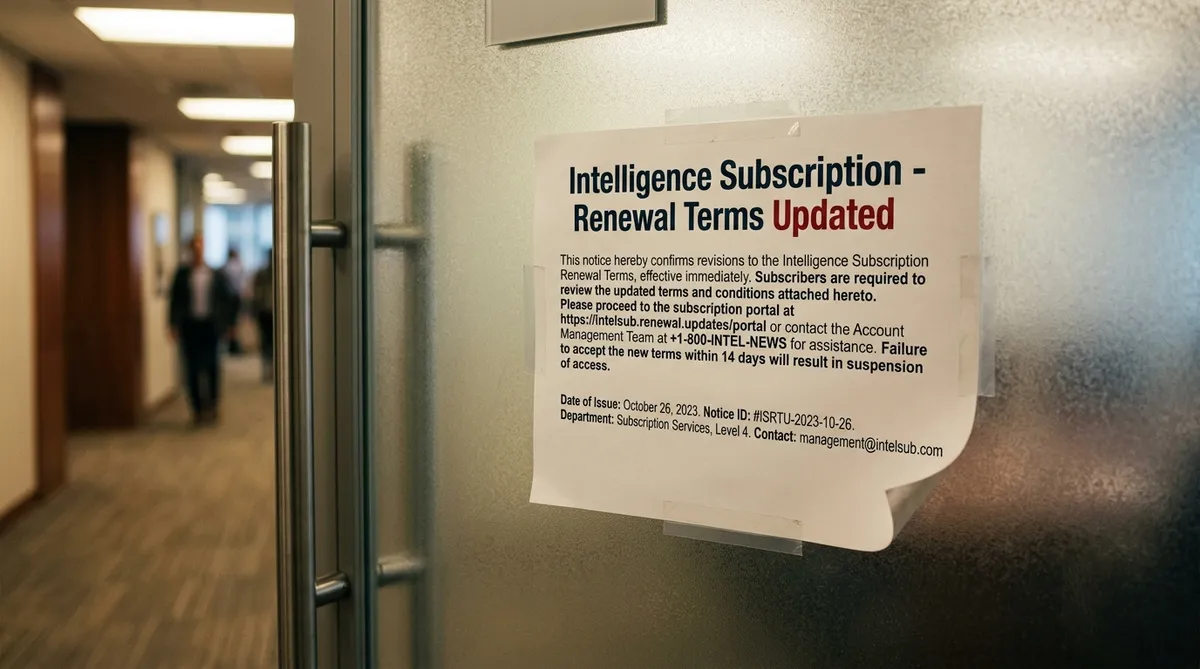
The Misconception
The popular fear goes like this - a machine arrives, learns your job, and politely shows you the door. Replacement. Obsolescence. A tasteful farewell cake. It is a satisfying story because it has an ending, and people like endings.
The actual story is worse because it never ends. Most jobs are not being taken. They are being refinanced. You still show up, you still do the work, you are often faster and better than before. The only thing that changed is that the sharpest part of what you do now arrives through a subscription, and the subscription is not yours. You did not lose the job. You lost the deed.
The Question
If the most valuable component of your work is delivered by a company that can change the price, the capability, or the terms on a Tuesday, in what sense do you still own your career - and what, if anything, is left that nobody can reprice?
The Explanation
For most of history, professional skill behaved like property. You built it slowly, it depreciated slowly, and nobody could remotely revoke it. Rented intelligence changes the asset class. The skill is still real, but it now sits on infrastructure you do not control, under a contract you did not negotiate, with a landlord who also rents to your competitors. To see how that plays out, it helps to follow one tenant through the building.
Lena wrote headlines for a living. Good ones. The kind that made a mediocre product sound like a decision you had been putting off. For fifteen years, her head was the only place those sentences existed before they existed. Then a chat box started producing eighty percent of a Lena headline in four seconds, and the remaining twenty percent, which was the entire point, became a line item nobody wanted to pay for separately.
It is worth being precise about what that chat box is, because the vagueness is where the trouble hides. A model is a set of weights, billions of parameters that live on hardware Lena will never see. She does not buy the weights. She buys tokens, metered per request, priced per million, with input and output billed at different rates. Her entire professional edge is now an API call. The thing she rents cannot be stored, resold, or inherited. When the request ends, so does her access to the thing that made her fast.
Lena adapted, because adapting is what tenants do. She built a library of prompts, learned exactly how to coax the model into her voice, and discovered which phrasings produced brilliance and which produced a LinkedIn post. She got proud of it. Her prompts were her craft now. She did not think of them as repainting the walls of an apartment she did not own, but that is what they were.
And apartments, as any renter knows, change hands. Model providers retire models on a schedule, usually with a few months of warning and a cheerful migration guide. Every prompt tuned to a specific model's quirks is a tenant improvement, and the landlord does not reimburse tenant improvements. The replacement model is marketed as better, which is often true in aggregate and frequently false for the exact behaviors you depended on. Your workflow does not break loudly. It drifts. Outputs get slightly different, your tricks stop working, and the burden of proving it is yours.
Lena's drift arrived by phone. A client who had, with no malice at all, discovered the same chat box. He did not want to drop her. He wanted to pay her a third of what he used to, since the hard part was clearly automated now. She explained that the hard part had never been typing. He agreed in the way people agree when the invoice is already drafted.
He was not wrong about the economics, only about where they landed. The per-token price of intelligence has fallen dramatically and will keep falling. This is not the same as your price falling slowly. In a market where everyone rents the same capability, the premium for having it collapses to roughly the subscription fee, and the value migrates to whoever owns the model or whoever owns the client. The freelancer in the middle is holding a sublease. Meanwhile vendor lock-in accumulates quietly - fine-tunes that only run on one provider, agent workflows bound to one tool schema, embeddings that are meaningless anywhere else. Switching costs rise exactly as pricing power leaves.
So Lena did something old-fashioned. She read her own contracts. Then she rewrote them so that she was paid for judgment, accountability, and the right to say no, rather than for sentences. Clients could get sentences anywhere. What they could not rent was a person who would notice that the brilliant headline was also a lawsuit, and who would answer the phone when it was. Her rate did not go back up to what it was. But it stopped being indexed to someone else's price list.
What she had found, without naming it, was the short list of things that sit outside the lease. Verification - knowing when the confident output is wrong. Context - the unwritten history of a client, a market, a mistake made in 2019. Accountability - a name that can be blamed, which the terms of service explicitly disclaim. And optionality - the ability to run an open-weight model locally, which is closer to buying a condo than owning a house, since you own the unit but not the electricity, the hardware, or the next generation. None of these are glamorous. All of them are the parts of the job that survive a price change.
The Closing Argument - a coda if you will
The lease metaphor is not pessimism. Plenty of people rent well, and plenty of owners go bankrupt. The problem is only pretending you own something you do not. The professional who believes their edge is permanent will be surprised by the renewal notice. The professional who knows exactly which parts are rented, and invests in the parts that are not, will at least be surprised on their own terms.
So, a modest proposal. Read the lease. Know what the landlord can change. Spend your weekends building something that does not require a login. And when someone tells you the machine is coming for your job, correct them gently. It is not coming for the job. It just bought the building.