We Were Worried About the Wrong Aspect of AI
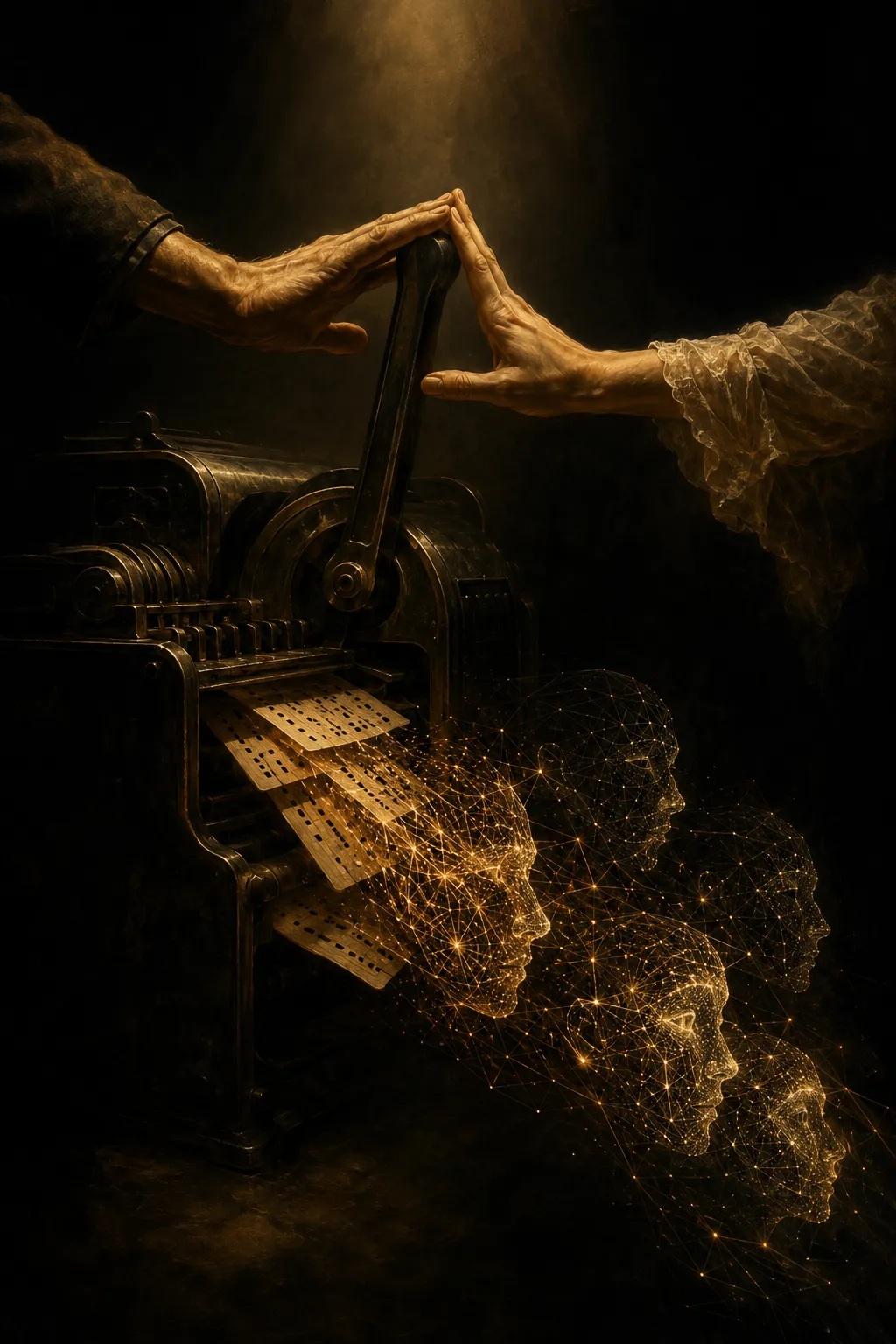
Everyone has the same nightmare now, and it is a very boring one. You are at your desk. An email arrives. It is warm and grammatically perfect, which is how you know a machine wrote it, and it explains that your role has been "transitioned" and that the company thanks you for your "contributions to the journey". You have been made redundant by something that does not get tired, does not unionize, and does not need dental.
This is the fear that sells magazine covers and fills conference keynotes. It is the fear that launched a thousand reskilling startups. And it is, I want to suggest, the wrong fear - or at least the smaller threat. We are all staring so hard at the threat to our paychecks that we have failed to notice the threat to something we never thought to put a price on. While we were busy worrying about AI taking our jobs, we forgot to ask whether it might take our freedom.
The Kurzweil Trick
Ray Kurzweil, who has built a career on being right about the future slightly more often than is comfortable, has a useful piece of advice for anyone trying to predict it. Do not extrapolate "more of the same", he says. The future is not the present with a faster processor. The interesting question is never "what will this technology do better". It is "what does this technology suddenly make cheap that used to be impossible or prohibitively expensive".
Apply that lens to AI and the jobs panic starts to look like a failure of imagination. "AI replaces knowledge workers" is more of the same. It is the spinning jenny, the spreadsheet, the ATM, the self-checkout - the long, familiar story of machines eating tasks while humans scramble up the ladder to invent new ones. We have run this experiment for three centuries. It is genuinely disruptive and genuinely painful and also genuinely not new.
The thing that is new - the capability that was once ruinously expensive and is now nearly free - is something else entirely. AI has collapsed the cost of content, ubiquitous surveillance. All possible media - video, pictures, audio, data and text in any language. All the time. And almost nobody is panicking about that, because a layoff comes with a date and a severance package, while the slow disappearance of your privacy comes with nothing at all. It does not even send an email.
Some Comforting Math of Why You Get to Keep Your Job. Eventually.
Let me first reassure you about the boring nightmare, because the reassurance is real, even if it is cold.
There is a structural reason AI cannot actually fire everyone, and it is the same reason a snake cannot eat its own tail all the way to the head. The companies racing to replace workers with AI need someone to sell things to. Demand (and if you are in the government - taxes, too), in an advanced economy, come overwhelmingly from the urbanized white-collar workforce - the very people the spreadsheets are itching to automate. Fire them all and you have not built a lean utopia. You have built a very efficient factory in a town where nobody has any money. The robots produce, the algorithms optimize, and the warehouse fills with goods that no laid-off worker can afford to buy.
The folk version of this idea is the legend of Henry Ford paying his workers five dollars a day so they could afford the Model Ts they built. It is a lovely story and it is mostly nonsense. Ford's own historians will tell you the real motive was a savage turnover problem - people were quitting the soul-crushing assembly line so fast that Ford was training a new workforce every few months. The five-dollar day was a retention bribe, not an act of macroeconomic generosity. But the deeper logic survives the puncturing of the myth. An economy is a circle. Capital needs customers. You cannot sell automation, prediction products and productivity software into a desert.
So the white-collar worker enjoys a strange kind of protection - not from being valued, but from being needed as a consumer. You are safe because you spend.
I should be honest, because the smartest people in this argument are on the other side. Daron Acemoglu and Simon Johnson have spent years documenting an uncomfortable fact - over the past four decades, automation has multiplied productivity and corporate profit without delivering much of it to workers at all. Acemoglu has a wonderful, deadpan phrase for the technology doing this. He calls it "so-so technology" - automation that is not actually better than a human, just cheaper, like the call-center menu that wastes nine minutes of your life before connecting you to a person anyway. And Yanis Varoufakis argues, more radically, that we have slipped out of capitalism entirely into something he calls technofeudalism, where the platform lords collect rent rather than profit and no longer especially need a thriving mass of consumers, only a captive herd producing data.
If they are even half right, then the circle I just described has a leak in it. The protection is weaker than the optimists claim. So no, your job is not perfectly safe. But here is the thing - even in the gloomiest version of the economic story, the harm has a familiar shape. It is poverty, inequality, precarity. Bad, but legible. We have words for it and we have, in principle, tools to fix it - taxes, transfers, unions, laws. The economic threat, however severe, lives inside a debate we already know how to have and we generally know how it plays out.
The other threat does not.
What Actually Got Cheap
Here is a number to sit with. At its peak in 1989, the East German Ministry for State Security - the Stasi - employed around 91,000 full-time officers and ran somewhere between 173,000 and 189,000 unofficial informants, the famous Inoffizielle Mitarbeiter. Some estimates of the occasional snitches run far higher. To watch a country of 16 million people, the most thorough surveillance state in human history needed, by some counts, one operative for every 57 citizens. It needed your neighbor, your colleague, sometimes your spouse. It needed a sea of human beings willing to inform on each other, and a warehouse of paper files on six million people - more than a third of the population.
And even then, it drowned. The Stasi's deepest limitation was not ambition but labor. It collected far more than it could ever read. The files piled up faster than humans could process them. Totalitarian surveillance, it turned out, did not scale, because spying contantly and thoroughly on a million people required something close to another million spies, and people are expensive, unreliable, and prone to having a conscience at the worst possible moment.
Now consider that Clearview AI, a company you have probably never knowingly interacted with, claims a database of more than 30 billion human faces - roughly four times the population of the planet - scraped from the open internet without anyone's consent. A single police officer with a subscription (or 0.50 EUR budget per search) and a phone can match a face against that database in seconds. The thing that used to require 280,000 informants now requires one detective, one laptop, and a quiet afternoon.
That is the order-of-magnitude collapse. That is the Kurzweil point made real. The cost of comprehensive surveillance has fallen so far, so fast, that the central reason tyranny used to burn itself out - the sheer human expense of paying enough people to watch everyone else - has simply evaporated. The bottleneck is gone. You no longer need a nation of informers. You need a vendor contract.
A Brief History of Cheap Control
The pattern is older than the computer, and the history is not subtle once you start looking for it.
Begin with the punch card. In the 1930s, the cutting edge of data processing was the Hollerith tabulating machine, leased across Europe by IBM's German subsidiary, Dehomag. When the Nazi regime needed to identify and locate Jews, it did not invent a new technology. It rented an existing one. The census became a weapon. Edwin Black, who documented this in exhausting detail, describes how a logistical problem that would have taken years with pencil and paper - quantifying and routing the deportation of millions of people - was compressed into days by the lightning speed of the machines. There is a particular column on those cards, a particular hole, that designated a person as a Jew. Bureaucracy, mechanized.
Then look at two men who held the same kind of machine and made opposite choices, because this is the part of the story that matters most.
In the occupied Netherlands, a meticulous civil servant named Jacobus Lentz built an identity card so clever it was nearly impossible to forge - photo, fingerprint, three watermarks - and he built a population registry of beautiful, lethal completeness. Lentz was not a monster in the cartoon sense. He was a perfectionist. He dreamed, in his own words, of data so complete that one could speak of "a paper human" standing in for the real one. His system worked exactly as designed. The Netherlands lost roughly three-quarters of its Jewish population, the highest rate in Western Europe - against around a quarter in France. Good record-keeping was the difference between those numbers. Lentz served three years in prison after the war. Three.
In France, the man at the controls was René Carmille, the head of the national statistical service. He, too, ran the census on punch-card machines. But Carmille was secretly in the Resistance, and when the time came to tabulate the religion of French citizens, the column that would have built a register of Jews went systematically unpunched. He sat at the most powerful surveillance instrument of his era and, quietly, refused to feed it. He was arrested by the Gestapo and died at Dachau in 1945, having sabotaged from the inside the very machine he was paid to run.
Same technology. Two men. One built the paper human. One starved the machine. The tool did not decide. They did.
And the technology need not even be sophisticated to be deadly. In Rwanda, the instrument of one of the fastest genocides in history was a small laminated card. Belgian colonizers had introduced identity cards listing ethnicity - Hutu, Tutsi, Twa - decades earlier. In 1994, at the roadblocks, that card was the whole apparatus. You handed it over. The killers read one line. As one scholar put it, the cards "served as death warrants". No algorithm required. Just cheap, systematic, total identification - the eternal prerequisite of organized cruelty.
The Same Machine, Now With a Friendly App
The cautionary ceiling is China, and I will give it one paragraph because the lesson is the contrast, not the spectacle. China now has more surveillance cameras than the rest of the world combined, on the order of one for every two people. In Xinjiang, an "Integrated Joint Operations Platform" flags Uyghurs for behavior as innocuous as using a VPN, leaving the country, or switching off a phone too often. Domestic security spending there rose roughly tenfold in a decade. (One caveat, because precision matters - the dreaded nationwide "social credit score" of Western imagination does not really exist as a single number. The reality is a fragmented patchwork, which is somehow more unsettling, because it means this was assembled piecemeal, by ordinary bureaucratic momentum, the way these things always are).
Now the part that should actually keep you up at night, because it is not happening over there. It is happening where you live.
In London, the Metropolitan Police have used live facial recognition to make well over 1,700 arrests since the start of 2024. They are quick to tell you the false-positive rate is vanishingly small, by their own measurement, and that 85 percent of Londoners support it, also by their own measurement. In the same year the European Union's flagship AI Act switched on its ban against exactly this kind of biometric dragnet, a European democracy was rolling it out at a clip of one arrest every 35 minutes.
In the United States, Clearview's founder cheerfully told a reporter that his 30-billion-face database represents "not even 1% of what's out there". At least seven Americans have been wrongfully arrested on the say-so of a facial recognition match. Every single one of them was Black. Robert Williams was handcuffed on his own front lawn, in front of his daughters, because an algorithm was confident and a detective did not bother to check. Meanwhile ICE has handed Palantir tens of millions of dollars to build a deportation-targeting platform, drawing on data the government already holds on all of us, and your Amazon doorbell has spent years quietly forwarding clips of your street to the local police - sometimes, the company admitted, without a warrant and without asking you.
The EU, to its credit, wrote the boldest law on Earth and aimed it straight at this. The AI Act explicitly bans scraping faces off the internet to build recognition databases. It is a good law, if at nothing else at its intent. And then, like all good laws written by committees that also want to catch criminals, it carved out exceptions - for serious crime, for terrorism, for finding the missing. The most elegant loophole is this. Watching you live in the public square is mostly banned. But filming the square and running every face through the database three days later is merely "high risk", which is regulatory language for "allowed, with paperwork". So film the protest now. Identify everyone on Thursday. The ban survives. So does the surveillance.
Why the Quiet Threat Wins
The reason almost nobody marches against this is that the harm is built to be invisible. A layoff is an event. It has a date, a meeting, a cardboard box of desk plants. Your freedom does not get fired. It erodes, microscopically, on a Tuesday, in a server you will never see, and you feel exactly nothing - until the day, much later, when you notice you have started to behave.
The legal scholar Daniel Solove spent a whole book dismantling the most seductive line in this debate - "I have nothing to hide". His answer, roughly, is that privacy was never about hiding wrongdoing. It is the precondition for a self that can think, dissent, experiment, and be wrong in private before being right in public. Take that away and you do not catch more criminals. You manufacture quieter, more obedient citizens, the kind who feel a small involuntary flinch before searching anything controversial, the kind who self-censor without ever being told to. Shoshana Zuboff calls the broader machine surveillance capitalism, and her sharpest observation is almost an aside - Ford's bargain, however cynical, bound the company to its workers and customers in mutual dependence. The new model owes you nothing. You are not the customer. You are the raw material.
That is the real asymmetry. The job threat is loud, dated, and survivable. The freedom threat is silent, gradual, and the kind of thing you only diagnose in the past tense.
The Hopeful Part, Which Is Also the Point
I promised this would not end in the dark, and the reason it does not is René Carmille at his unpunched column.
The cheapness of these tools cuts both ways. The same falling cost that lets one detective surveil a city lets one journalist expose the company doing it - Kashmir Hill unspooled Clearview from a laptop. The same satellites that map a population, map the camps built to hold them. The same encryption that protects a dissident protects you. Power got cheaper, yes. But so did watching power, and that has never been true at this scale before.
And the pushback is not theoretical. San Francisco banned government facial recognition outright, and at least sixteen other American cities followed. Illinois passed a law so sharp that Facebook paid 650 million dollars for scanning faces without consent, and Meta's total bill for biometric sins now runs past two billion. Clearview has been fined into the tens of millions across Europe and is, legally speaking, radioactive on the continent. Robert Williams sued the city that arrested him and won the strongest police constraints on the technology in the country.
None of this is destiny. That is the entire argument. The punch card built the paper human in Amsterdam and starved in Carmille's office in the same war, with the same machine, because the difference was never the technology. It was the hand on the lever and the law around it, and whether enough people were paying attention to notice which way it was being pushed.
So by all means, update your resume. Learn the new tools. The robots really are coming for the busywork, and that fight matters. But do not let the loud, legible, survivable threat to your job distract you from the quiet one to your liberty - the one that does not send an email, does not offer severance, and is counting on you to be too worried about the first thing to notice the second.
Watch the column. Notice who is punching it.