Tokenomics are coming

The Hidden Price of AI and How We Will Pay It
There is an old joke about a man who sells ten dollar bills for five dollars each. When asked how the business is going, he says it is booming, he just needs more volume. For four years we have watched the smartest people in technology reinvent this joke, add a chatbot and agents to it, and raise money at a valuation that assumes the man will one day discover a margin hidden inside the ten dollar bill.
The economics of a token, the little unit of text an AI model receives and emits, and the slowly dawning realization that every single one of those tokens costs real money to produce, and that producing more of them faster currently is not a path to profit but a more efficient path to the same cliff.
The revelation that everyone already knew
When a company files to go public, it has to stop talking like a founder and start talking like an accountant. The prospectus is the one document where the vibes are legally required to reconcile with the numbers. And the recent filings on the road to IPO told a quietly devastating story - expenses scale with revenue.
Read that again, because the entire technology industry was built on the opposite promise. The whole point of software, the reason it ate the world and minted a generation of billionaires, is that it does not scale like that. You write the code once. The ten thousandth customer costs you almost nothing to serve. Marginal cost trends toward zero, margins trend toward heaven, and the spreadsheet curves apart into that beautiful pair of diverging lines that venture capitalists have tattooed on their hearts.
AI does not do this. Every query lights up a rack of very expensive chips in a very expensive building drinking a very expensive amount of electricity and water. Serve more customers, burn more compute. Revenue goes up and the cost of revenue goes up right alongside it, holding hands, walking into the sea together. The two lines do not diverge. They are in a committed relationship.
So when you see the headline that revenue tripled, the appropriate response is not applause. It is the question an accountant would ask, which is - and what did it cost you to triple it. The answer, increasingly, is roughly three times as much.
The circular economy of mutual admiration
Here is the part that should make you laugh and then make you check your retirement account.
A handful of enormous companies have discovered that you do not strictly need outside customers to make your numbers go up. You can keep business amongst yourselves and call it growth. Chip maker invests billions in a model company. Model company uses the billions to buy chips from the chip maker. Chip maker books the sale as revenue, the model company books the investment as a partnership, and a cloud provider in the middle signs a contract so large it gets its own press release with a quote about reimagining the future of human potential.
No external dollar of profit has entered this system. Nobody outside the circle has paid for anything useful. But every valuation in the loop just went up, because each company can now point to the others and say look, demand is exploding, these serious people are giving us serious money (and quite often - promise to give money and/or stock).
It is a group of friends standing in a circle, each handing the next one a ten dollar bill, like the three stooges, all of them now feeling considerably richer.
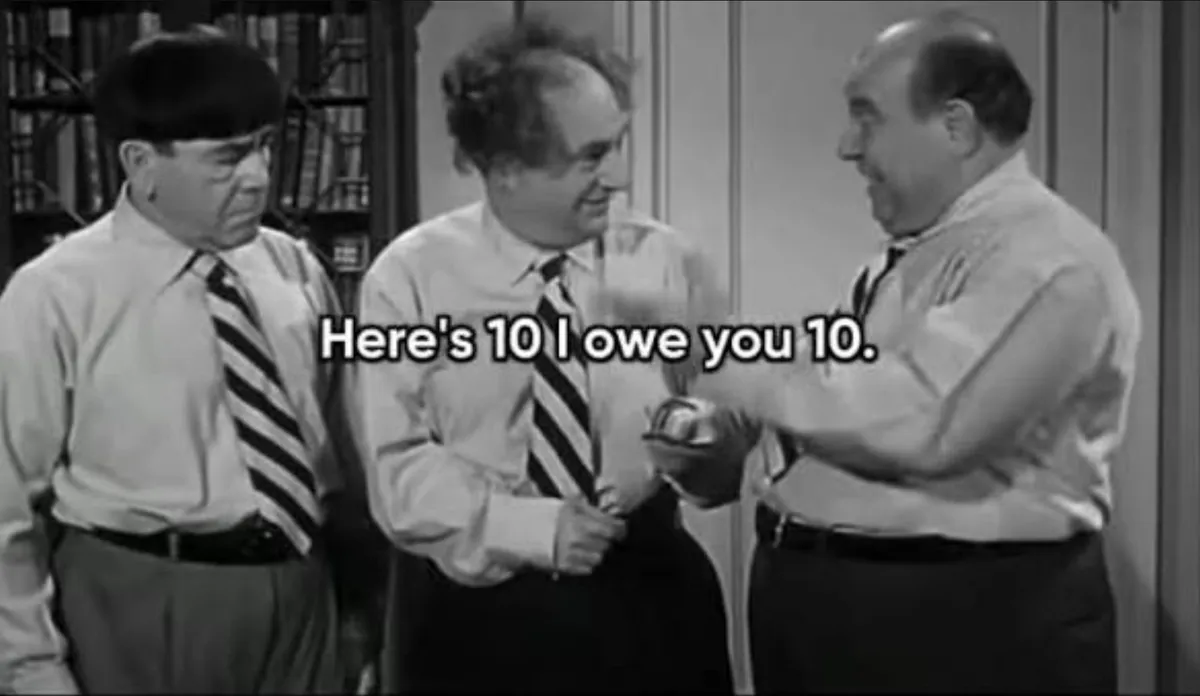
This works beautifully right up until someone needs to take a dollar out of the circle and spend it on rent.
Where did the venture capital go
The tell is in the structure of the money. Venture capital, that famously incurious and risk averse breed, has largely lost its appetite for funding this directly. Not because they stopped believing, exactly, but because the checks required are now the size of national infrastructure budgets and the returns keep being scheduled for a year that is always one year away.
So the money has changed its costume. The growth has stopped looking like equity, the kind where you buy a piece of the upside, and started looking like debt and infrastructure, the kind where you buy a building full of depreciating hardware and pray the demand shows up before the loan does. When the smart money starts lending instead of buying, it is not a sign of confidence. It is a sign that someone wants their principal back with interest regardless of how the dream turns out.
And the dream, four years in, still has no visible return on investment to show a skeptic. There are wonderful use cases. There are genuine productivity gains in many places. There is a great deal of writing that nobody asked for. What there is not, anywhere on the balance sheet of the broad economy, is the trillion dollars of new value that the trillion dollars of spending was supposed to conjure. The technology may well be transformative. The accounting is still waiting for it to prove it in the only language accounting speaks.
You are the exit liquidity, in five convenient installments
Every bubble needs someone to hold the bill when the music stops, and the genius of this one is that it has arranged for ordinary people to pay it only financially five separate times, through five separate doors, most of them without noticing they walked through any of them. That is disregarding ecological consequences, water supply disruptions, noise, etc.
The first door is the obvious one. As the era of free and heavily subsidized AI ends, you and your company will pay the real price for usage and tokens. The cost that was buried in venture subsidy, hidden so you would form a habit, will surface on your invoice. The ten dollar bill, it turns out, was always going to cost you ten dollars plus GM, eventually. The discount was the bait.
The second door is your portfolio. We will all soon own stock of the major AI companies when they go through huge IPOs, but even if you don't buy their stock - through your pension, your index fund, your sensible diversified retirement account that you were told to leave alone, you already own a slice of these valuations. You did not pick them. They are simply so large now that owning the market means owning them. When the circle of friends finally has to settle up, the correction does not stay politely contained among the wealthy who chose the risk. It arrives in the statement of a schoolteacher who just wanted the boring fund.
The third door is the one nobody campaigned on. The data centers are real (although not in the sizes promised for now), and they are thirsty for electricity in a way that strains the grid they share with your house. Build enough of them near enough to you and the price of power rises for everyone on the same wires, the cost of new generation gets socialized across the rate base, and a portion of the AI boom arrives quietly in your monthly electricity bill, itemized as nothing in particular. You are subsidizing the revolution every time you run the dishwasher.
The fourth is even more hidden and with strategic implications, unlike the higher bills for electricity you will get right away. Communities are paying for AI data centers by huge tax rebates the communities use to attract big players to select them for their next build. Data centers are not creating a lot of jobs past their building is complete, not that the majority of higher paid jobs during building are sourced locally, since the specialized data center technicians building a simple warehouse into a real data center are in short supply and unavailable locally. On the other hand, communities will usually not collect tax revenues, stemming from these data centers for a long time.
Now you know of the fourth door - the fifth is pretty evident. Data centers are notoriously power and water hungry. Unlike power, water is much more constrained by natural and geographical factors, so higher demand for water in a community usually makes water permanently more expensive - it is not an expense that pays off after infrastructure is built - you cannot build a water generation plant as cheaply and with a small land (think desalination plants as they scale best but only near the ocean or sea - bad luck Inyo county) footprint as a powerplant. So it is not even a question of money, even if the money comes from elsewhere.
The bill is due
None of this means the technology is fake. That is the lazy conclusion and it is wrong. Electricity was real during the bubble in electric companies. Railroads were real, and the internet was extremely real, while fortunes evaporated in both. A technology can be world changing and a generationally bad investment at the same time, and history is mostly the gap between those two facts being violently closed.
What is happening now is simply the oldest event in finance wearing a new and very expensive jacket. The subsidy is ending, the circular financing is getting harder to refill, and the moment of reckoning is the one where we finally find out what AI is actually worth when somebody has to pay the real price for it with real money that did not come from selling a story to the next person in line.
The bill is due. The interesting question was never whether AI works. It is where, once the subsidies and the circular accounting and the manufactured demand are stripped away, this whole thing really fits in the grand scheme of the economy. We are about to find out. Most of us, it turns out, already prepaid.
The man with the ten dollar bills, by the way, eventually did go public. The prospectus was magnificent. Growth potential - enormous. It's just that expenses scaled with revenue.