The So-So AI
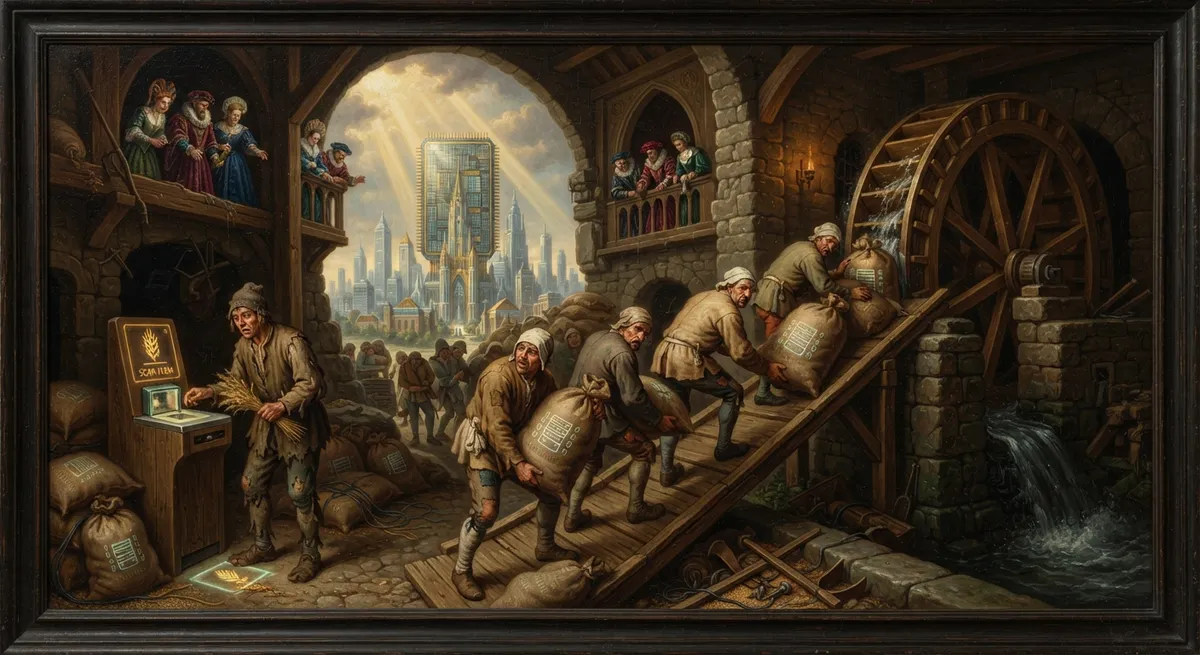
What a thousand years of technological disappointment can teach us about the machine that automates intellectual work
Every era gets the miracle it deserves. Ours is a machine that can pass the bar exam, compose a competent sonnet, and expand "sounds good, ship it" into a warm, professional, four-paragraph email - which a second machine, on the receiving end, dutifully compresses back into "sounds good, ship it." Economists call this a productivity revolution. Thermodynamics has a less flattering word for it.
In Power and Progress, Daron Acemoglu and Simon Johnson - both of whom have since collected Nobel prizes for their efforts, presumably handed over by a human - conduct a thousand-year audit of the claim that technology automatically makes everyone better off. The audit does not go well. Their most useful gift to the present moment is a small, devastating category - the so-so technology.
A so-so technology is good enough to replace a worker, but not good enough to make society richer or economy grow. It automates a task, pockets the wage, and generates efficiency gains so modest they disappear into rounding error. It creates no new tasks, no new demand for human skill, no compounding surge of prosperity and does not serve as a basis for other innovations. It simply moves money from one line of a spreadsheet to another, upward.
The patron saint of the genre is the self-checkout kiosk. It fired the cashier, deputized you - unpaid, untrained, hunting for a barcode on a bag of loose ginger - and lowered the price of exactly nothing. The store saved a salary. You gained a new hobby - negotiating with a machine about an unexpected item in the bagging area. National productivity statistics, of course, shrugged.
The deeper argument of the book is that the "productivity bandwagon" - the comforting assumption that gains from technology flow naturally into wages and wellbeing - is not a law of nature. It is a settlement, and settlements are negotiated. Historically it holds only when two conditions are met - the technology creates new tasks for humans to do, and workers hold enough countervailing power to claim a share of the winnings. Remove either condition, and you get progress for the few and patience (eventually lack thereof) for the rest.
History keeps the receipts.
A thousand years of receipts
The medieval "agricultural revolution." Between roughly 1000 and 1300, Europe adopted heavier plows, better crop rotation, water mills and windmills. Output per peasant rose meaningfully. The surplus, however, flowed almost entirely to lords and the church, who used it to fund the great cathedral-building boom and, in many places, a legal monopoly obliging peasants to grind grain at the lord's mill, for a fee, on pain of punishment. The mill ground the grain, and then it ground the peasant. Living standards for the people doing the actual farming barely moved for three centuries. They did, in fairness, get more magnificent architecture to be malnourished next to.
The cotton gin, 1793. Eli Whitney's machine multiplied the productivity of cotton processing by an order of magnitude - a textbook triumph of innovation. The result was not leisure, nor wages, nor freedom. It made slavery vastly more profitable, and so slavery expanded, hardened, and spread westward, while conditions for the enslaved grew more brutal under the new economics of scale. This is worth sitting with, because "labor-saving technology" is doing remarkable work in that phrase. It saved the laborers nothing. It is the cleanest demonstration on record that a productivity miracle plus an absence of power for the people doing the work equals catastrophe with excellent margins.
The early Industrial Revolution. From the 1780s to the 1840s, British output per worker climbed while real wages flatlined - a stretch economic historians politely call Engels' pause. Hours lengthened, cities became mortality engines, and children went into the mines, because small hands were a feature. Sixty to eighty years is a long time to wait for the trickle, even by trickle-down standards. The Luddites, routinely slandered as technophobes, understood the situation perfectly well - they were not against machines, they were against being robbed by means of machines, a distinction their employers found inconvenient and Parliament found hangable.
And then, the good chapters. The pause eventually ended - not because the steam engine grew a conscience, but because the two conditions finally clicked into place. Railways, electrification, and the modern factory created whole new categories of work - engineers, machinists, clerks, managers, conductors - while unions, reform acts, and the expanding franchise gave workers the leverage to demand a cut. Henry Ford's five-dollar day was not charity, it was strategy, and it shared the gains anyway. The postwar decades saw productivity and median wages rise together for a generation. Technology can absolutely deliver broad prosperity. It has just never once done so on autopilot.
Is AI a railway or a kiosk
So which lineage does today's AI belong to? Acemoglu and Johnson, writing at the dawn of the generative boom, worried it was trending towards a kiosk. Three years on, the symptoms are worth checking honestly.
The missing productivity. Robert Solow quipped in 1987 that you could see the computer age everywhere but in the productivity statistics, and the line has aged into prophecy with a software update. Acemoglu's own back-of-the-envelope estimate puts AI's likely contribution at well under a percentage point of total factor productivity growth over a decade - "transformative" is carrying a heavy load in the marketing decks. A widely cited MIT study found that roughly 95 percent of corporate generative-AI pilots produced no measurable return, a hit rate that would embarrass a dowsing rod.
Automation of the wrong end. As the writer Joanna Maciejewska memorably complained, the deal was supposed to be that AI does the laundry and dishes so humans can make art and writing - instead the machines make the art and writing while humans keep doing the laundry, increasingly under algorithmic supervision, at a pace set by software that never needs a bathroom break.
The content ouroboros. Researchers have even coined a word - workslop - for AI-generated material that has the shape of work without the substance, quietly forwarding the real effort downstream to whoever must decode it. One model inflates three bullet points into a report nobody wanted, another model summarizes it back for people who never intended to read it. Somewhere in that loop, value is allegedly created. What is definitely created is the appearance of productivity, which is not productivity - it is productivity theater with excellent lighting.
The surveillance dividend. The one domain where AI is unambiguously effective today is watching. It counts a warehouse picker's seconds, scores the fatigue in a driver's eyelids, and grades the warmth of your voice on a support call. These systems are profitable, deployed at scale, and generate exactly the kind of gain the book warns about - real, private, and invisible in anyone's paycheck.
The customer as unpaid staff, again. The support chatbot is the self-checkout of the mind. The company saved a salary. You spent twenty minutes typing the word AGENT in increasingly hostile capital letters.
Displaced labor, modest and concentrated gains, no obvious new tasks, a strong tilt toward monitoring and cost-cutting over capability-building. That is the so-so signature, and current AI matches an uncomfortable amount of it.
The counter-thesis - the pessimists may simply be early
Now the honest rebuttal, because the case against the case might be stronger than the doomers admit.
General-purpose technologies are slow burners. The electric motor was available in the 1890s, yet factory productivity barely budged for thirty years - because owners simply bolted a big electric motor where the big steam engine used to be and changed nothing else. Only when a new generation redesigned the factory itself around distributed power did output explode. Computers repeated the trick, with Solow's paradox resolving into the late-1990s productivity surge. Erik Brynjolfsson calls this the productivity J-curve - massive intangible investment looks like nothing right up until it looks like everything. On this reading, 95 percent of pilots failing is not an indictment. It is the tuition bill.
Early evidence points to complement, not just substitute. The best-known field study of AI at work - customer support agents given an AI assistant - found productivity gains around 14 percent, with by far the largest gains going to the newest, least experienced workers. Coding assistants show a similar pattern. A technology that compresses the gap between novice and veteran is the precise economic opposite of the cotton gin. So-so technologies deskill and displace - this one, so far, appears to upskill the bottom faster than the top.
Genuinely new tasks are appearing. Not just prompt engineering - a profession with the lifespan of a mayfly that had a LinkedIn account - but model evaluation, AI auditing, data curation, DataOps, MLOps, agent orchestration, and above all, science. AlphaFold cracked protein structures that had resisted humanity for fifty years, Claude is claimed to have helped prove (no one has yet read the 250 000-page proof - so we assume that for now) the Riemann hypothesis for the Riemann zeta function, and AI-designed materials and drug candidates are entering pipelines. A technology that accelerates discovery does not merely re-slice the pie. It plants orchards. Nothing about a kiosk ever did that.
The countervailing powers showed up early this time. Engels' pause took two generations to correct. This cycle, Hollywood's writers struck and won contractual AI guardrails within a year of ChatGPT's launch, regulators drafted AI acts before mass deployment rather than decades after, and unions are bargaining over algorithmic management right now. Perhaps a thousand years of receipts taught us something - or at least taught us to unionize faster than we industrialize.
And the fatalism refutes itself. The book's own thesis contains the rebuttal. So-so-ness is not a property of the transformer architecture. It is a property of deployment choices made by people. Nothing in the loss function requires the kiosk.
The dial, not the machine
So - dynamo or kiosk? The uncomfortable answer is that the machine does not get a vote. The real lesson of Power and Progress is not that technology disappoints, nor that it delivers, but that technology is an amplifier wired to whoever holds the dial. The so-so outcome is the default, not the destiny - it is what happens on autopilot, because automating an existing cost line is legible to a CFO in a way that inventing new human capabilities is not. Cutting a salary fits in a cell. Creating a new profession does not.
Which means the future is an audit question, and three questions are enough for any AI deployment. Does it create new things for humans to do, or merely cheaper ways not to employ them? Does the gain show up in a paycheck, or only on a margin slide? And is the customer now doing the job?
Answer those honestly, at scale, with actual leverage behind the answers, and AI becomes the railway. Answer them the way we answered the self-checkout, and we will have built the most sophisticated so-so technology in history - a machine that can explain, in flawless prose, exactly why you no longer matter.
One last note. If an AI helped draft this essay, then one of two things is true. Either the result is mediocre, which proves the thesis, or it is rather good, which proves the counter-thesis. The author declines to say which - so-so technologies rarely do. 😉