The Ship of Theseus Has Shipped
Panta rhei
Cratylus, Heraclitus
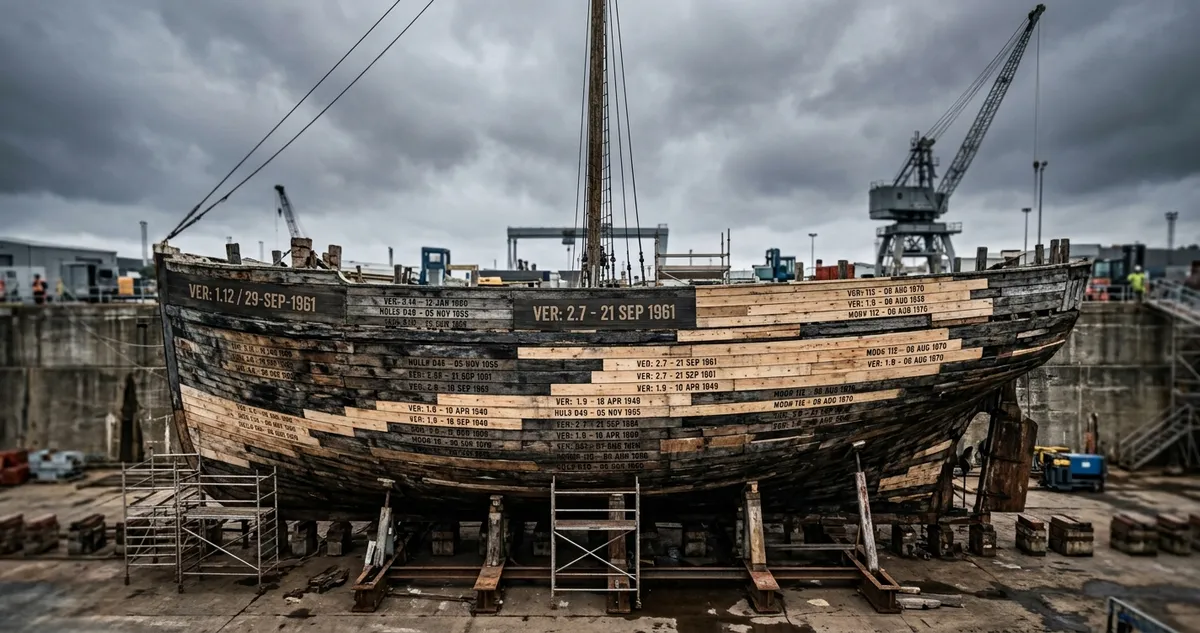
Plutarch once told a story about a boat. The Athenians preserved the ship of Theseus that sailed home from Crete (the guy who killed the Minotaur in the Labyrinth and forgot to change the sails with white ones so his father Aegeus threw himself in the sea filled with grief - giving the name of the Aegean sea), and being conscientious custodians of the memory of the mythical hero they replaced each plank as it rotted, and being philosophically inclined as they are - they eventually asked whether the thing in the harbor was still the same ship.
What gets left out of the retelling is that the Athenians did not care. They kept sailing the thing to Delos every year. The shipwrights had a maintenance schedule, the priests had a festival, and the ontology was somebody else's problem. Only later did the question migrate from the dock to the seminar room, where it has been living without paying rent ever since.
The modern version is less relaxing, because the ontology now arrives as a ticket.
The Refit Nobody Logged
Take a company eleven years old. The founders are gone, one gracefully. Of the engineers who wrote the first system, none remain, and of the engineers who wrote the second, two remain and both are in management. The codebase has been rewritten twice, once for defensible reasons and once for a promotion. The market it serves is not the market it was built for, and the pivot was so successful that the deck describing it has been retconned into the origin story.
The logo has been simplified twice into progressive abstraction and flattened (of course), arriving at a shape that suggests either momentum or a bird or something. The name is unchanged. The domain still resolves.
What has genuinely persisted through all of it - the legal entity, the trademark, a scheduled job authored by a person whose profile now reads "advisor", and every promise anyone ever made on the company's behalf.
Consent Does Not Transfer. Obligation Does.
Here is the practical form of the puzzle. A team spends a sprint preserving compatibility for an integration contract negotiated by a salesperson who left in 2019, with a customer that has since been acquired, on behalf of a use case the acquirer intends to retire. Everyone involved suspects this. Nobody can act on the suspicion, because nobody can locate the person authorized to say the promise is over.
This is the interesting asymmetry. Consent is personal and expires with the person. Obligation is institutional and does not. The people who agreed to the constraint are gone; the constraint is at standup. It has outlived every human who understood its purpose and it is still setting the agenda, like a will written in a language the heirs no longer read but continue to obey phonetically.
Multiply that by a decade and you do not have a technology company. You have a working museum with a support commitment.
Fossils, And The Cost Of Digging
G. K. Chesterton told us not to remove a fence until we know why it is there. Sound advice for one fence. It scales into something else entirely - a fenced subdivision, with an HOA, in which no resident can name a single original property line and all of them mow around the posts.
Every organisation of any age is thick with rules whose justification has decayed while the rule stayed crisp. No deploys on Friday, a policy that outlived the outage, the database that caused the outage, and arguably the company that had the outage. Two approvals on that repository, because of an incident in a system that was decommissioned during a reorg two reorgs ago. A field in the schema that must never be null, defended with the vigour of scripture and the evidentiary basis of a rumour.
The rules are load-bearing until proven otherwise. Proof is expensive. Nobody's compensation depends on producing it. So the fences stay, and the mowing gets slower, and everyone agrees the yard has gotten harder to maintain.
Identity Is A Liability Structure
Philosophy asks which ship is really the ship. Institutions answer the question empirically, and the answer is bracing - the real ship is the one that receives the subpoena.
Identity, at the scale of an organization, is not a property discovered in the object. It is a decision about where to send the invoice. Continuity is not something a company knows about itself; it is a claim other parties enforce upon it. Customers enforce it, regulators enforce it, the press enforces it, and so does one commenter with a very long memory and a screenshot from 2016.
Which means the metaphysics was never the hard part. Nobody in the building is confused about whether the planks were replaced. They are confused about who is permitted to say so out loud, and in whose presence such a statement would count.
Who Is Allowed To Declare A New Ship
The candidates, in ascending order of honesty.
The rebrand. The weakest instrument available, and the most popular. A new name and a refreshed palette, announced by the same people, from the same offices, over the same infrastructure. The announcement's authorship is the tell. If the old regime can perform the discontinuity, there was no discontinuity, only a change of costume, and the ghosts retain their veto.
New leadership. A genuine but temporary license. An incoming executive gets a window in which "decisions made before I arrived" is a complete sentence, and the window closes faster than anyone expects, roughly the moment the first decision that is unambiguously theirs goes badly.
Acquisition. Transfers the vessel rather than replacing it. Sometimes it scuttles it and calls this integration.
Bankruptcy. The only mechanism in ordinary commercial life that actually does the thing. A court with standing declares which obligations survive, prices the ones that do not, and distributes the damage to named parties. It is the philosophically cleanest event a company can experience, which says something unflattering about the alternatives.
Quiet collective abandonment. How most obligations really die. No announcement, no owner, no minute. One day the rule is simply not invoked, and then it has been years, and its absence is discovered by a new hire who asks why the document says otherwise.
Note what the honest mechanisms share. Somebody with standing absorbs the cost of the discontinuity in public. That is what a declaration is. Amnesty requires a sovereign, and the reason nobody in the building volunteers is that sovereignty means owning what happens next, by name, in writing, retrievable.
Two Ways To Get This Wrong
The Pretenders hold the ceremony and change nothing. New identity, same fears. Every deprecated promise remains functionally live because no one was released from it, so the organization now carries its old constraints and a fresh set of brand guidelines about how to describe being unencumbered.
The Amnesiacs declare year zero and start throwing planks overboard on principle. Freed at last from the tyranny of the past, they retire the dull endpoint with the low traffic numbers and discover it was how three hospital systems submit claims. It turns out some of the planks were the hull, and the sea has opinions about this.
Both failures are the same failure. Neither party bothered to enumerate. It is easier to make a claim about identity than a list about obligations, and a list is the only thing that has ever worked.
The Shabby Ritual That Actually Does It
Obligations are social facts, and social facts do not biodegrade. They persist until someone with authority speaks them out of existence, which is why marriage requires a wedding and debt requires a discharge and there is no such thing as a private, internally felt release from a public commitment.
So the mechanism you need is not a manifesto. It is closer to paperwork with a spine.
A legitimate declaration is enumerated, costly, signed, and published. Not "we are a different company now" but "these four promises end on this date, these are the parties it harms, this is what we are offering them instead, and this is who decided." Four sentences that no rebrand has ever contained, because each one creates an obligation of its own, which is precisely the point. You cannot discharge a commitment with a document that commits you to nothing.
There is a version of this in every engineering organization already, sitting unloved in a repository. The deprecation notice. The major version bump. We built an entire convention for announcing that continuity has ended and compatibility is no longer promised, and then we handed it to whoever runs the release and told them to keep the wording consistent. Semantic versioning is applied ethics with a bad reputation.
What The Declaration Frees
The obvious answer is engineering capacity, and the obvious answer is too small.
What it frees is attention. An unexamined constraint costs exactly as much cognitive room as a real one, and a team that has never been told which promises are still binding will treat all of them as binding, which is functionally identical to treating none of them seriously. That is how an organisation produces paralysis and a surprise outage in the same quarter, and then holds a retrospective in which both are described as communication problems.
There is a second thing it frees, and this one explains the scarcity of honest declarations. Inherited reputation is an asset the current crew did not earn, and it is extremely pleasant to sail under. An honest accounting of what the ship no longer owes would require an equally honest accounting of what it no longer deserves, and no leadership team has ever been eager to trade goodwill it did not build for relief from debt it did not incur. Most organizations want the name on the hull and none of the cargo.
Release Notes
The ship of Theseus has already shipped. Version one, no changelog, no migration guide, and a support window extending into a future that will contain none of the people who agreed to it.
The philosophers can keep the puzzle - they have furnished it nicely. What everyone else needs is not a theory of identity but a signature - someone with standing willing to write down which vessel we are actually sailing, and to be wrong about it in public, where wrongness counts.
Absent that, the work continues, diligently, plank by plank. Maintenance on a monument, performed by a crew who believe they are at sea.