The Quiet Theft of Purpose

"Independence + Purpose = Happiness" Morgan Housel
Morgan Housel has a tidy little formula for a good life. Independence means controlling your own time. Purpose means having a reason to get out of bed that someone else did not assign to you under threat of termination.
It is a lovely recipe. Two ingredients. Hard to mess up.
Enter artificial intelligence, holding a knife in each hand, asking very politely whether it can help with the chopping.
The pitch, and the catch
The promise of AI is seductive precisely because it sounds like it is handing you both ingredients on a silver tray. It will do your boring tasks, so you get your time back. That is independence. It will free you to do the meaningful work only a human can do. That is purpose. You will be a strategist, a visionary, a person who sips coffee while the robots toil.
The catch is small and distant, the way a trapdoor is small and distant until you are standing on it. For a great many people, the boring task and the meaningful task were the same task. The thing being automated away was not the drudgery surrounding the work. It was the work. And with the work goes the paycheck, which is the boring industrial machine that manufactures the feeling of independence, and the craft, which is the quiet little factory that manufactures purpose.
So the recipe survives. We just outsourced both ingredients to a vendor and forgot to read the contract.
This has happened before, and we always tell the same story
The reassuring narrative goes like this. Technology destroys some jobs and creates better ones. The blacksmith's grandchild becomes an engineer. Progress, baby. Do not be a Luddite.
It is a good story. It is also told almost exclusively by the people who became the engineers, and almost never by the blacksmith, who is conveniently dead and cannot be reached for comment. Let us reach for comment anyway.
The weavers who smashed the looms - Britain, 1810s
The actual Luddites were not technophobes flailing at the future. They were skilled textile workers, some of the best paid craftsmen of their era, who had spent years mastering a trade that gave them both a decent income and a profession they were proud of. Independence and purpose, in other words.
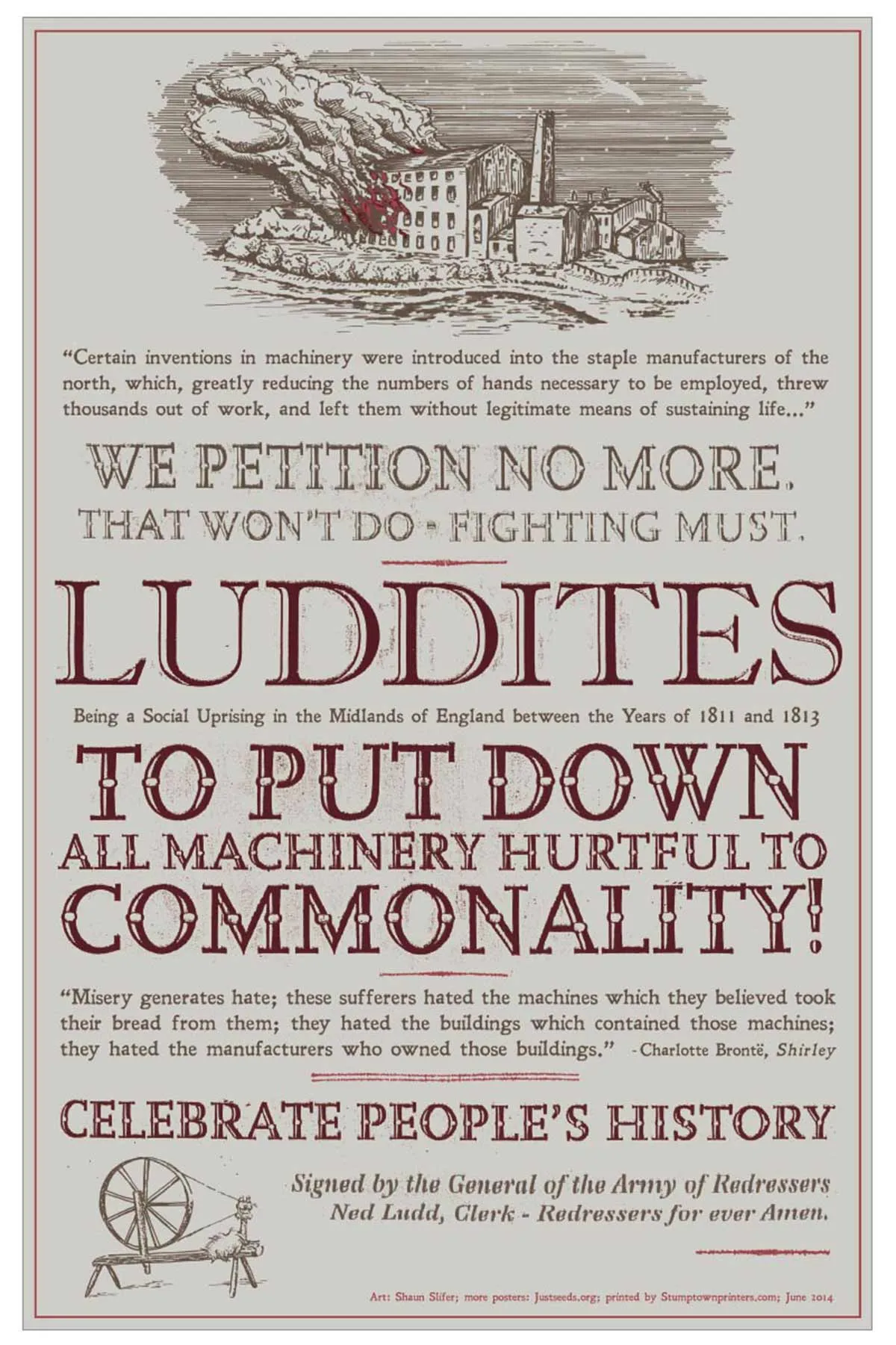
The mechanized loom did not just lower their wages. It took a craft that had taken a lifetime to learn and handed a fraction of it to an unskilled child who could mind a machine for pennies. The Luddites were not confused about whether the looms were efficient. They were furious about who collected the efficiency. They smashed the machines not because they hated tools but because nobody had bothered to ask what a person is supposed to do with themself once their skill is worth nothing.
History remembers them as the people who were wrong about progress. History books were printed with money from the mill owners.
It is not an automobile who is going to take your job. It is a horse driving an automobile
For a few thousand years the horse had the most stable job in the economy. Then the automobile arrived, and every reasonable economist of the day could explain that horses would simply move into new, higher value equine roles.
The horse population of the United States peaked around 1915 and then fell off a cliff. The horses did not retrain. There was no second act in logistics. The economist Wassily Leontief used exactly this example to make an uncomfortable point - the assumption that a displaced worker always finds new work is not a law of nature. It held for humans for two centuries because humans could do many things a machine could not. The horse was simply a worse bet on that question than we are. The interesting and slightly chilling question is by how much.
The human computers, mostly women, who computed the space age - mid 1900s
Before "computer" meant a machine, it meant a person, very often a woman, who did mathematics by hand for a living. They calculated artillery tables, plotted trajectories, and got men to the moon. The work demanded enormous skill and gave them a rare professional foothold in a world that offered them very few.
Then the electronic computer arrived and did their arithmetic instantly and without coffee breaks. The optimistic version is correct on its own terms - many of them became some of the first programmers, and the field they helped invent is now enormous. But notice the shape of it. A hard won, skill based independence got dissolved, and the lucky and well positioned few climbed onto the next machine. The rest were thanked for their service. We tend to celebrate the ones who made the jump. Survivorship is a hell of a flattering lens.
The scribes who were replaced by the thing you are reading - Europe, 1450s
When Gutenberg's press started multiplying books, the monks and professional scribes whose entire identity was the patient, sacred copying of text faced a machine that did in an afternoon what took them a year. One abbot, Johannes Trithemius, wrote a passionate defense of hand copying as spiritually superior work that should never be abandoned. He then, with magnificent and unintentional comedy, had it printed, because that was how you reached people now.
That is the whole pattern in one anecdote. The new tool does not just win. It becomes the only way to be heard, even by the people mourning what it killed. You are, after all, almost certainly reading this on a screen produced by the very forces it is complaining about.
So what is actually different this time, if anything
Every previous wave automated muscle, or routine, or arithmetic. The comforting wall we leaned on was that judgment, creativity, language, and synthesis were ours. They were the higher ground we retreated to. They were the "meaningful work only a human can do" in every consulting slide ever made.
AI is climbing the higher ground. Not because it is conscious or wise, but because a startling amount of what we called judgment turns out to be pattern matching at scale, which is the one thing these systems do for breakfast. The lawyer's research, the analyst's memo, the illustrator's draft, the coder's boilerplate, the copywriter's everything. These were not the drudgery beneath the craft. For many people they were the craft, and the ladder up to it.
Here is the part the optimists are right about, and it matters. New work will appear. It always has. People will build things with these tools that we cannot currently imagine, and some of that work will be richer and more independent than what it replaced.
Here is the part they keep skipping. "New work will appear" is a statement about the aggregate, about the species, about the economy as a graph that goes up. It is not a promise to any individual person about Tuesday. The aggregate was always fine. The aggregate is fine the way a forest is fine after a fire. Tell it to the trees.
One quiet theft, and one loud one
There are two ways AI takes the recipe, and only one of them is obvious.
The loud one is unemployment. Job goes away, income goes away, and with it the independence that a steady paycheck quietly funds. This one gets the headlines and the policy proposals and the earnest panels.
The quiet one is worse and almost nobody is panicking about it. It is the slow hollowing of purpose for the people who keep their jobs. It is the writer who now edits the machine's draft instead of writing, the doctor who approves the algorithm's read instead of reading, the student who never struggles through the essay and so never finds out what he thinks. The work continues. The salary continues. But the part where you built something and it was yours and the building of it told you who you were - that part gets quietly contracted out, and you are left as a reviewer of your own former life, clicking approve.
Independence without purpose is just unstructured time, which we call retirement when we are being kind and depression when we are being honest. Purpose without independence is a fulfilling job you cannot afford to quit, which is most of human history. AI is uniquely talented at separating the two and handing you one wrapped as a gift.
The unfashionable conclusion
None of this is an argument to smash the looms. The looms always win, and the people who smash them are remembered as fools by the people the looms made rich. It is, instead, an argument to be deeply suspicious of anyone, human or otherwise, who offers to relieve you of your work as though work were only a burden and never also a source of the self.
Housel's recipe is not wrong. It is more right than ever. Independence and purpose really are most of happiness. That is precisely why it is worth noticing when a wildly convenient new tool quietly takes both, hands you back a coupon for "more leisure" and "higher level work," and waits, patiently and without resentment, for your thumbs up.
The machine is not your enemy. It does not have the energy to hate you. It just loves efficiency a little too much to understand that for the animal currently reading this, the inefficient struggle was sort of the entire point.