The Quartz Crisis
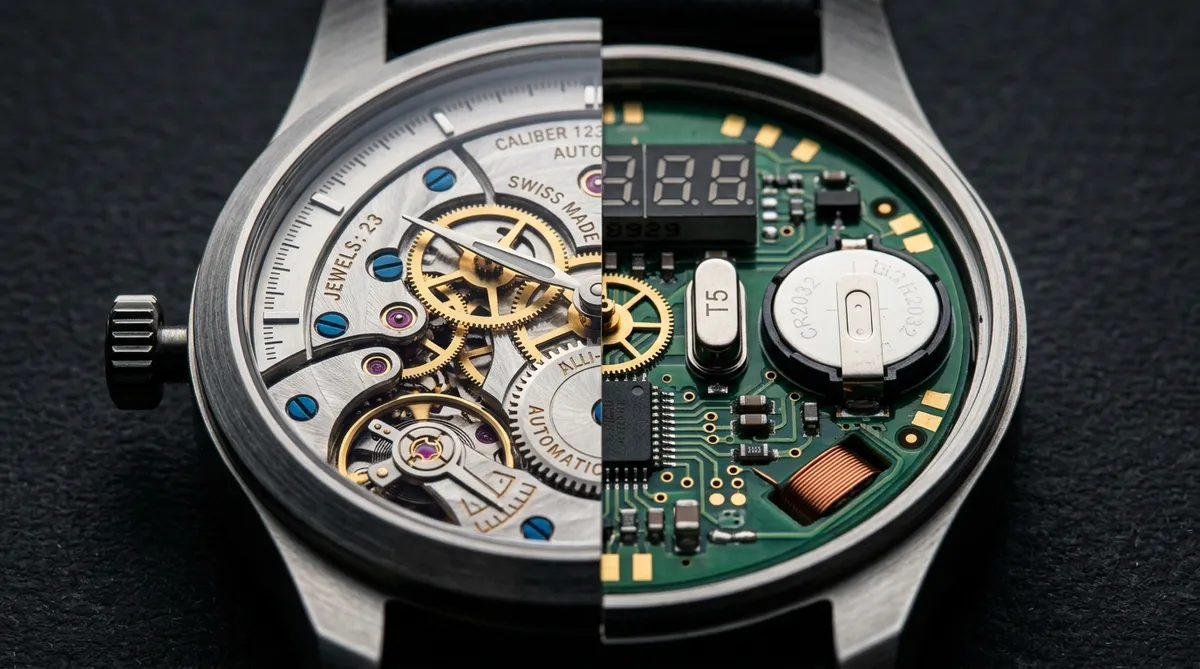
A cheaper, less charming machine arrived. The incumbents diagnosed it correctly. Two thirds of them lost their jobs anyway.
On Christmas Day 1969, Seiko put a watch on sale in Tokyo called the Astron. It cost roughly as much as a modest car, kept time to within about five seconds a month, and contained a small vibrating sliver of quartz instead of three hundred years of accumulated Swiss judgement.
The Swiss watch industry looked at it and reached a verdict that was, on the merits, entirely correct. The thing had no soul. No escapement to regulate, no balance wheel breathing away at five beats a second, no craft, no patience, no lineage. A watch is not a timer. A watch is an heirloom that happens to tell the time.
Within fifteen years, Swiss watchmaking employment had fallen from roughly 90,000 to under 30,000. The number of firms went from something like 1,600 to something like 600. Switzerland's share of the world's watches fell from about half to a small fraction of that. The industry did not shrink. It was harvested.
And here is the part that should make every executive uncomfortable, because it removes the one excuse we all reach for first - they were not ignorant. They knew exactly what quartz was. They had invented a great deal of it themselves.
The awkward footnote - they built the guillotine
The Centre Electronique Horloger was founded in Neuchâtel in 1962, funded by the Swiss industry itself, for the express purpose of not being blindsided by electronic timekeeping. It produced a working quartz prototype in 1967. Its Beta 21 movement went into cases stamped with the most reverent names in the business.
So the Swiss did not miss the technology. They financed it, engineered it, and shipped it. Nobody in Neuchâtel needed a memo explaining quartz. They had written the memo.
What they did next is the actual lesson, and it is a lesson about identity rather than intelligence. They took a technology whose entire structural advantage was that it could eventually be made almost free, and they sold it as an expensive feature in an expensive watch to expensive customers. They positioned a cost revolution as a luxury upgrade, because expensive was the only thing they knew how to be good at.
Meanwhile the Japanese, and shortly afterwards anyone with a plastics mould and a supplier in Hong Kong, took the same physics and ran it down the price curve until a watch cost less than lunch. Seiko notably did not treat its quartz patents as a fortress to be defended. It let the technology spread, in a market where it was structurally better placed than anyone to survive the resulting commoditisation. That is not generosity. That is understanding which axis the fight is on.
The wrong axis
The Swiss argument, restated in the language of a modern strategy deck, was this - our product is superior on craftsmanship, heritage, finishing, mechanical ingenuity and emotional resonance, and the challenger is superior only on accuracy, price, durability, convenience and ease of manufacture.
Read that sentence twice. It is a description of total defeat, written by the loser, in the confident tone of a winner.
Everything they claimed was true. Every single word. The mistake was not factual, it was a mistake about ranking. They assumed the market's purchase criteria were their own purchase criteria, in their own order, with their own weightings. They graded the competitor's exam using their own answer key and were delighted to find it failing.
Most people buying a watch in 1975 were not buying an heirloom. They were buying a device to know what time it was, and they had a strong opinion about paying less and being right more often. Soul did not appear anywhere in their consideration set, not because they were philistines, but because a wrist device that costs two weeks of wages is a different product category from a wrist device that costs two hours of wages.
Quartz did not only take existing customers. It manufactured new ones - teenagers, children, second watches, third watches, sports watches, giveaway watches. The incumbents were defending a market while the challenger was inventing a larger one next door and then annexing theirs on the way past.
The lesson - you can be completely correct about your product's superiority and completely wrong about whether that superiority is the thing being bought. Those are two separate research projects. Most companies only fund the first one, because the first one is flattering.
Taste is not a moat
Here is the sentence the Swiss watch industry paid sixty thousand jobs to learn, so please take it free of charge.
Being aesthetically correct offers no protection whatsoever.
There is a persistent belief in accomplished organisations that refinement is a form of defence. That if our thing is genuinely better made, more elegant, more tasteful, more thoughtfully considered, the market will eventually come around, because quality is a kind of gravity.
Quality is not gravity. Quality is a feature with an addressable market, and that market may be far smaller than the one you currently occupy. Soul is a premium attribute. Premium attributes are, by construction, minority interests. When you retreat into the part of the market that shares your taste, you are not defending a position. You are describing the size of your new company, and it is a rounding error next to the old one.
The connoisseur's judgement and the market's judgement are different instruments measuring different things. Confusing them feels like discernment. It is actually the most expensive kind of vanity available to a management team.
The executive as customer, a fallacy in three acts
The people running Swiss watchmaking in 1970 owned beautiful watches. They could explain why hand finishing on an unseen bridge matters. They were, in the most literal sense, unqualified to assess the mass market, because they had never once been a member of it.
This is not a Swiss disease. It is endemic.
- The software leadership team that cannot imagine anyone choosing the clunky cheap tool, because they have never had a budget of zero.
- The airline executives who fly in the front and design for the back.
- The publisher who finds the format vulgar, in a room where everyone also finds it vulgar, which is mistaken for market research.
- The agency that knows the cheap generated version is worse, and is right, and will lose the account anyway to someone who charges a tenth.
When the entire leadership layer sits in the top few percent of its own market by taste and by wallet, the company loses the ability to feel the middle of the market at all. It retains the ability to have opinions about it, which is worse, because opinions are indistinguishable from data when everyone in the room agrees.
The diagnostic question - when we say the customer wants this, whose wrist are we actually looking at.
The comforting narrative is the dangerous one
The most dangerous strategic claim in any company is the one that is simultaneously true and flattering.
"Quartz has no soul" was true. It also happened to imply that no painful change was required, no factories needed retooling, no skills needed retiring, no thirty year careers needed reinventing, and no senior person needed to be wrong in public. A conclusion that arrives pre-loaded with permission to do nothing should be treated as a suspect, not a witness.
The Swiss ecosystem made this worse in a structurally beautiful way. The industry was a dense mesh of hundreds of specialist suppliers, each making tiny brass and steel components with extraordinary precision. That mesh was the competitive advantage. It was also the ransom note. Nine hundred suppliers of exquisite mechanical parts is an unassailable position right up to the second the world stops wanting exquisite mechanical parts, at which point it is nine hundred phone calls, a great deal of obsolete tooling, and a political impossibility.
Incumbent inertia is rarely stupidity. It is usually a rational sum of many small, locally sensible refusals to destroy something that still works.
The comeback, and why you should read it as a survivor's memoir
The Swiss did recover, and the recovery is genuinely brilliant, which is why it is quoted so often and understood so rarely.
Two things happened. First, ASUAG and SSIH, the two crumbling giants, were merged in 1983 under the reorganisation associated with Nicolas Hayek. Second, and more importantly, the industry stopped trying to win the fight it had already lost.
It launched a plastic watch with 51 components instead of the usual ninety-odd, welded shut so it could never be repaired, in colours, at a price a teenager could reach. The Swatch was not a defence of horological soul. It was an admission that at the low end the product is fashion, and fashion is bought with a different part of the brain than engineering. The single most humiliating sentence in the history of luxury goods is that the Swiss watch industry was rescued by a disposable plastic watch, and it is also the most instructive one.
Then, quietly, the mechanical watch was repositioned - not as a superior instrument, which it demonstrably was not, but as jewellery, as craft, as signalling, as a thing you hand to your child. The taste argument was eventually vindicated. It was vindicated about twenty years late, to a much smaller audience, at much higher margins, by people who had first accepted the humiliation of losing on the merits.
Note the sequence, because everyone gets it backwards. The Swiss did not win by insisting on their values. They won by conceding the entire functional argument, exiting the axis they had lost, and rebuilding on an axis where their values were the whole product rather than a talking point.
And then be honest about the cost. Roughly two thirds of the workforce did not take part in the comeback. They took part in the case study. "We emerged stronger" is a sentence written by survivors and it should never be used as a reason to delay.
The second act nobody puts in the deck
Swiss watch exports today are worth tens of billions of francs on well under twenty million units. Apple ships several times that number of watches a year without appearing in the same statistics, because it is not selling watches, it is selling a wrist.
So the Swiss won the argument about value and lost the argument about wrists. Which is a reminder that the disruption you survive tends to be followed, at a polite interval, by a different one that redefines the category so thoroughly that your victory is no longer being scored.
The field guide, for people who would rather not be a case study
Ask these in your next strategy session and watch the temperature change.
- What is the axis we are winning on, and is there evidence, gathered from people unlike us, that customers rank it first.
- Which of our beliefs about the market are both true and convenient. Attack those first.
- If a version of our product existed at a tenth of the price and eighty percent of the function, who buys it, and is that number larger than our entire current market.
- Are we treating a cost technology as a premium feature because premium is the only muscle we have.
- Who in this building has personally bought at the low end of our market in the last year. If the answer is nobody, our customer insight is an aesthetic preference wearing a lanyard.
- What would we have to be willing to cannibalise, and what is the name of the person whose career that cannibalisation ends. That person's incentives are your actual strategy.
- If we lose the functional argument entirely, what is our second axis. Do we have one, or do we have a slogan.
The last word
The Swiss were not fools. They were connoisseurs, and they made the specific error available only to connoisseurs, which is to mistake refinement for defensibility and their own taste for the market's.
Quartz was soulless. It really was. It also told the time better, cost almost nothing, needed no servicing, and did not care in the slightest what anybody in Neuchâtel thought of it.
The market is not a jury of your peers. It has never once asked for your notes on craftsmanship. Be excellent by all means, but be excellent about something the customer is actually buying, because history is generously stocked with beautiful, principled, technically superior organisations that were right about everything except the question on the paper.