The Open-Soruce Big Bang
On why most of your hard problems were already solved by a fish, a mammal, and soon, an open-source solution
The fish and the mammal who took the same exam
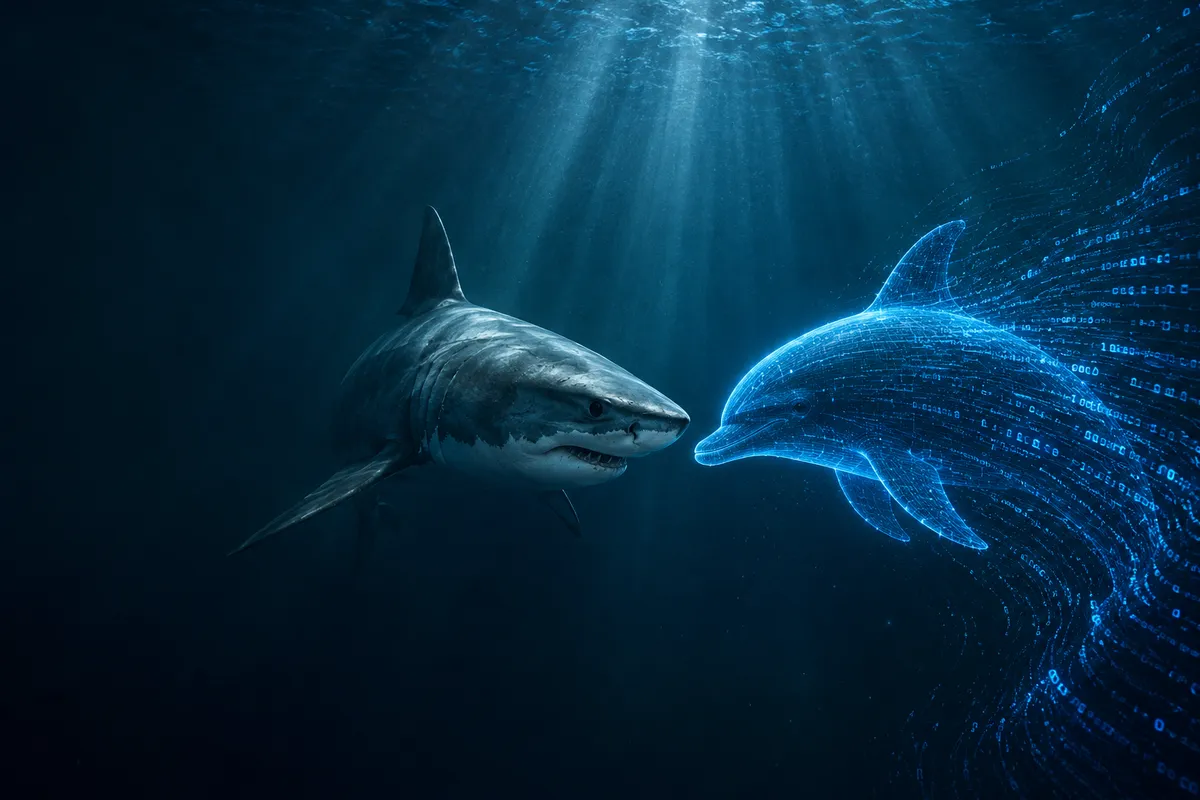
Put a dolphin next to a shark. Same torpedo body, same dorsal fin, same general business of being the thing other animals do not want to be downstream of. You would assume close cousins. You would be off by about 300 million years and an entire mountain of priorities. The shark is a fish. The dolphin is a mammal that got bored of land, walked back into the ocean, and re-derived the shark from first principles, because the ocean only accepts a narrow range of answers.
This is convergent evolution, and the lesson is a little rude - the environment sets the problem, and the problem allows only so many good solutions. Build something fast in deep water and you will end up looking like a shark whether your ancestors were fish or college-educated land mammals. Nature does not award points for originality. It awards survival, and survival has a style in water.
Evolution, importantly, has no patent office. The shark spent roughly 400 million years on research and development. The dolphin showed up a few dozen million years ago and shipped essentially the same product with a blowhole and a personality. Nobody got sued. The good design was just lying there, in the water, free for anyone willing to die enough times to find it.
The cat that decided to be a dog
Now run the tape the other direction. The hyena looks like a dog, runs like a dog, and shows up at the same buffet as the dog. It is not a dog. The hyena sits on the cat side of the family tree, right next to the lion. The lion and the hyena are relatives who clearly could not stand each other at the reunion, took completely different jobs, and grew into completely different shapes to do them. One became the brooding apex influencer who sleeps twenty hours a day and gets all the press. The other became the relentless, bone-crushing operations team that actually clears the plate.
Same family, opposite niches, opposite forms. And in the dolphin case - total strangers, same niche, same form. Either way, the niche wins. Ancestry is merely a suggestion. The problem is the boss.
Business is just convergent evolution with worse smells
Now look at what humans build, and notice that we are nowhere near as clever as our pitch decks insist.
Every marketplace independently re-derives ratings, reviews, and a trust-and-safety team that is permanently sad. Every subscription product re-derives the three-tier pricing page with the middle column highlighted, because someone read the same behavioral economics paper you did. Every social app re-derives the feed, the like, the notification dopamine drip, and eventually the apology tour. Every growing company re-derives the org chart, then the reorg, then the second org chart.
We call these things innovations. They are dorsal fins. They are the shape the water forces (in our case socio-technical forces, societal factors and mist if all human behavior) onto anything trying to move through it. The startup graveyard is full of founders who believed their checkout flow was a brand-new genus, when it was in fact the four-hundredth independent evolution of the same button.
"Our proprietary algorithm", in most cases, is a phrase that means "an if-statement we have become emotionally attached to". The real moat is usually just the part of the system the team is too embarrassed to open source, not the part that was ever actually hard.
None of this is an insult. It is the entire point. If problems have a small number of good solutions, then everyone who is any good will keep arriving at that same small number of good solutions. The convergence is evidence the solution is correct. It is not evidence that everyone is a thief.
Enter the convergence engine
Here is where it gets funny, and slightly threatening, depending on your equity situation.
AI is, by construction, a machine for the common solution. A large model is trained on the accumulated output of nearly everyone who has ever solved a problem and then written about it, which makes it exquisitely good at exactly the part of the world that has already converged. Ask it for the standard answer and it hands you the standard answer at a speed that makes your senior engineer feel things.
This gets pitched as a weakness - it is mid, it is average, it regresses to the mean. Sure. But the mean is precisely where all the solved problems live. Being a fluent native speaker of the solved-problem space is not a bug when the task in front of you is, statistically, a solved problem wearing a fake mustache.
Agentic engineering then closes the loop. The model no longer just describes the dolphin. It grows the dolphin, tests the dolphin, deploys the dolphin, and opens a pull request titled "feat - add dolphin". The cost of producing the standard, correct, boring, load-bearing solution to a known problem is collapsing toward the cost of asking for it out loud.
The Open-Source Big Bang
Put all of that together and you get the thing in the title.
For most of history, the standard solution to a common problem was expensive to build, so it stayed locked inside whoever could afford to build it. The commons - the shared, free, public pile of solved problems - filled in slowly, one underpaid maintainer and one heroic weekend at a time. That is now changing the way the early universe changed. When the cost of generating a competent solution drops far enough, the solved-problem space does not fill in gradually. It detonates outward and paves over everything that was already, secretly, the same problem in a different costume.
Soon - and "soon" here is doing the heavy lifting of a word that means "faster than your roadmap" - there will be a good, open, free system for nearly every problem that has already converged. Not because anyone decreed it. Simply because the marginal cost of someone, somewhere, getting annoyed enough to generate it and push it public is now approaching a couple of afternoons.
This rewrites the opening move of getting anything done. The first step is no longer "let us build it". The first step is "let us check whether the dolphin already exists". Because it almost certainly does, it is almost certainly free, and the person who built it is almost certainly more obsessed with this exact problem than you will ever be.
The new rule
So here is the operating principle for the next while.
If you need something done, look for the open-source solution first. There is a very good chance it exists, it is decent, and reinventing it from scratch is the modern equivalent of a dolphin filing a patent on the fin.
And if you look and there is no good open-source solution - congratulations, you have found a genuinely unconverged niche. You have located a real gap in the fossil record. You now have a window, and that window is roughly a few weeks wide, to build it yourself before someone with the same idea, the same tools, and slightly less Tuesday on their hands ships it first and names it after their cat.
The moat used to be measured in years. Then in months. It is now measured in the gap between you noticing the opening and someone else noticing the same opening. The moat is a puddle, the puddle is evaporating, and there is already something with a dorsal fin swimming in it.
The animals that refused to converge
Before you panic-sell your codebase, the honest footnote.
Convergence only owns the converged part. Nature still produces the platypus - a mammal that lays eggs, sweats milk, and hunts with an electric bill-sensor, apparently on a dare. It still produces the tardigrade, which survives the vacuum of space out of what can only be described as spite. These exist because they sit in niches so strange that the usual answers never bothered to show up.
The same gap survives in human work. The genuinely novel problem, the weird-shaped market, the thing that runs on taste, trust, timing, or a relationship a model cannot fake - these do not converge on command, because there is not yet a crowd of prior solutions to average over. The open-source big bang paves the solved. It does not pave the strange.
So the durable skill is not building the dolphin. Soon almost anyone can summon a dolphin before lunch. The durable skill is knowing which of your problems are dolphins and which are platypuses, and then refusing to spend platypus effort or money on a dolphin, or platypus confidence on a dolphin.
In short
Most problems are the same problem in a different costume. Nature solved this the slow way, by patiently killing everything that got the answer wrong. We are about to solve it the fast way, by generating the right answer for free and giving it away before lunch.
Look for the open-source solution. If it exists, use it and feel no shame - you are a dolphin, not a thief. If it does not exist, build it now, today, this hour, because the niche is open and the water is full of things with fins.
The good designs were always just lying there in the water. The only thing that changed is how fast we can now reach in and pull one out.