The Jab
Why the cheapest punch in boxing is the most misunderstood idea in corporate strategy
Nobody has ever been carried out on a stretcher by a jab
Watch a boxing highlight reel and you will see the last three seconds of a forty minute argument. The overhand right. The hook that arrives from outside the frame. The moment the legs stop being legs. What you will not see, because nobody edits it in, is the punch that was thrown more times than every other punch combined.
The jab does almost no damage. It ends almost no fights. And every trainer who has ever lived says the same thing, usually while shouting it at someone who is not listening - the fight is won or lost by the jab.
This is because the jab is not really a punch. It is an instrument. Four things happen when a fighter extends the lead hand, and only one of them involves hurting anyone.
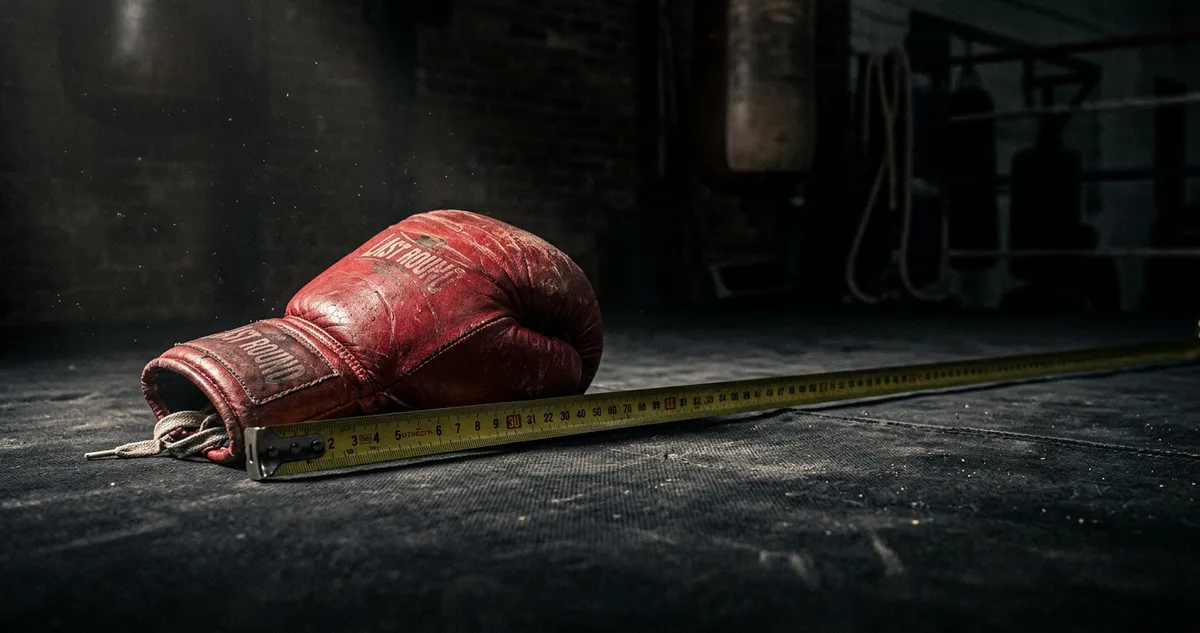
It measures. An extended arm is a ruler with a fist on the end. If the jab grazes the chin, the cross lands. If it falls short, the cross is a gift to the other man. This is distance information purchased at the price of one arm extension, which is the best exchange rate available anywhere in the sport.
It disrupts. Whatever the opponent intends to do requires a sequence, and a sequence requires one unbothered moment to start. The jab denies the moment. It does not hurt. It interrupts, which over twelve rounds is worse.
It conceals. The feet do the real work in boxing. The jab occupies attention at head height while the feet quietly buy an angle nobody agreed to give you.
And it preserves balance. This is the part that matters most and gets discussed least. The jab is cheap to throw, but more importantly it is cheap to miss. Miss a big right hand and you are briefly a piece of furniture. Miss a jab and you are exactly where you were, still upright, still guarded, now better informed.
The corporate world has never respected the jab
Strategy discourse is written entirely in the grammar of the knockout. The big bet. The bold move. The moonshot. Bet the company. Books get structured around one decisive act because one decisive act has a narrative, and forty small probes have a spreadsheet, and nobody has ever been asked to give a keynote about a spreadsheet.
The incentive layer finishes the job. Promotion committees want a noun - a launch, a platform, a transformation, ideally one with a codename borrowed from Greek mythology. "We established for eleven thousand dollars that the market is not there" is a sentence that damages a career in the same breath that it saves eight million dollars. Meanwhile the organisation has "fail fast" painted on a wall near the good coffee machine and runs post mortems that are functionally coroners' inquests with a headcount attached.
So the modern enterprise arrives at a strange equilibrium. It venerates the haymaker, it fears the miss, and it therefore does the only thing available to a fighter who wants to throw one perfect punch and cannot afford to be wrong - it waits, flat footed, doing more analysis, while somebody nimbler works out the range.
The reframe - a ruler, not a wager
Most companies that do experiment model the experiment as a small bet. It has stakes, odds, a win condition and a loss condition. This sounds rigorous. It is quietly ruinous, for three reasons.
Gambles are judged on outcome, so people stop running the ones they might lose. What survives the funding conversation is the test whose answer everybody already suspects, which is to say the test worth nothing.
Gambles demand justification proportional to their stakes, and justification is not free. The review process for a fifty thousand dollar pilot routinely consumes eighty thousand dollars of senior attention, at which point you have paid haymaker prices for jab information and will understandably decide to do it less often.
Gambles produce a hit rate, hit rates become metrics, and now you have an organisation optimising to be right rather than to know things. Those are not the same objective and they diverge fast.
The alternative model is simple and it changes everything downstream. An experiment is a ruler, not a wager. Its output is not a win. Its output is a distance.
Under that framing, a probe that "fails" has still delivered its entire product. You threw a jab, it fell six inches short, and you now know something you were previously guessing about with great confidence in a slide deck. The punch did its whole job. It was never supposed to end the fight.
Which gives the sentence worth stealing from this piece -
A jab that misses is not a failed jab. A jab that lands and teaches you nothing is a failed jab.
What actually counts as failure
The corporate vocabulary is impoverished here. It has one word, failure, for two opposite events, and the confusion is expensive.
A probe that returns unwelcome news is a success. It cost little, it moved your beliefs, it saved you from committing weight to a punch that would have missed. Reward it, ideally in public, ideally in money.
A probe that returns nothing is the real failure, and it is everywhere. The pilot underpowered to the point of horoscope. The rollout so confounded by three simultaneous changes that no one can attribute anything. The test with no decision rule written down in advance, whose results are therefore not analysed but litigated, in a room, until the most senior intuition present wins on points. These cost the same as good experiments and return zero. These are the jabs thrown with the eyes closed.
So stop asking whether the experiment worked. Ask four better questions.
- What did we believe before it, and how far did the result move that belief? If no possible outcome would have moved anything, you did not run a test, you ran a ceremony.
- Was the decision rule written before the data arrived? If not, you did not commission an experiment, you commissioned an argument.
- What does it cost us to be wrong here, as distinct from what it costs us to try?
- How long before this measurement goes stale?
That last one is underrated. Distance is not a constant. The range you measured three quarters ago belongs to a market that has since moved its feet, which is why "we already tested that in 2023" is not an answer, it is an artefact.
Designing a jab that is genuinely a jab
The cheapness of a jab has nothing to do with its size. It has to do with recovery. You stay balanced.
So the only design test that matters is this - if this fails, what has to be unwound? If the honest answer includes a reorganisation, a three year vendor contract, a public commitment, a rebrand, or a human being whose job title now contains the name of the hypothesis, then you have not built a probe. You have built a haymaker in a jab costume, and you will discover this at the worst possible moment, because organisations cannot abandon anything that has been given a headcount.
The second design principle is cadence over magnitude. Twelve cheap measurements a year beat one expensive one, not because each is better but because range keeps changing and you keep needing to know it. Frequency is also what disrupts everyone else's sequence. Competitors, regulators and internal empires all plan against your tempo, and a firm that is continuously moving is very hard to plan against.
The third is that jabs cover the feet. A company whose only visible activity is the occasional grand announcement telegraphs its entire intent months in advance. A company generating constant low grade motion is illegible until the real weight transfer has already happened.
Why your organisation will not do this anyway
Because range finding produces no heroes. There is no promotion packet line for "correctly determined that we were out of range." The work is unglamorous, cumulative, and its greatest triumphs are counterfactual - the disasters that did not occur, which are famously difficult to photograph.
The obvious fix is to reward information generated rather than outcomes achieved, and it half works. Be warned that within one quarter of announcing that metric, clever people will farm it, running tests engineered to be maximally publishable and minimally consequential. There is no metric shaped solution to a taste shaped problem. The fix is leaders who can tell a real measurement from a performance of one, which is unsatisfying as advice and precisely why the capability stays scarce enough to be worth having.
Where this metaphor deserves suspicion
Any essay that rides one analogy this hard owes you the places it breaks.
You can win rounds on points and still lose the fight. Some markets are winner takes most, and a firm that probes forever, feeling admirably rational, loses on the cards to somebody who committed while the data was still ambiguous. Range finding earns the right to throw the big punch. It is not a substitute for eventually throwing it.
Perfect measurement on the wrong axis is worthless. You can establish the distance with beautiful precision in a fight you should never have accepted. Probes tell you how far. They do not tell you whether to be standing there, and cheap experimentation is not a replacement for judgement about which questions are worth asking.
Some things cannot be jabbed at all. Trust, safety, brand, anything where the pilot is itself the reputational event. Some doors open once.
And jabbing looks passive, which carries a real internal cost. The jab heavy fighter gets booed by people who came to see a war. Expect the same from your board.
The knockout is a conclusion, not a strategy
By the time the decisive punch lands, the interesting work is finished, and it was done earlier in a series of unmemorable extensions of the lead hand that nobody will mention in the write up. The company that looks brave at the moment of commitment is rarely braver than its competitors. It simply knew the distance, because it had spent a year measuring while everyone else was busy assembling the business case for a swing.
Your rivals would be delighted for you to keep waiting for the perfect moment. It gives them all the time they need to keep measuring you.