The Escapement Is the Whole Trick
The Escapement Is the Whole Trick
A fully wound mainspring is a small coiled catastrophe. It wants to unwind all at once, immediately, in a single violent shrug that would spin the gear train into a blur and destroy the very thing it powers. Left alone, stored energy has no interest in being useful. It has one interest, which is to stop being stored.
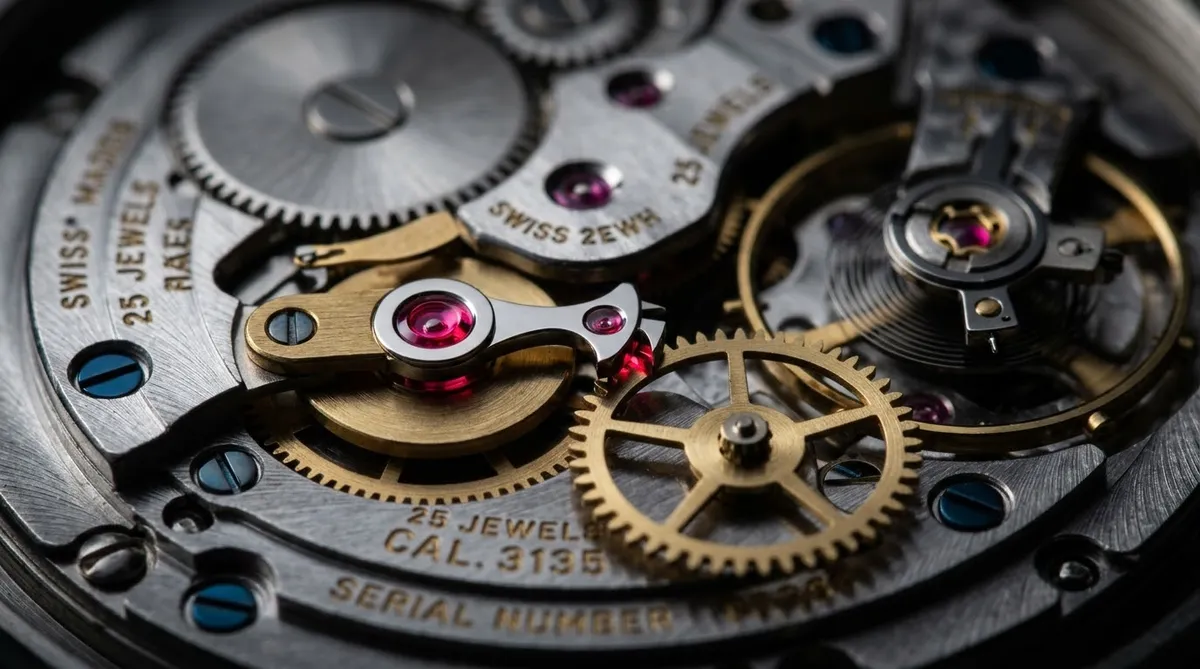
Everything we admire about a mechanical watch is the machinery that stands between that ambition and its consequences. The escapement - a lever, a wheel with slanted teeth, an oscillating balance - takes a wild uneven shove and doles it out in ten thousand identical little permissions per hour. Tick. Tick. Tick. That sound is not a side effect. That sound is the product.
Organizations are extraordinarily good at winding mainsprings. Funding rounds, reorgs, town halls, a competitor's launch, a board deck with a red slide in it, the arrival of a leader who talks fast. Pressure is not the scarce resource. Pressure is never the scarce resource. What almost no organization builds is the small unglamorous mechanism that converts that pressure into a rate.
So the energy discharges the only way it can, which is in bursts. And the hands jump.
What Unregulated Release Actually Looks Like
You have seen this watch. It runs eleven days behind and then, in the last seventy-two hours of the quarter, it advances four days. Everyone is proud of the four days. Nobody mentions the eleven.
The tells are consistent across industries and company sizes.
- Work arrives in floods and then nothing, and both states are described as normal
- Deadlines are set by the calendar rather than by throughput, so the calendar becomes the only forcing function anyone trusts
- Heroism is the primary delivery mechanism, and therefore the primary promotion criterion, and therefore permanent
- The words "we just need to push" appear in a document that also contains the words "sustainable" and "long term"
- Planning is fast and finishing is slow, or the reverse, and nobody has noticed the asymmetry because nobody is measuring the halves separately
That last one has a proper horological name. Watchmakers call it beat error, and it means the balance wheel spends more time swinging one way than the other. The watch still ticks. It sounds fine to the human ear. It simply cannot keep time, and the reason is invisible unless you put it on a machine that listens to each half of the cycle independently. Most companies never do. They listen to the quarter, which is the equivalent of judging a watch by whether it is roughly correct at noon.
The Escapement Is Not a Brake
Here is where a lot of well-meaning governance goes wrong. A brake also slows things down. A brake is not an escapement.
A brake converts energy into heat. That is its entire function. An escapement converts energy into motion at a known rate. The difference is not philosophical, it is thermodynamic, and you can feel which one you work inside of. Committees that exist to say no are brakes. Approval gates with no service level are brakes. The reorganization that quietly deletes a team's autonomy is a brake with a nice name.
Heat in an organization looks like friction, rework, attrition, and the peculiar exhaustion of people who were busy all quarter and cannot name what moved. The energy went in. It did not come out as motion. It came out as warmth in the room.
A real escapement releases. Reliably, in small amounts, on purpose. It says yes on a schedule.
The Remontoire Problem - Enthusiasm Decays, Cadence Should Not
A mainspring does not deliver constant torque. It shoves hard when freshly wound and limps at the end. This drove watchmakers slightly mad for a few centuries, and they solved it twice.
First with the fusée, a chain and a cone that mechanically compensates as the spring weakens. Then, more elegantly, with the remontoire - a tiny secondary spring, sitting right next to the escapement, rewound at short intervals by the big spring. The escapement never touches the mainspring's mood. It only ever feels the small spring, which is always nearly full.
Read that again with your executive team in mind.
Leadership attention is a mainspring. It arrives at maximum torque - the offsite, the new strategy, the memo everyone actually read - and then it decays, because it is a finite thing being spent across an expanding surface. The organizations that hold their rate are the ones where the cadence is powered by a small local spring that gets rewound often, rather than by the diminishing enthusiasm of whoever announced the initiative in February.
Practically, this means the weekly ritual survives the sponsor losing interest. The review happens whether or not the VP is in the room. The definition of done does not soften as the original excitement fades. If your delivery rate is a direct function of how recently a senior person expressed urgency, you do not have a remontoire. You have a mainspring and a lot of optimism.
Amplitude, Or Why Functioning Is Not Evidence
When a movement is dirty or the oil has aged, the balance wheel's swing gets smaller. This is amplitude loss, and the cruel part is that the watch keeps running. It ticks. It shows a time. It is simply no longer isochronous, meaning it no longer keeps the same rate under different conditions. Wear it on a still day and it is nearly right. Move your wrist and it drifts.
Teams do this. A depleted team continues to produce. Standups happen. Tickets close. The visible mechanism moves. What is lost is not output but stability - the ability to hold a rate under disturbance. So the team performs adequately in the calm month and falls apart the week two people are on leave and a customer escalates, and everyone concludes that the week was unusually hard, rather than that the swing had been shrinking since March.
Anyone can look at a movement and see whether it runs. Amplitude requires you to actually measure. Choose accordingly.
The Tourbillon Is Your Dashboard
The tourbillon rotates the entire escapement to average out the effect of gravity on the balance wheel. It is a magnificent piece of engineering that solves a problem pocket watches had because they sat in one orientation all day, and that wristwatches largely do not have, because arms move. It is very expensive, it usually makes accuracy slightly worse, and it is always positioned so you can see it.
I am not going to name the corporate equivalents. You have three of them and you know their names. The framework rolled out to fix a coordination problem that was actually a staffing problem. The transformation office. The dashboard with forty-one metrics on it, visible to everyone, driving nothing, described in the announcement as bringing visibility.
The diagnostic question is not whether a mechanism is sophisticated. It is whether it changes the rate. If it does not touch the rate, it is jewelry. Jewelry is permitted, but it should be budgeted as jewelry and not as engineering.
Complications Come After Accuracy, Not Instead Of It
In watchmaking, complications are everything beyond telling the time - the calendar, the moon phase, the chronograph, the chiming mechanism that costs more than a house. Every one of them draws power from the same mainspring and adds friction to the same train. A movement with a perpetual calendar and a poor escapement is an expensive way to be wrong about the date until 2100.
The order of operations is not negotiable. Rate first. Then complications, each one paid for out of a power budget you have actually calculated.
The company that adds a fourth product line before it can reliably ship the first one has not diversified. It has added a moon phase to a watch that gains nine minutes a day.
The Quartz Lesson Nobody Enjoys
In 1969 a quartz crystal, vibrating at 32,768 times per second, made four hundred years of Swiss mechanical craft economically irrelevant almost overnight. Not because it was more beautiful, or more admirable, or harder to make. Because it was a better oscillator, and the oscillator was the whole thing.
The industry's initial response was to insist that customers cared about the craft. The industry's eventual response, some very lean decades later, was to stop competing on accuracy and start competing on meaning, which worked, and which is a different business.
The lesson is uncomfortable in both directions. If your advantage is your cadence, someone can buy a better one. If your advantage is not your cadence, be extremely clear about what it is, because a competitor with a faster reliable rate will eat every market where being right on time matters.
Servicing, Or Why Rituals Rot Quietly
Oil dries. Not dramatically. Over five years it thickens, then it varnishes, and the watch that ran beautifully now runs beautifully-ish, and the owner adjusts to it. This is why service intervals exist and why they are specified in years rather than in symptoms.
Cadence mechanisms rot the same way. The retro that has become a status update. The planning session where the plan is already made. The metric that everyone now games without malice, out of simple institutional muscle memory. None of these fail loudly. They keep the shape of the ritual and lose the function, and because the shape is intact, nobody schedules a repair.
So schedule it anyway. Once or twice a year, take the mechanism apart and ask what it is now doing, as opposed to what it was built to do. Expect to be mildly embarrassed. That is what a service is.
Why Cadence Compounds and Effort Does Not
Effort accumulates and then decays. It has a half life, and the half life is roughly the tenure of the person who cared most. Every organization is a graveyard of enormous efforts that left no trace, which is why institutional memory so often consists of a wiki page last edited by someone who no longer works there.
Cadence compounds because it produces something effort cannot - predictability. And predictability is the raw material of coordination. When a rate is known, other people can plan against it without asking permission or holding a meeting. Commitments become makeable. Dependencies stop being negotiations. Someone three teams away can build on your output without ever speaking to you, which is the only mechanism by which a large organization outperforms a small one instead of merely outweighing it.
That is the compounding. Not the work itself, but the shared clock that lets work be composed. A watch is admirable not because its hands move but because you can leave the room and know where they will be when you return.
The Tick Is the Product
We tend to treat regularity as the boring residue of good work - the thing that shows up once the interesting problems are solved. It is the reverse. The interesting problems are solved by whatever produces the regularity, and everything else is downstream of that single act of measured release.
Your organization is not short on energy. It has never once been short on energy. It is short on the small ugly lever that stands between the spring and the gears and says, calmly, once more, not yet, now.
Build the lever. Oil it. Listen to it.
Then leave the room and see if you can still guess the time.