The Escalation Path Is a Design Decision
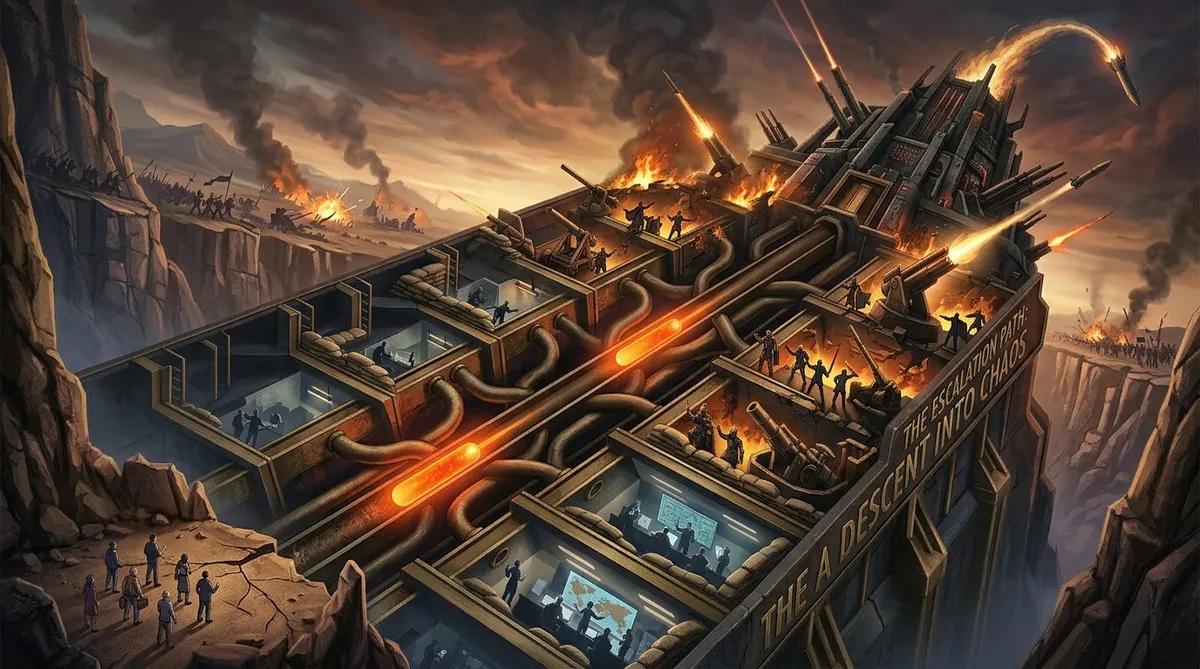
Every organisation has an escalation path. Most of them have never seen it, cannot describe it, and would be horrified by it if someone drew the diagram.
You already have one. You simply did not design it.
Here is the uncomfortable arithmetic. Problems have energy. Energy travels. If you do not give it a conduit, it will find one, and the conduit it finds will be whatever offers the least resistance and the most reaction.
In practice that means problems travel toward three kinds of people. The loudest, because volume looks like competence. The most senior, because seniority looks like permission. And the most reactive, because someone who visibly panics is the only proof available that the message landed.
Nobody wrote that down. Nobody approved it. It is nevertheless your operating structure, and it has been running in production for years without a single review.
The org chart is a work of speculative fiction
The org chart tells you who reports to whom, which is a statement about performance reviews and salary bands. It says almost nothing about how a broken thing gets to a person who can unbreak it.
The escalation path is different. It is the actual control plane. It determines what gets noticed, in what order, at what speed, and by whom. It decides which problems are treated as facts and which are treated as moods. Two companies with identical org charts and different escalation paths are not similar companies. They are barely the same species.
You can tell which one you are dealing with in about four minutes. Ask a mid-level engineer what happens when they find something alarming on a Friday afternoon. If the answer contains the phrase "it depends who is around", you have found an undesigned system, and you have found it in the wild, feeding.
Escalation is a routing problem wearing an emotional costume
Most organisations treat escalation as a character issue. Raising a problem is framed as either heroism or snitching, depending entirely on the outcome and the politics of the week. This is a category error of impressive scale.
Escalation is routing. It is the same problem as interrupt handling, or triage in an emergency department, or a fire alarm. The question is never "was this person brave enough to speak up". The question is "did the signal reach a receiver with the authority to act, within the time the problem allowed".
Framed that way, the failure modes stop being personality flaws and become engineering defects. Which is both more useful and, for the people who have been quietly blamed for years, deeply satisfying.
The four things nobody specifies
A designed escalation path has four components. Undesigned paths have none of them, which is why they behave like weather.
The trigger. A condition, not a feeling. "Error budget consumed by more than half before the midpoint of the window." "Any customer commitment made outside the approved discount range." "Two consecutive sprints with the same blocker unresolved." A trigger you cannot evaluate without a conversation is not a trigger, it is a vibe with a job title.
The latency budget. Two numbers, both of them missing from your documentation right now. How fast must this class of problem reach a decision, and how long is any single person permitted to hold it before passing it on. Without the second number, escalation is a game of hot potato played by people who have been told that dropping the potato is a career-limiting move, so they hold it until it cools, or until it explodes, whichever the potato prefers.
The receiver. A named role that can decide, not merely worry. This is where most escalation designs quietly collapse. The path arrives at someone with the standing to be concerned and no authority to spend money, stop a launch, or overrule a peer. Congratulations, you have built an expensive pipeline into a room full of anxiety.
The return path. The answer has to come back. If the decision is made in a channel the reporter cannot see, you have not built an escalation path, you have built a black hole with excellent internal culture. People escalate once into a black hole. After that they route around it, and they route around it permanently.
Latency debt, or why the same problem always arrives screaming
Here is the pattern everyone recognises and nobody names. The same class of problem keeps arriving in the same panicked shape, at the same terrible hour, with the same three exhausted people attached to it.
That shape is not a coincidence and it is not a personality trait of the people involved. It is a trained behaviour, and you did the training.
If calm early reporting produces nothing, and escalating loudly at the last possible moment produces immediate executive attention, resources and a suspension of the normal rules, then you have built a system with exactly one working interface, and that interface is screaming. Your people are not dramatic. They are empirical. They ran the experiment, they observed the results, and they optimised.
The corollary is bleak and worth sitting with. Every problem that arrives in a panic was available in a calmer form earlier, at a lower price, and your system priced calm at zero.
The hero who is also the bottleneck
There is a particular executive who solves everything. Drop a problem in front of them and it disappears with gratifying speed. They are, by their own account and by general acclaim, extremely effective.
They are also the reason nothing works. Every problem they solve personally is a problem that has learned to arrive at their desk. Over a couple of years, the informal path converges on them from every direction, and the organisation develops the shape of a funnel with a human at the narrow end. Their calendar becomes the rate limiter for the entire company.
The tell is the boast. "Nothing gets escalated to me" and "everything gets escalated to me" are both symptoms. The first describes a filter somewhere below that is eating signal and calling it maturity. The second describes a design with a single point of failure who is proud of it.
The goal is not fewer escalations. A well-designed path produces more escalations, earlier, smaller, and far less interesting. Boring escalations are the entire point. If your escalations are exciting, they are late.
If you do not build a path, your customers will lend you theirs
Every unresolved internal problem eventually finds an external route. The support queue. A public review. A regulator. A post that does numbers. An enterprise buyer mentioning it on a renewal call in a tone of profound calm.
These external paths have superb latency. Nothing in your company moves as fast as a Monday morning after a viral complaint. They are also the most expensive escalation mechanism ever devised, because the receiver is the market and the return path is your reputation.
So the choice was never whether to have an escalation path. The choice was whether to design one before someone donates one to you at retail price.
What designed looks like next to what you probably have
| Component | Undesigned | Designed |
|---|---|---|
| Trigger | Someone feels uneasy | A stated condition anyone can evaluate alone |
| Latency | Until the next available meeting | A stated budget per severity class, including hold time |
| Receiver | Whoever answers first | A named role with decision rights and slack in the calendar |
| Authority | Sympathy | Money, priority, veto, or the ability to stop the line |
| Return path | Silence, then a rumour | A logged decision back to the reporter within a stated window |
| Cost of raising | Reputational, ambiguous, remembered | Near zero, blameless, routine |
| Emotional register | Panic | Tedium |
Two entries deserve underlining. Slack in the receiver's capacity is not a luxury, it is the mechanism. An escalation path into a fully committed person is a queue with better lighting. And the cost of raising a problem must be lower than the cost of hiding one, because people are excellent at estimating both and will act on their estimate rather than on your values statement.
An untested path is a claim, not a capability
You would not ship a failover you had never triggered. Yet the escalation path is almost universally treated as a document rather than a system, which is to say it is asserted rather than exercised.
Test it. Take a plausible problem, inject it at the bottom on a Thursday evening, and measure. How long until it reached someone who could decide. How many hops. How many of those hops were sideways. Did anyone hold it overnight because they were not sure it qualified. Did the answer ever come back to the person who found it.
The results will be embarrassing, which is precisely their value. An escalation path that has only ever been tested by real emergencies has only ever been tested by the most expensive method available.
The point
You are already running an escalation system. It has triggers, they are just moods. It has latencies, they are just accidental. It has receivers, they are just whoever was unlucky enough to be nearby and responsive.
Designing it does not require a transformation programme or a new tool with a friendly mascot. It requires writing down, for each class of problem that actually recurs, what condition sends it upward, how fast it must move, who receives it, what they are allowed to do, and how the answer returns.
That is a short document. Its absence is why your calendar looks like that.