The Cold Chain
Why your best work is judged after you stop touching it
The one-star review arrives at 11pm. It says the beer tastes like a skunk that lost a fight with a wet cardboard box.
The brewer reads it twice. He knows this beer. He knows its gravity, its pH, its dissolved oxygen at packaging, the exact hour the hops went in. That beer left his building in a state approaching grace.
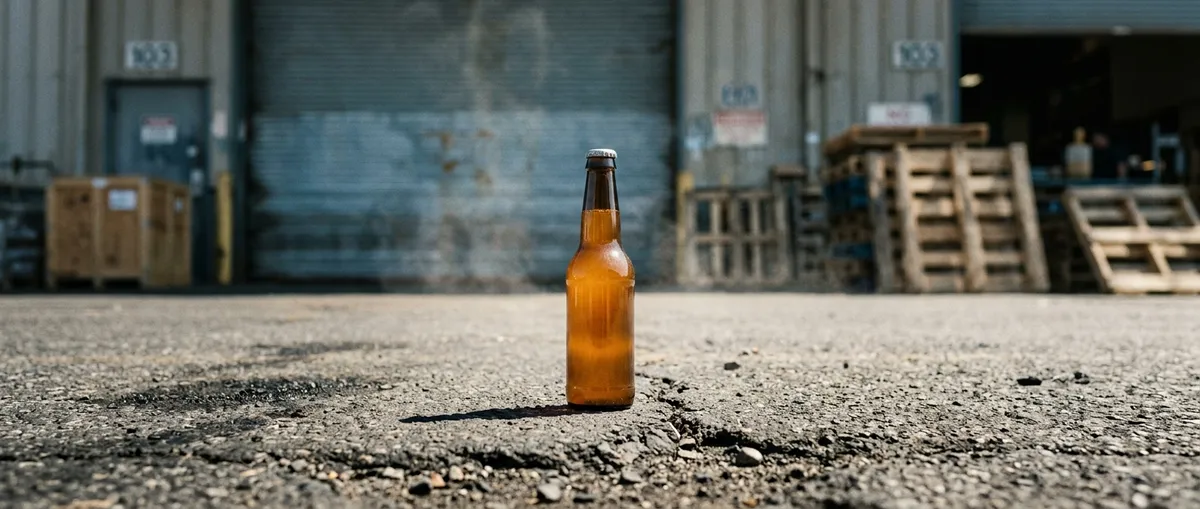
What he does not know, because nobody tells him, is that the pallet spent nine days on an unshaded dock in Phoenix in August, then three weeks in a fridge that was really a display case with a light in it. By the time it reached the reviewer, it was not his beer anymore. It was a chemistry experiment with his logo on it.
He still gets the one star. That is the part worth understanding.
The physics of being ruined by someone else
Beer has three natural predators and none of them work at the brewery.
Light is the fastest. Ultraviolet radiation hits riboflavin, which cheerfully passes the energy along to hop compounds, which break apart and reassemble into a thiol chemically adjacent to what a skunk deploys when frightened. In direct sun, a clear bottle can turn in the time it takes to walk from the car to the house. Not days. Minutes.
Heat is slower and crueller. Staling reactions roughly double in speed for every ten degrees Celsius you add, which means a case stored warm does not age a little faster, it ages on a different calendar entirely. What comes out the other end tastes of wet paper and stale sherry, notes the brewer never put in and cannot take out.
Time is just the accountant. It adds up whatever the other two did.
The crucial property of all three is that the damage is irreversible. You cannot re-chill a stale beer into freshness. There is no rework ticket. And exactly the same is true of the thing your team handed over last Thursday. You cannot retro-document a system after the only person who understood it has moved to another company. You cannot reconstruct design intent from the artifact once the argument that produced it has evaporated. Damage done in transit does not get repaired upstream, because upstream has already gone home.
The chain is the product
Here is the uncomfortable reframe. Nobody consumes your process. They consume the last inch of it.
The customer does not taste the fermentation, they taste the glass in front of them. The user does not experience your architecture review, they experience the page that took eleven seconds to load. The client does not experience your discovery workshop, they experience the fourth week of onboarding where nobody can find the file.
Which means the product is not the thing you made. The product is the thing that arrives. Everything between those two states is not logistics, not overhead, not "somebody else's remit." It is the product, still being manufactured, by people who do not know they are manufacturing it.
Justus von Liebig worked this out in the 1840s with fertiliser. Plant growth is not set by the average availability of nutrients, it is capped by whichever one is scarcest. Add all the nitrogen you like, if potassium runs out the plant stops. Your quality works identically. Your ceiling is your worst handoff, and no amount of excellence upstream can lift it. Spending another quarter perfecting the brew while the trucks stay unrefrigerated is buying a better camera to fix your lighting.
Custody conditions nobody bothered to write down
Every handoff carries a set of conditions under which the work survives, and almost nobody writes them down. For beer, the list is short and known - keep it cold, keep it dark, keep it moving, drink it soon. Brewers who care print some of this on the box. The good ones audit whether anyone read it.
Now try to produce the equivalent list for the handoffs in your own organisation.
A design goes to engineering carrying the unspoken assumption that the receiving developer can tell which spacing is decorative and which is load-bearing, which state is aspirational and which is legally required.
A release goes to operations carrying the unspoken assumption that somebody downstream knows which alert means wake up at 3am and which one has been firing harmlessly since 2019.
A signed contract goes from sales to delivery carrying a verbal promise made in a car park that appears in no document, no scope, and no estimate, and which the client will nonetheless treat as the entire basis of the relationship.
A handoff is a contract that both parties assume the other one drafted.
The result is a strange kind of institutional weather system. Work does not fail inside teams, where it is watched, measured, retrospected and owned. It fails in the gaps between them, where it is nobody's and therefore invisible. Your org chart has boxes and lines. The failures live in the white space, and the white space has no budget, no owner, and no name.
The lime
Corona is served with a lime wedge in the neck. The origin story is contested - bartender's whim, a bet, insect deterrence, sheer marketing - and the fact that nobody agrees is the most instructive detail available. One persistent theory is that the lime helpfully masks the aroma of a beer sold in clear glass, which is to say, the aroma of a beer that has been standing in the light.
Whether or not that is the true origin, look at the shape of it. A structural vulnerability produces an unpleasant symptom. Someone invents a small ritual that covers the symptom. The ritual is charming, so it spreads. The ritual becomes the brand. Eventually the ritual is so beloved that fixing the underlying problem would be an act of vandalism.
Your organisation is full of limes.
The weekly alignment meeting that exists solely because two teams never agreed on an interface. The support macro that apologises for a defect nobody has scheduled. The spreadsheet a heroic analyst maintains by hand because two systems refuse to speak. The onboarding call that explains what the documentation should have. Each one began as an intelligent local fix for a handoff that was never specified, and each one is now load-bearing culture. Try removing one and watch people defend it as tradition.
The diagnostic question is simple and nobody enjoys it. What defect is this ritual masking, and how long has masking been cheaper than fixing?
The blame lands on the label
There is an accountability asymmetry at the heart of all this, and it does not resolve itself.
Whoever's name is on the artifact absorbs the failure, regardless of where the failure occurred. The brewer eats the review. The engineer eats the outage caused by a config nobody handed over. The designer eats the screenshot on social media of a build that ignored half the spec. The partner who sold the engagement eats the delivery they were not allowed to staff.
The uncomfortable implication is that your span of care has to be larger than your span of control, permanently, and nobody is going to fund the difference.
This is why brewers who understand the cold chain behave like unbearable control freaks about assets they do not own. They audit distributors. They refuse accounts that cannot keep a cooler. They pull product from retailers who stack it in a sunlit window. From the outside this looks like arrogance. It is actually the only rational posture available to someone who will be blamed for another company's ambient temperature.
The corporate translation - the engineer who insists on being in the room for the launch is not empire-building. The designer asking to review the build is not distrustful. That is warranty defence, and treating it as scope creep is how organisations teach their best people to stop caring past the handoff.
Instrument the arrival, not the departure
The cold chain industry solved its observability problem with a device that costs about the same as a sandwich. You put a temperature logger in the pallet. When the shipment lands, you read what actually happened to it in the dark, in transit, when nobody was accountable.
Almost every corporate quality metric, by contrast, measures departure. Code coverage at merge. Design review sign-off. Deal signed. Ticket closed. Every one of these certifies the condition of the goods at the factory gate, which is precisely the moment when everything is still fine.
Two questions fix more than any dashboard.
What condition was the work in when it arrived, as described by the person who received it rather than the person who sent it?
And what happened to it in between that we have never once looked at?
Related, and harder - buy your own product at retail. Everything tastes magnificent straight from the tank. Every feature works beautifully on the laptop of the person who built it. Every process is elegant in the deck that proposed it. If you only ever consume your work at the source, you have no information about your actual product, only about your intentions.
Specifying custody
If you want the short version, it is this.
Name the receiver. A handoff to a team is a handoff to no one.
Write down what would spoil the work, in language the receiving side actually uses.
Date it. Freshness dating is a brewer volunteering to be judged, and it forces the whole chain to move.
Measure arrival condition, not departure condition.
Find one lime per quarter and ask what it is covering.
Put the receiving team's outcome in the sending team's scorecard, or accept that you have asked for care and paid for throughput.
And keep one thing in view. The industry did eventually notice this problem in software, invented a refrigerated truck, called it DevOps, and gave it a conference circuit. The insight underneath the branding is not technical. It is that quality is a property of a journey, not a moment, and that the moment you feel proudest of is usually the one furthest from the customer.
Excellence that cannot survive a hot afternoon on a loading dock was never excellence. It was a rumor about excellence, and the review will not be kind.