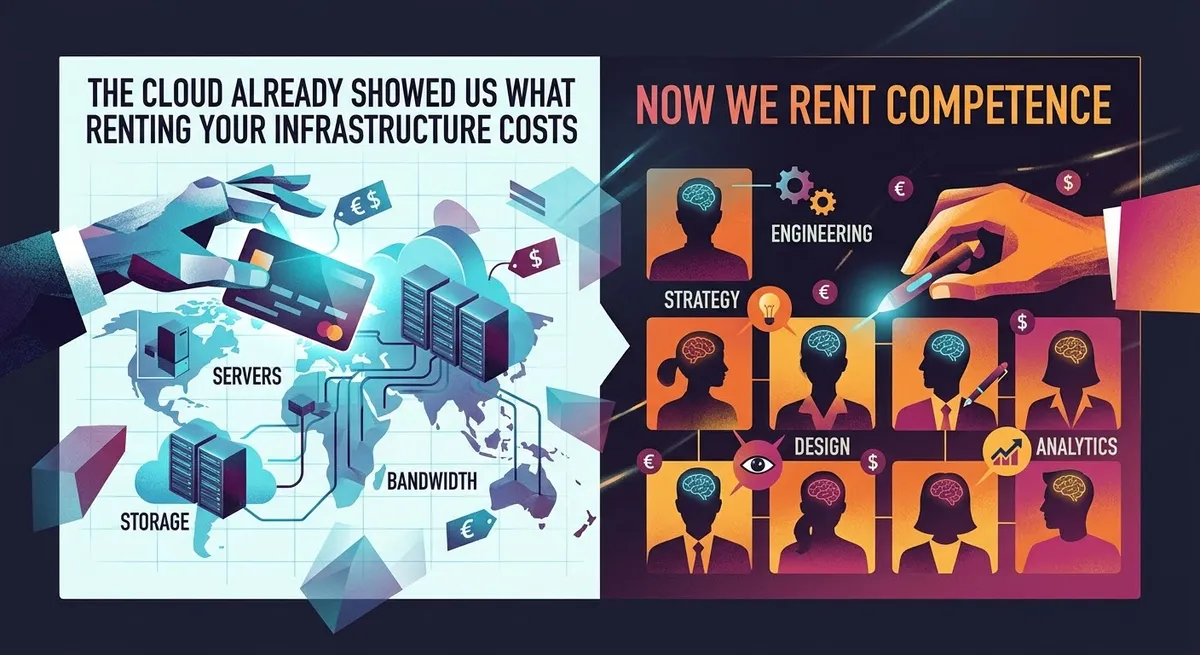
The Cloud Already Showed Us What Renting Your Infrastructure Costs. Now We Rent Competence
The Misconception
The comfortable belief goes like this. Renting intelligence is nothing like renting servers. Servers are physical, scarce and sticky. Knowledge is abstract, abundant and portable. You can swap one model for another the way you swap a search engine, and the worst that happens is your prompts need a trim. Infrastructure lock-in was a hardware problem. Competence has no cables.
It is a pleasant story, and it has the structure of every pleasant story the industry tells itself at the start of a procurement cycle. It is also, almost word for word, the story we told about the cloud in 2010. Only the nouns have been swapped.
The Question
If the cloud taught us that renting infrastructure quietly rewrites your cost structure, your architecture and your bargaining position - what happens when the thing on the invoice is the ability to think?
Not "will AI take the jobs", which is a different and more tiresome question. This one is narrower and less comfortable. When a company moves its competence from payroll to a metered endpoint, what does it stop owning, what does it stop knowing, and what does it cost to come back?
The Explanation
Consider a company. Call it Meridian, because every mid-sized company in a parable sounds like a hedge fund. In 2012 Meridian had a server room, a sysadmin named Tomasz who was mildly feared, and a CFO who had just seen a slide. The slide said "capex to opex" and had an arrow on it. Within eighteen months the server room was a meditation space, Tomasz had "transitioned into a cloud architect role", and the monthly bill was smaller than the old depreciation line. Everyone was very pleased. The slide had been correct, which is the most dangerous thing a slide can be, when it's wrong.
Correct, because the economics of that first phase were real. Elasticity meant you paid for what you used, and what you used in year one was modest. Managed services turned the undifferentiated heavy lifting - patching, backups, failover, the 3 a.m. pager - into a line item. The catch was never hidden. It was simply priced for later. Cloud providers earn their margin on three things. Variable pricing that grows with your success. Proprietary services that are faster to adopt than to leave. And egress, the fee for taking your own bytes back out the door. None of these hurt a small customer. All of them are designed to hurt a large one.
By 2019 Meridian was a large one. The bill had grown faster than revenue, which the finance team discovered the way finance teams discover most things, in a spreadsheet, on a Thursday, after the number had been true for a year. Nobody could explain the bill. Not because it was wrong but because it was correct across forty thousand rows. Meridian hired a consultancy to explain it, the consultancy recommended a tool, the tool required a team, and the team got a name. FinOps. An entire discipline, with certifications, devoted to managing the cost of the thing that was supposed to remove the cost of managing things.
And the cost that no FinOps dashboard could show was the one written into the architecture. Meridian had not rented virtual machines, which are portable. It had rented a managed queue with specific delivery semantics, a serverless runtime (which has servers in the same way boneless wings have chickens), an identity system every other service assumed, and a database whose consistency model had quietly shaped three years of application code. This is data gravity and its sibling, API gravity. Every integration that saves a week on the way in costs a quarter on the way out, because what you built is no longer an application. It is a description of one vendor's opinions, written in your business logic.
Which is roughly what Meridian discovered when repatriation came into fashion, repatriation being the industry's word for admitting a mistake with enough syllables to keep your title. A few companies moved workloads back onto owned hardware and published the savings, which were large and faintly embarrassing. Meridian looked into it. The hardware was easy, it turns out they still make servers and will sell them to anyone. The problem was Tomasz. Tomasz had left in 2017, and nobody had replaced him with another Tomasz because there had been nothing for a Tomasz to do. The knowledge of how to run the thing had been rented out along with the thing, and only one of the two could be bought back with a purchase order.
That is the part of the cloud lesson that never makes the slide, and it has nothing to do with hardware. Outsourcing a capability does not just move its cost. It removes the internal pressure that keeps the capability alive. Skills are maintained by use. Teams that never touch a kernel stop producing people who understand one. The organization keeps the vocabulary and loses the fluency, which is worse than losing both, because fluent vocabulary is how a company convinces itself it still knows things. Economists call it hollowing out. Engineers call it "we'd have to hire for that", said in the tone of someone who has already decided not to.
2026. Meridian HQ.
Meridian has a new slide. Same arrow. The words are "headcount to tokens". The pitch is that competence - analysis, code, drafting, support, the thousand small acts of knowing that make a company work - can be metered like compute. Pay for what you use. Scale on demand. No need to carry a bench of expensive people for problems that only occur in Q3. The slide does not mention that the competitor across town has the same slide, the same vendor and the same price, which makes "competitive advantage" a strange phrase for something sold by the million tokens. But in year one the bill is small, the output is miraculous and the CFO is very pleased. The slide is correct again. You can already hear the problem.
You can hear it in the invoice first. Inference is priced per token in and per token out, so the cost grows with usage and with verbosity, and both grow with success. The endpoints are not interchangeable, whatever the benchmark tables imply. A workflow tuned to one model's behavior is a workflow with opinions baked in, the way Meridian's code had the database's opinions baked in. Prompts, evaluation suites, agent scaffolding, retrieval pipelines, fine-tuned weights that cannot leave the platform they were trained on - this is the new managed service layer, and it has the same shape. Fast to adopt. Slow to leave. And models are retired on the vendor's calendar, not yours, which is a migration you never scheduled, arriving as an email.
Meridian will survive the email. The real echo is not the bill. It is Tomasz. Meridian stopped hiring the junior analyst who used to spend two years learning the business by doing its tedious parts, because the tedious parts are now a prompt. Meridian stopped carrying the mid-level engineer who used to review the junior's work, because there is no junior, and the model does not need reviewing, or so the slide assumes. In five years Meridian will need a senior person who can look at a confident, fluent, wrong answer and know it is wrong. That person is grown from juniors. Meridian has stopped growing them. It has outsourced the garden and kept the vase.
A vase, at least, can be bought again, and this is where the analogy stops being a metaphor and becomes a warning. Infrastructure could be repatriated because the knowledge of running infrastructure survived outside the company, in vendors, in documentation, in people like Tomasz who went elsewhere. Competence specific to your business survives nowhere else. Why the pricing engine has that one exception, which customer will scream, what "done" means in your domain - none of this was ever in the model and none of it will be, because the model learned from the public internet and your business is not on it. When you rent generic competence and let the specific kind atrophy, there is no on-prem differentiation of your business to competitors to go back to. The egress fee is not charged per gigabyte. It is charged in the years it takes to grow a person.
Meridian's CFO, to be fair, is not a fool, and asks the obvious question, which is whether the lesson is simply "do not rent". It is not, any more than the cloud lesson was "buy a server room and put a meditation space next to it". Plenty of companies use the cloud well. They do it by knowing exactly what they are renting, keeping the ability to leave, and holding enough internal understanding to judge whether the vendor is doing a good job. The ones who got burned took "focus on your core business" to mean "stop understanding how your business works and what makes it special".
Understanding, in the new era, has a concrete shape. Treat prompts and evaluation suites as portable assets, versioned, model-agnostic where possible, tested against more than one provider. Keep humans in the loop not as a compliance ornament but as the people who can tell when the output is fluent nonsense, which requires that they could have produced the output themselves, slowly, on a bad day. Protect the apprenticeship pipeline on purpose, because the market will not. Measure the cost of competence the way FinOps eventually learned to measure the cost of compute - not by the invoice, but by what it would cost to no longer have it. And read the retirement emails.
In the version of the story where Meridian reads them, it ends up with a smaller team than it had in 2012 and a much larger one than the slide promised. The people who remain do less typing and more judging. They rent capacity by the token and own the ability to say "no, that is wrong", which turns out to be the only part of competence that was ever worth paying for. Tomasz, for what it is worth, now consults. His rate is extraordinary. He is, after all, the one who remembers.
Remembering was the whole lesson. The cloud did not fail. It did exactly what it said it would, and then it did what it never said, which was to charge you later for the things you had forgotten how to do. Renting competence will follow the same curve, because it is the same curve, drawn by the same incentives and sold with the same arrow on the same slide. The only difference is the thing on the invoice. Last time it was machines, which can be bought back. This time it is understanding, which cannot. Rent as much of it as you like. Just keep a copy.