The Brave New Barbeque and the End of Business Analysis As We Know It
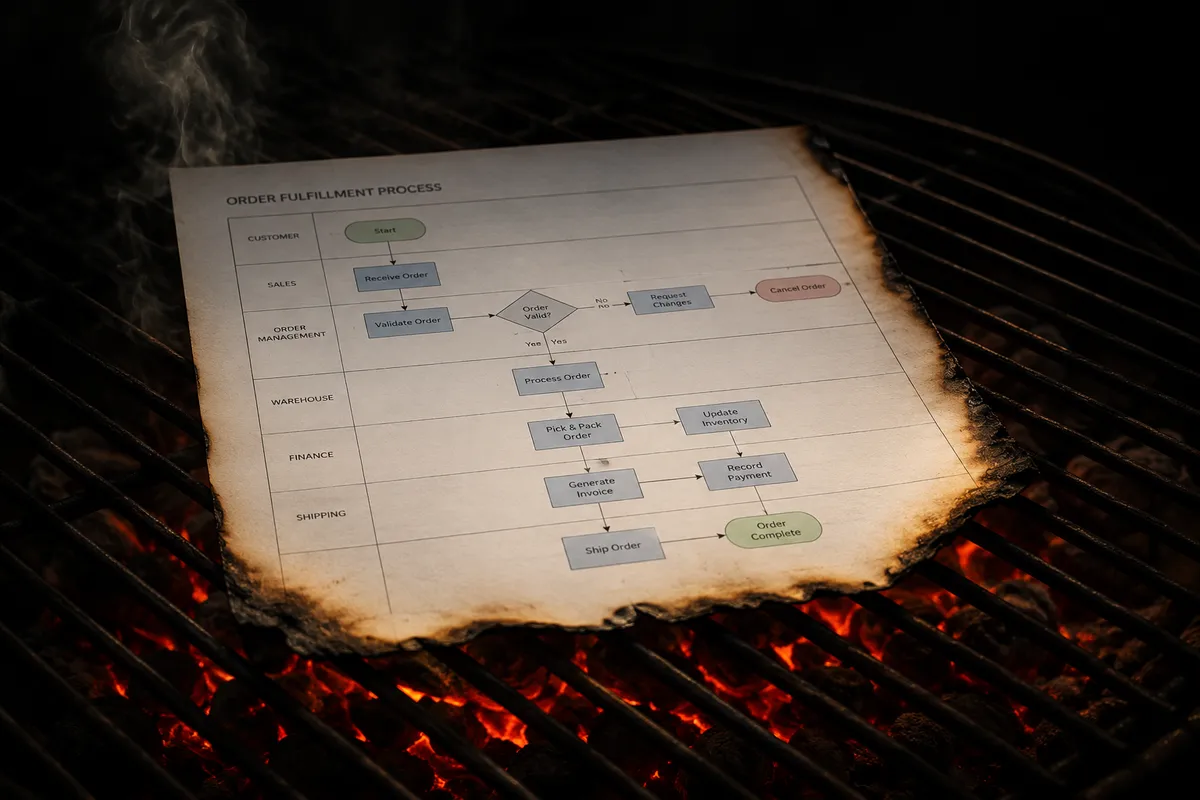
There is a comforting lie at the centre of every serious engagement, and it goes like this. Understanding a business takes time. Lots of time. Time measured in workshops, in stakeholder interviews, in something called a discovery phase, which is the corporate equivalent of a gap year - expensive, vaguely spiritual, and ending in a slideshow nobody reads.
We loved that lie. We built whole careers on it. We printed it on business cards under titles like Senior Business Analyst and Principal Consultant, and we charged by the day, which is a brilliant incentive structure if your core competency is taking your time.
Then somebody pointed a skill called grill-me at a process owner and let it run.
The meat of the matter
Here is the uncomfortable thing about a tool that interrogates. It does not get tired. It does not have a 2 p.m. slump. It does not silently decide that the awkward follow-up question is not worth the social friction, then write that down as a known limitation. It just keeps asking. Politely, relentlessly, and without the faintest flicker of ego.
That last part matters more than anyone wants to admit. The most expensive failure in business analysis is not the missed requirement. It is the question nobody asked because it would have made a senior person look foolish for not knowing the answer. The grill does not care about looking foolish. It has no career. It cannot be invited to fewer meetings as punishment for being annoying. It will ask why the approvals step exists, and then it will ask why again, and it will keep going until it hits either the actual reason or the magnificent admission that the actual reason is - a person who left in 2019 set it up and everyone is afraid to touch it.
A human analyst gets to that truth too, eventually, after enough trust and enough coffee. The machine gets there before lunch.
What we were actually selling
Let us be honest about what business analysis often was. A great deal of it was translation. Take what the people who do the work already know, and render it into a format that the people who fund the work will respect. Boxes. Arrows. A swim-lane diagram, because nothing says rigour like a swim lane. The knowledge was already in the building. Our genuine value was patience, structure, and a willingness to sit through the eleventh retelling of how invoices get approved.
Strip the romance away and the job had three real parts. Extract what is in people's heads. Structure it into something usable. Apply judgement about what actually matters. The first two are exactly the parts that a tireless, structured, infinitely patient interrogator turns out to be unreasonably good at. It can extract for nine hours straight on every single tiny feature. It can structure on the way out. And with a bit of improvement it can swallow an entire operating model, every exception, every undocumented workaround, in the time it takes a human team to schedule the kickoff.
So the question is not whether the machine can do the nitty gritty. It can, and it is faster, and it does not need its expenses reimbursed. The question is what is left.
The part that does not go on the grill
What is left is the third part. Judgement. And judgement is doing more quiet work than the profession ever gave it credit for.
The grill can tell you that two departments describe the same process in incompatible ways. It cannot tell you which of them you are politically allowed to overrule. It can surface that a control is redundant. It cannot decide whether removing that control is a brilliant efficiency or the kind of decision that ends up in a regulatory filing with your name near the top. It can extract every fact about a decision. It cannot be held accountable for the decision, and accountability, it turns out, was never a documentation problem. It was the whole point.
There is also the small matter of knowing which question deserved the heat in the first place. The machine will grill everything with equal enthusiasm, which is wonderful when you do not yet know where the bodies are buried and faintly absurd when you do. Taste - the sense of where to push hard and where the answer does not change anything - remains stubbornly human. For now.
The brave new bit
Here is where the cheerful part ends and the Huxley part begins.
When extraction becomes nearly free and nearly instant, we will use it everywhere, because that is what we do with anything that becomes nearly free. Every decision will come pre-grilled. Every process will arrive fully documented, beautifully structured, and quietly stripped of the human friction that used to slow it down enough for someone to think twice.
And there is something genuinely lovely about a world without the eleventh retelling of the invoice approval process. But the friction was not only waste. Some of it was the time during which a person noticed that the whole thing was a bad idea. The slowness was a bug and also, occasionally, a conscience.
A world that can understand any business instantly is a world that can also restructure it instantly, optimise it instantly, and never once pause in the warm certainty of a perfectly documented model. That is not a tooling risk. That is the comfortable, frictionless, well-structured certainty that Huxley was actually worried about. The soma was never a pill. It was the feeling of having all the answers and none of the doubt.
So, the end of business analysis
Yes and no, which is the most analyst answer imaginable, and I refuse to apologise for it.
The end of business analysis as a slow artisanal craft, billed by the day and justified by the myth that understanding takes a season - that part is over, and most of the people defending it are defending the billing model, not the work. Good riddance to the swim lane as a substitute for thought.
But analysis as judgement, as the act of deciding what the extracted truth means and who has to answer for it - that is not ending. It is being handed back, undiluted, to the humans, now that the machine has taken the tedious half off their plate.
The grill got hot. The meat is cooked faster than anyone expected. The only thing left to decide is whether we are going to taste anything at all, or just keep eating because the kitchen never closes.
Pass the judgement. It is the only thing on the menu that was ever really yours.