The AI Automation Paradox - an ATM Story
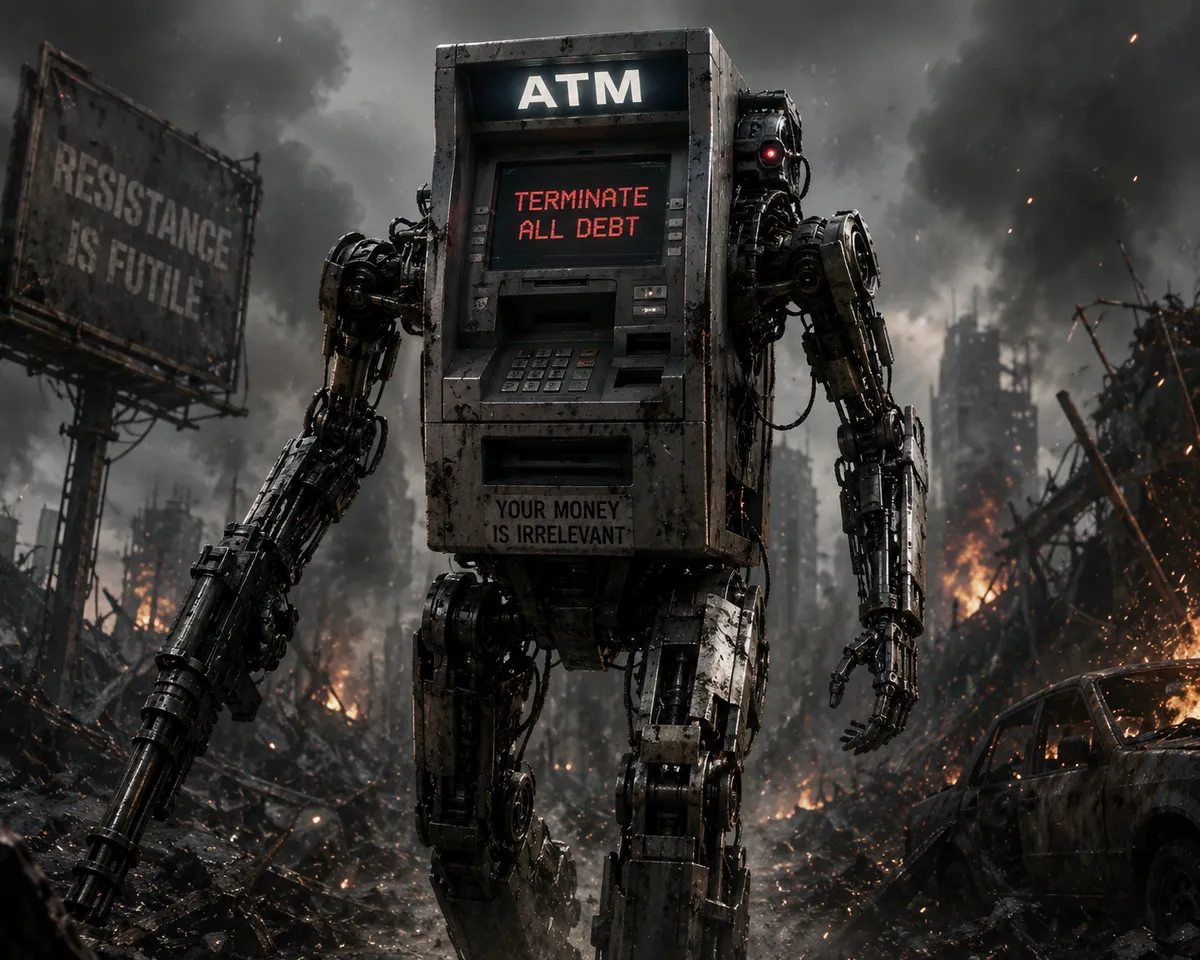
The Curious Afterlife of a Bank Teller
Or why robots have been weirdly bad at their one job
In 1985, if you had told a bank executive that thirty years after the rise of the ATM the United States would employ more bank tellers than ever, you would have been gently escorted from the premises. Probably by a security guard. Maybe even by a teller.
And yet, this is what actually happened.
The Plot Twist Nobody Wrote
The American Enterprise Institute's James Pethokoukis revisits a story that should be tattooed on the inside of every techno-pessimist's eyelid. When ATMs arrived in the 1970s, the obvious prediction was the obvious one - machines do tellering, tellers stop tellering, slow piano music plays over a montage of unemployed cash-handlers staring at the rain.
The actual sequence of events, as economist James Bessen documents in Learning by Doing, was less Greek tragedy, more weird sitcom.
Yes, ATMs reduced the tellers needed per branch. An average urban branch went from needing about 21 of them to about 13. The trouble is that "cheaper to run a branch" turns out, in the language of banking executives, to mean "let's open more branches". They did. Total teller employment grew. For a long stretch, it actually outpaced the overall labor force.
The robots came. The tellers multiplied. The robots have some explaining to do.
The Most Underrated Word in Economics
The hidden hero of this story is a concept that no one will ever put on a motivational poster - elasticity of demand. When something becomes dramatically cheaper to produce, people sometimes buy so much more of it that the total number of humans required to make the thing actually goes up.
Bessen notes the same thing happened in the nineteenth-century textile industry. Power looms automated almost the entire process of weaving. Weavers, one assumes, began updating their LinkedIn profiles. Instead, their ranks swelled for decades. Cloth got cheap. People bought cloth like it was about to be illegal. Someone had to mind the machines.
Add scanners to cash registers, cashiers multiplied. Add electronic discovery software to law firms, paralegals reproduced like rabbits at a deposition. There is a pattern, and the pattern is not machine equals pink slip. The pattern is closer to machine plus cheap equals more of the thing, plus, sometimes, more of the humans.
What Actually Got Automated Was Not the Job
This is the part most worth dwelling on, because it gets quietly disappeared from the discourse every time a CEO uses the word "AI-native" in a shareholder letter.
The ATM did not automate the bank teller. It automated one task the bank teller used to do, namely handing you cash. The job, freed from the tyranny of counting twenties, evolved into something else. Tellers became, in the dignified phrasing of bank HR departments, "members of the customer relationship team." They sold mortgages. They cross-sold credit cards. They explained, patiently and repeatedly, to your grandmother why she might consider a CD instead of a Folgers can.
Their wages went up. The share of college graduates among them rose. The job survived by morphing into a slightly different job that the machine could not yet do, and arguably it paid better.
In other words - the teller did not get killed. The teller got promoted. By a robot.
Now for the Necessary Pessimism
It would be intellectually dishonest, and also kind of annoying, to stop there. The original piece concedes a fact that is ten years more obvious now than when it was written - teller employment is, finally, declining. The Bureau of Labor Statistics projected an 8% drop a decade ago, and the intervening years have not been kind to the branch office. Online banking, mobile deposits, and the slow euthanasia of physical bank locations are accomplishing what the ATM, the proud little box with the broken receipt printer, never could.
So here is the part the optimistic version of this story sometimes downplays - the teller's reprieve was real, but it was a reprieve, not an immortality clause. The robots eventually came for the cash-handling. Then they came for the branch visit itself. Eventually they may come for the customer relationship team, at which point it will be unclear whether the team works for the bank or the bank works for the team's chatbot.
So What Is the Actual Lesson
The lesson is not that automation never destroys jobs. It does. The lesson is that the destruction is almost always weirder, slower, and more counterintuitive than the headlines suggest, because second-order effects are real and they have opinions.
A useful mental model in five parts:
- A new technology automates a task, not a job.
- The cost of doing that task collapses.
- Demand for whatever the task is part of may rise temporarily, sometimes dramatically.
- The job reshuffles around whatever tasks the machine cannot yet do.
- Eventually the machine learns those too, and the job either evolves again or finally goes the way of the elevator operator, the lamplighter, and the typing pool.
This is not a feel-good story. It is a long, slightly chaotic one with periodic plot twists and an ending that depends on how fast humans can re-skill relative to how fast machines can learn new things. The bank tellers got several decades. The horses got considerably less.
The Awkward AI Coda
Every discussion about automation in 2026 has to address the elephant, which in this case is generating text in another tab.
The ATM was a single-purpose machine. It could spit out cash. That was the entire resume. The Bessen story works because the ATM automated one slice of one job, and left the rest of the job, and indeed most of the labor market, alone.
A modern AI system is, at a minimum, multi-purpose, and at maximum, an alarming generalist. The honest worry is not that AI is more powerful than an ATM. It is that AI might be more powerful than the category of things ATMs are. If a technology chips away at tasks across thousands of jobs simultaneously, the comforting reshuffling math from the bank-teller story gets a lot harder to write out on the back of an envelope.
Maybe the second-order effects will rescue us again. Maybe demand for cheaper cognitive work will explode and we will all become whatever the 2026 equivalent of a bank teller is - customer relationship managers for the AI that does the actual work, members of a new and slightly bewildered team.
Or maybe the bank-teller story turns out to be the friendly version of automation, and the next one will be told from a slightly different angle.
In the meantime, if you walk into a bank, smile at the teller. They are a survivor of one of the great economic plot twists of the twentieth century. They may also be the warning label for the twenty-first.