Stall, Stuck Fermentation, and Burnout
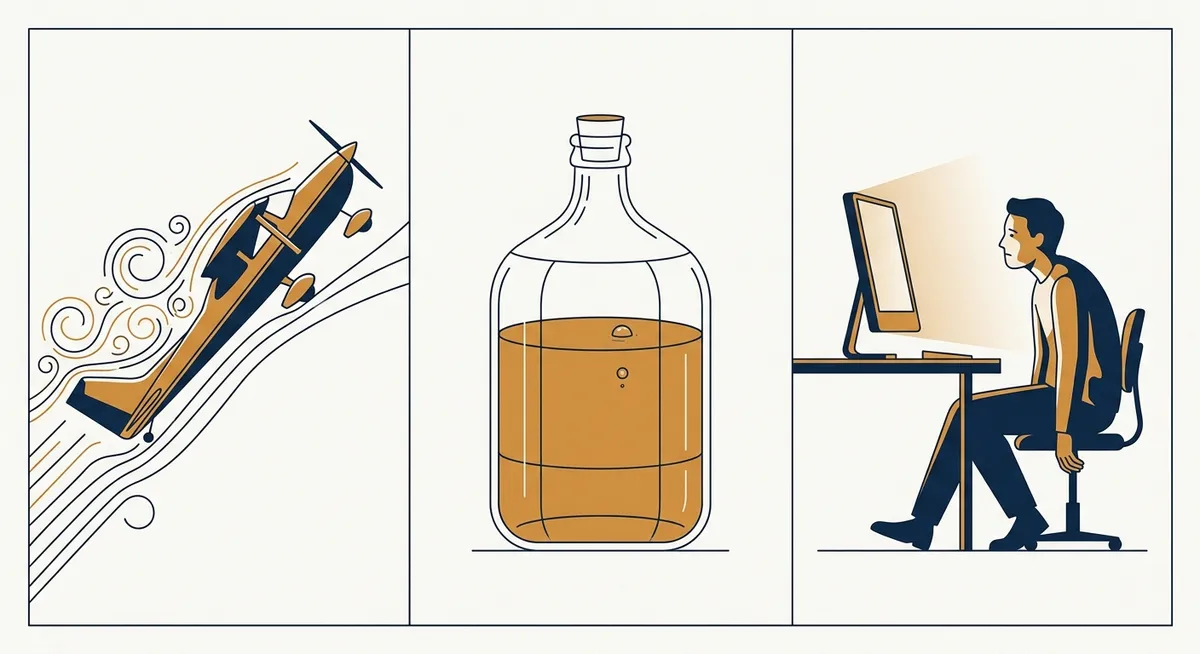
The truth behind burnouts
Three failures that look like laziness, are actually physics, and get worse every time you push harder.
The wing did not run out of air
The word "stall" is one of aviation's cruelest jokes. Every driver on earth hears it and thinks of an engine coughing to a stop, which is to say they think of a fuel problem, a power problem, a not-enough problem. So when a wing stalls, the untrained instinct is beautifully, fatally wrong. The nose is dropping, the ground is arriving, and every nerve in the body says pull back and add power.
But a wing does not stall because it lacks speed or thrust. It stalls because the angle at which it meets the air has crossed a critical threshold, the smooth flow over the upper surface detaches, and lift collapses while drag spikes. You can stall at full throttle. You can stall going very fast. You can stall a perfectly healthy aircraft with two working engines and a full tank, and pulling back on the stick, the thing your body is screaming for you to do, deepens the very condition that caused it.
The recovery is to reduce the angle of attack. Lower the nose. Give away altitude, which is the one thing you feel you cannot spare, in order to buy back the condition under which lift is even possible. Aviation had to train this into people, because nobody arrives with it.
Hold that thought. We are going to the winery.
The yeast was not lazy
A stuck fermentation is when yeast, halfway through converting sugar into alcohol, simply stops. There is sugar everywhere. The yeast are, in the loosest sense, still there. And nothing happens.
The novice reaction is to feed it. More sugar, more warmth, more of whatever seemed to be working before. This is close to the worst available move, because the usual culprits are conditions rather than supplies - nitrogen depletion, a temperature swing that shocked the culture, osmotic pressure from sugar concentration that was too high to begin with, or the yeast quietly poisoning themselves with the ethanol they were hired to produce. Adding sugar to a fermentation stuck on osmotic stress is like handing a drowning person a bucket of water and noting that they seemed thirsty.
What actually works is unglamorous. Correct the temperature. Add nitrogen, which nobody puts on the label. And if the culture is genuinely spent, you do not motivate it, you build a fresh starter, acclimatize it carefully to the hostile environment, and step it in. The yeast were never lazy. They were living in their own exhaust.
The person was not weak
Burnout completes the set, and it is the only one of the three that I have chosen to name after the victim.
Nobody says the wing burned out. We say the aircraft stalled, an event with a measurable angle. Nobody says the yeast lost their passion. We say the fermentation is stuck, which locates the problem in the process. Then we get to human beings and suddenly the vocabulary changes. Burnout. Low performer. Disengaged. Attrition risk. Not a resilient fit for a high-velocity environment. The language quietly relocates a systems failure into somebody's character, which is convenient, because characters can be replaced and systems have owners.
The research has been fairly consistent for decades. Burnout is not a fuel gauge reading zero. It tracks chronic mismatches between a person and their working conditions - workload, control, reward, community, fairness, and values. It is, in the World Health Organization's framing, an occupational phenomenon rather than a medical one. Which means that when a company responds to burnout with resilience training, it is responding to an organizational diagnosis with an individual prescription, and doing so with a straight face.
The corporate reflex is the pilot's reflex. Output is dropping, so pull back on the stick. More hours, more urgency, more visibility, a stretch goal to reignite the spark. And then, when things get truly grim, a wellness webinar scheduled at seven in the evening.
One failure shape wearing three costumes
Strip the domains away and the same structure appears every time.
A system's output is limited by two very different kinds of constraint.
- A power problem. Output is limited by the quantity of input. Add input, get output. The relationship is roughly proportional, mistakes are cheap, and effort is virtuous. Most of ordinary life works this way, which is why we assume it everywhere.
- A condition problem. Output is limited by a state variable that has crossed a threshold. Adding input pushes the state variable further in the wrong direction. The relationship is nonlinear, the failure has a cliff edge, and effort is actively harmful.
The trap is not merely that the two look alike from the outside. It is that the treatments are exact opposites. For a power problem you add. For a condition problem you subtract, or you change the medium. Guessing wrong does not leave you where you started. It accelerates the failure while producing evidence that seems to confirm your mistaken theory, because output keeps falling and clearly that means you did not push hard enough.
This is the mechanism behind most corporate death spirals, and you can spot them by their tell - everyone involved is working harder than ever and the numbers are getting worse.
The corporate bestiary
Adding engineers to a late project. Brooks wrote this down in 1975 and we have spent fifty years treating it as folklore. The constraint is coordination overhead, and communication paths grow roughly with the square of headcount. Adding people adds load to the exact variable that is already saturated. It is sugar into a stuck ferment.
Running teams at one hundred percent utilization. Queueing theory is unsentimental here. As utilization approaches full, waiting time does not rise gently, it goes vertical. Somewhere north of about eighty percent, throughput starts eating itself. Slack looks like waste on a spreadsheet and functions like oxygen in reality, so managers dutifully remove it, then wonder why nothing ships and everything is on fire.
Fixing quality problems with deadline pressure. The defects were caused by haste. The response is more haste. Rework grows, which consumes the time that was already short, which increases haste. This one is close to perpetual motion.
Fixing miscoordination with more coordination. Past a threshold, an organization spends all of its lift overcoming its own drag. The meeting about the misalignment is itself now a source of misalignment. Nobody can cancel it, because that would look like disengagement.
Fixing a trust deficit with an incentive. If people are hiding bad news because bad news is punished, paying more for good news buys you better fiction, faster.
Fixing a culture that punishes failure with a hackathon. The innovation was never blocked by a shortage of enthusiasm or free pizza. It was blocked by everyone's accurate read of what happens to the person who ships something that flops.
Why we guess wrong almost every time
Because the wrong answer is more attractive in every respect except being correct.
Power problems are legible. Input is countable. Hours, headcount, spend, calls made, story points delivered. Condition variables like control, fairness, coordination load, and psychological safety are real, consequential, and absent from the dashboard, which in most organizations makes them theoretical.
Power problems are actionable by authority. "Try harder" is an instruction a manager can give at scale on a Monday. "The conditions I designed are the constraint" is not an instruction, it is a confession.
Power problems are morally flattering. They cast the situation as a test of will, and everyone gets to be brave. Condition problems cast it as a design review, and someone has to own the design.
And diagnosing a condition problem is career-adjacent to insubordination. The junior analyst who says "we are past the critical angle" is technically correct and socially auditing their leadership. So the incentive is to say nothing, work later, and quietly update their resume. Which the company will eventually record as a retention issue, and treat, naturally, as a power problem, with a small bonus.
The diagnostic
When output drops, the first question is not what do we add. It is power problem or condition problem. Four tests get you most of the way.
1. The increment test. Add a small amount of input and watch. If output rises roughly in proportion, you have a power problem, congratulations, this is the easy kind. If output stays flat or falls while cost rises, stop adding.
2. The history test. Look at the trend of input against output. If input has been rising or holding steady while output falls, you are not short of input. You are past a threshold. Effort has already been ruled out as the missing ingredient, by experiment, at everyone's expense.
3. The hysteresis test. Power problems reverse the moment you restore the input. Condition problems do not. A stalled wing needs the angle reduced well below the critical angle before flow reattaches. A stuck fermentation frequently never restarts without a fresh culture. A burned out person does not come back from a long weekend, and a team that has learned that speaking up is expensive does not unlearn it because you said the word "candor" in an all hands. If recovery requires overshooting backwards, it was a condition all along.
4. The cliff test. Did performance degrade gradually, or did it fall off a table? Smooth slopes suggest capacity. Cliff edges suggest thresholds. Nonlinearity is a fingerprint.
Instruments, or how aviation actually solved this
Here is the part worth stealing.
Aviation did not fix stalls by exhorting pilots to fly better. It fixed them by measuring the condition variable and making it impossible to ignore. Angle of attack indicators. Stall warning horns. A stick shaker that physically vibrates the controls, because at a certain point you stop trusting people to read a gauge and start speaking directly to their hands.
Every serious safety gain came from instrumenting the thing that actually causes the failure, rather than the thing that is easy to count.
Corporate dashboards, almost without exception, measure power variables. Output, hours, utilization, velocity, pipeline. The condition variables go unmeasured, which is why the stall is always a surprise. A functional organization would track work in progress against capacity, queue lengths and wait times rather than only completion counts, how long the average decision waits for someone with authority, how many unresolved conflicts are aging quietly, how many people are single points of failure, and how much of the calendar is drag rather than lift.
And then it would build itself a stick shaker. Something automatic, ugly, and hard to override, that triggers on the condition rather than on the outcome. A work in progress limit that physically refuses new intake. A rule that a missed date defaults to cutting scope instead of adding weekends. An escalation that fires on queue age with no human discretion involved, because human discretion at that moment is exactly what is compromised. The whole point of a stick shaker is that it works on a pilot who is convinced they are fine.
Against convenient diagnosis
Now the honest caveat, because this framework is a scalpel and scalpels get used for burglary.
Sometimes it really is a power problem. Sometimes a team is genuinely under-resourced, and the sophisticated language of conditions and thresholds is a fog machine deployed to avoid saying that not enough work is being done. "We are past the critical angle" is an excellent thing to say when true and an excellent thing to hide behind when false. The diagnostic cuts both ways, and it only has value if you are willing to accept either answer.
So run the tests properly. If you add a modest amount of input and output rises, that is your answer, and no amount of systems vocabulary changes it. Adding is not always wrong. Adding is only catastrophic when the constraint is a condition, which is roughly the situation nobody checks for and therefore roughly the situation everybody is in.
The lesson, at altitude
Three domains, one shape. A wing full of thrust that cannot fly. A vat full of sugar that will not ferment. A person full of talent who cannot start. In all three, the system did not run out of input. It crossed a line, and past that line the input became the poison.
The instinct in every case is to pull back on the stick, and the fix in every case is to give up some altitude you are certain you cannot afford - reduce the load, correct the medium, restore the condition, and only then start climbing again.
The yeast never needed a lunch and learn. It needed nitrogen and a lower temperature. Your team is probably not short of motivation either. It is just, at present, living in its own exhaust.