Signed Movements
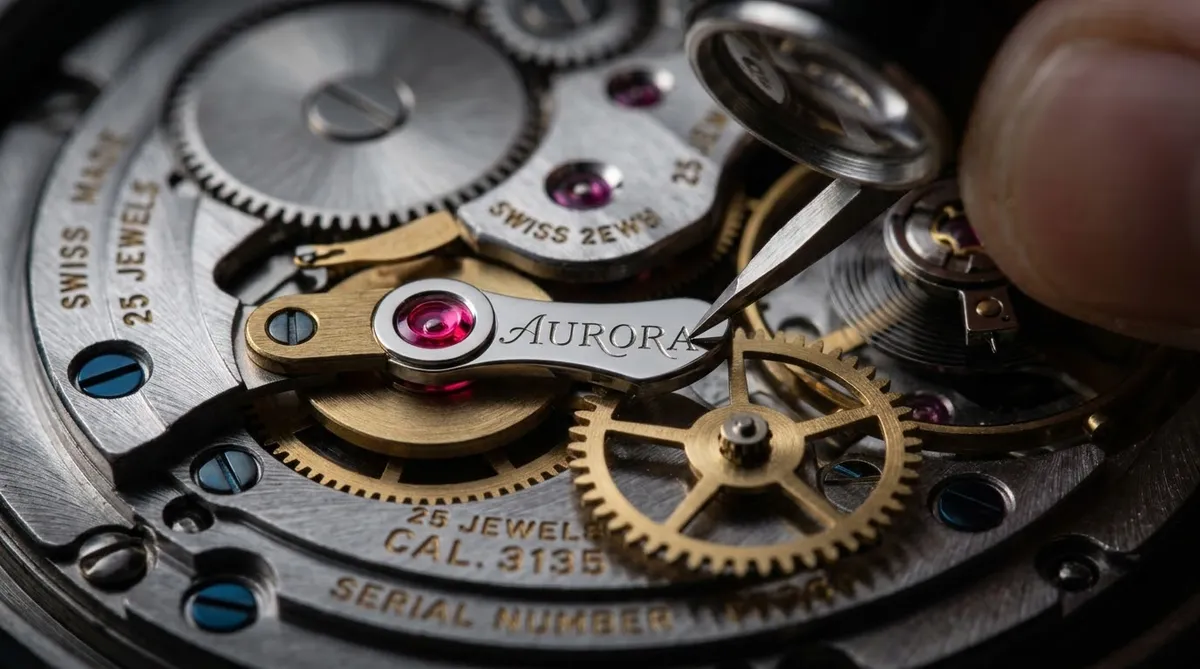
On putting your name where nobody will ever look
Inside a mechanical watch, on a small bridge of steel that holds the balance wheel, a watchmaker engraves a name. Sometimes it is the house. Sometimes, in the older tradition, it is a person, followed by the word fecit - he made it. The engraving sits under the dial, behind the case, in the dark, under a component that must be removed to be seen. The owner of the watch will almost certainly never look at it. The owner of the watch is not the audience.
This is a strange thing to spend money on. The dial is where the marketing lives. The dial is what gets photographed, cropped square, and posted with a caption about heritage. The movement is the part that does the work and the part nobody sees, and it is therefore the natural home of every possible shortcut. Which is exactly why the good ones sign it.
The corporate world has arrived at the opposite arrangement with impressive consistency. We have never had more surfaces for our names - profiles, bios, headshots taken against exposed brick - and we have never produced so much unsigned work. The deck is authored by "the team." The architecture was chosen by "the org." The decision to reorganise around customer segments was reached by a process best described in the grammatical mood of weather. It happened. It was decided. Nobody made it.
The audience for a signature is the next person to open the case
The watchmaker's name inside the movement is not vanity and it is not branding. It is a message to a specific reader - the watchmaker who opens this case in twenty years, holding a tiny screwdriver and a grudge. That person needs to know who did this, because who did this tells them what they are dealing with. A signature is a promise made to a stranger you will never meet, in a place you will never revisit, about work you cannot defend once you have put the caseback on.
Now consider the artifacts your company produces. The financial model with a hardcoded 0.87 in cell AH204. The service that mysteriously retries three times and then gives up in silence. The contract clause that everyone assumes was negotiated for a reason. The onboarding document that instructs new hires to ask Priya, who left in 2022.
Every one of these will be opened again. Software is opened not every five years but every five minutes. And when it is opened, the single most valuable piece of metadata is not the ticket number. It is a name attached to a decision by someone who was willing to have it attached.
git blame is not a signature. It is a forensic tool, and the clue is in the name. Nobody in the history of horology ever engraved the word blame on a balance cock. Version control tells you whose fingers were on the keys. It does not tell you who stood behind the choice, which is the only thing anybody actually wants to know at two in the morning.
What anonymity does to hidden work
There is a quiet law of craftsmanship that deserves more attention than it gets - unsigned work drives out signed work, because at the moment of delivery the two are indistinguishable and one of them is cheaper.
A polished dial and an unpolished movement look identical from the front. The bevelled edges on an internal bridge, hand finished, catching light that will never reach a human eye, add cost and return nothing measurable. No customer asks for them. No dashboard captures them. In any rational quarterly review they are pure waste.
This is precisely why they are the truest signal a workshop emits. Anyone will finish the visible surfaces, because visible surfaces are performance. Only a certain kind of shop finishes the surfaces that nobody audits. The Geneva Seal, to its enormous credit, understood this and built a standard that inspects the parts you cannot see - a rare example of a quality regime that grasped where quality actually hides.
Your organisation has an equivalent, and it is not your product. It is your test coverage on the unglamorous path, your data dictionary, your error messages, your handover notes, your comments explaining why rather than what. It is everything that costs something now and returns nothing that shows up in this quarter's numbers.
Technical debt is not a moral failing of engineers. It is what accumulates in the unsigned parts of the case. Give the hidden work an author and it improves within a fortnight, not because people are shamed into it but because they are finally permitted to be proud of it. Pride requires a subject. You cannot be proud on behalf of a collective noun.
The passive voice is not a style choice, it is a governance structure
"It was decided to consolidate the platforms."
Read that again and notice how much engineering has gone into it. Nobody decided. The decision precipitated out of the atmosphere of the building. Two years later, when the consolidation has cost eleven million and produced a system that only works if you restart it on Sundays, there is no author to ask, no reasoning to inspect, and no one to say the most valuable sentence available to any institution - I thought this, for these reasons, and I was wrong about the third one.
That sentence is how organisations learn. Its absence is how they repeat themselves with rising confidence.
The passive voice is popular because it works. It is a liability structure disguised as a prose preference. Committees are, among other things, industrial machinery for laundering authorship - eleven people in a room, a decision at the end, and no signature anywhere on it, which is a considerable achievement in the presence of eleven witnesses.
Meanwhile the wall in reception says OWNERSHIP in a confident sans serif, and every document in the building was written by "Strategy."
Why organisations resist signing - a signature is a claim of authority
Here is the part that gets skipped in the accountability workshop.
Signing is not merely accepting consequences. Signing is asserting that you had the standing to decide. A signature says - this was mine to make. Which is a far more disruptive statement than it appears, because it reveals, in permanent ink, where authority actually sits in the company rather than where the org chart claims it sits.
That is the real friction. Organisations do not resist naming because they fear cruelty. They resist naming because naming is legible, and legible authority can be contested, audited, envied and removed. Diffuse authority is comfortable for everyone who benefits from it. If the decision has no author, nobody can be found to have exceeded their remit, nobody can be found to have abdicated it, and nobody can be found at all.
Anonymity is not humility. It is insurance. And like most insurance it is quietly expensive and purchased mainly by people who already have assets to protect.
Watch what happens when a company genuinely adopts signed decisions. The first objection is never "this is too harsh." It is "who gets to sign?" Which is the entire question, arriving in disguise, and the fact that it arrives at all proves the signature was doing real work before anyone had written a single one.
The counterfeit signature - accountability without authority
There is a failure mode worse than anonymity, and consultancies have industrialised it. The analyst builds the model, at some cost to their spine and their weekend. The partner presents it. The letterhead is the signature. If the model is right, the firm was insightful. If the model is wrong, someone junior misunderstood the brief.
The corporate version is a decision log where the names belong to people who were told what to write. That is not a signature. That is a pre-signed confession, and everyone involved knows it, which is why the document is completed with the enthusiasm of a hostage video.
The rule is simple and almost never followed - a signature is only legitimate where the signer could have refused. If you cannot say no, your name on the artifact is not accountability, it is a hazing ritual with a filing system.
The corollary is more uncomfortable for senior people. If you reserve the authority, you inherit the signature. You do not get to hold the veto and delegate the engraving.
The mechanism cuts both ways, and most companies only install one blade
Medieval masons carved marks into stone, and those marks were not confessions. They were invoices. The mark identified whose work this was so the man could be paid for it. Attribution and credit were the same instrument, which is why nobody had to be threatened into using it.
Most modern accountability schemes install the blame edge and leave the credit edge in the box. Then they express surprise that adoption is poor. If a name on a thing only ever gets read during an incident review, people will develop an entirely rational allergy to having their name on things, and the organisation will discover it has built an elaborate system for producing orphans.
Use it for pay, promotion, and reputation first. Use it for post mortems second. In that order, or not at all.
Practices worth stealing
- Put the name on the artifact, not in the ticket. Metadata rots; the document survives.
- Sign decisions, not only documents. One name, one date, one paragraph of reasoning, including the thing you were unsure about. That last part is where all the future value is stored.
- Never let a collective noun be an author. "Finance decided" is not information.
- Insist that signature follows authority. If someone could not have said no, their name does not go on it, and you should be embarrassed to have asked.
- Audit the hidden surfaces, not the deliverable. Read the handover note, the migration script, the appendix. Praise them loudly and specifically, in public, at least once a quarter, until people understand you were serious.
- Countersign rather than co-sign. A reviewer's name is a second signature with a different meaning, and blurring the two produces documents with four authors and no author.
- Hand the name over honestly at handover. Unowned work is not work that someone forgot to claim; it is work you decided not to maintain. Say so out loud.
- Retire signatures. A name from six years ago is history, not jurisdiction. Signing is not a life sentence, and pretending otherwise is how you frighten people into anonymity again.
Coda - the most prolific anonymous author in history now works here
Something new has arrived in the building and it does not sign anything. It produces code, memos, analyses and recommendations at a volume no human workshop could match, in fluent and confident prose, with no name inside the case and no capacity to hold one. It cannot be proud of a bevel. It cannot be asked, in twenty years, what it was thinking.
Which means the burden of the signature has not been reduced by automation. It has been concentrated. Whoever accepted the output signed it, whether or not they noticed. Reviewed by is the new fecit, and it is the only version of the old tradition still available to us.
The watchmaker's name is inside the case because the case will be opened. That is the whole argument. Everything you make will be opened by someone who does not know you, cannot ask you, and will draw a conclusion about you regardless.
You may as well be identified correctly.