Roman Roads and Platform Teams
Roman Roads and Platform Teams
On funding things whose value arrives late, uninvited, and in someone else's budget
In 312 BC, a Roman censor named Appius Claudius spent public money on a road to Capua. The justification was a war. Move legions south faster than the Samnites can regroup, hold the ground, end the campaign. It was a sound justification. It worked. And it explains almost nothing about why we are still talking about the Via Appia twenty-three centuries later.
The road carried soldiers for a few decades. It then carried grain, wine, olive oil, tax collectors, magistrates, imperial couriers, a prisoner from Tarsus on his way to trial in Rome, plague, pilgrims, popes, Grand Tourists with sketchbooks, and eventually tourists in rented hatchbacks looking for parking. The empire that funded it fell over. The road did not. Something like eighty thousand kilometres of paved trunk route, and several times that in lesser roads, went on doing useful work for a millennium after the accounting entity that authorised it ceased to exist.
No one computed the net present value of that. No one could have. The entire second act of the Roman road network consists of uses that were not merely unforecast but unforecastable, because the users had not been born, the goods had not been invented, and the religion had not been founded.
This is the shape of every platform investment you will ever be asked to approve.
The first act pays the bill, the second act pays the dividend
Here is where most platform advocacy goes soft, so let us be precise. Appius Claudius did not build a road on a bet about the future. He built it to win a specific war, and it won that war. The military case cleared on its own merits, in its own decade, against a named adversary.
What he also did, and this is the part that matters, was build it far heavier than the war required. Multiple courses of stone. A cambered surface for drainage. Milestones. Alignments chosen for permanence rather than for the cheapest possible route to the current objective. The war paid for a road. The engineering standard produced an asset.
The lesson is not that platforms should be funded on faith in unknown futures. The lesson is that the first use case buys the road and the overbuild buys the option, and only one of those two things has to be defended in the meeting.
A platform team that cannot name its legion is not building infrastructure. It is building a monument, and monuments are evaluated on a different and much less forgiving basis.
Why the ROI model is structurally incapable of seeing this
Now the awkward mathematics.
In a discounted cash flow model, uncertainty is a penalty. The less confident you are in a projected benefit, the harder you discount it, the smaller the number at the bottom. This is entirely correct behaviour for a model of a known revenue stream.
In an options model, uncertainty is a premium. The more volatile the future, the more a cheap right to act in that future is worth. This is also entirely correct.
Same input. Opposite sign. A platform proposal walks into a room holding an instrument calibrated to punish precisely the property that makes the asset valuable. The wider the range of plausible future uses, the worse the business case looks and the better the investment is.
What happens next is predictable and slightly tragic. Platform teams learn that the room only accepts one instrument, so they manufacture certainty. They forecast adoption they cannot know. They produce a productivity percentage arrived at by starting from the approval threshold and working backwards with great confidence. And having promised a forecast, they are then held to the forecast, which converts a call option into an obligation. This is the single most expensive financial transformation available to a middle manager, and it is performed cheerfully, quarterly, at scale.
The Via Appia would have failed this review. Projected pilgrim volume for the fourth century AD, unavailable. Sensitivity analysis on the collapse of the western empire, unavailable. Confidence interval, wide enough to drive a legion through.
Optionality also lets the Goths in
Any honest treatment of this analogy has to concede the obvious. The roads that carried grain to Rome also carried armies to Rome. Excellent infrastructure is famously indifferent to the direction of travel, and the invaders of late antiquity were not obliged to march through mud out of politeness. Plague moved at the speed of trade. So did rebellion.
Optionality is two sided. A platform that makes it trivially easy for forty teams to ship also makes it trivially easy for forty teams to ship the same bad decision, at once, with excellent tooling. Centralise authentication and you have centralised the outage. Standardise the data pipeline and you have standardised the leak. The value of a shared substrate and the blast radius of a shared substrate are computed from the same number.
And the word itself gets abused. In practice, optionality is what people say when they cannot name a customer. It is the vocabulary of the unfundable, deployed at exactly the moment the specifics run out. The correct response to a proposal justified entirely on optionality is the one Appius Claudius could have answered instantly, which is - which war, and does the road win it.
The empire did not kill the roads, the maintenance budget did
Where the analogy gets genuinely instructive is the decay pattern.
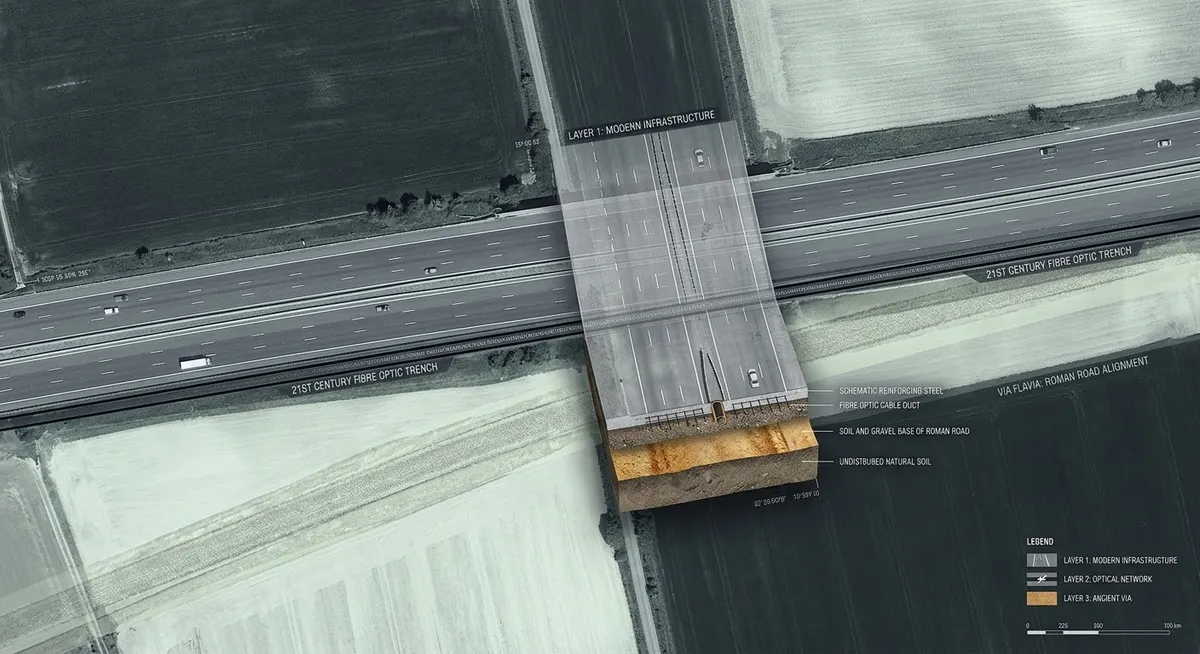
Roman roads did not vanish when Rome fell. They degraded slowly, unevenly, and mostly through the withdrawal of upkeep rather than through any dramatic event. Surfaces went unrepaired. Bridges dropped and were not replaced. Stretches of dressed stone were quarried by locals building something more immediately useful, which is the most relatable act in this entire essay. Some sections survived long enough that modern trunk roads still follow their alignments. Others became a field with a suspiciously straight hedge in it.
The asset outlived the funder because the substrate was overbuilt. The asset degraded because carry cost is real and nobody had budget for it.
Platform teams live inside this exact dynamic and rarely name it. There is always money for the build, occasionally money for the migration, and never money for the unglamorous decade of upkeep in between. Organisations will fund a new internal developer platform and then, three years later, fund a project to replace the internal developer platform, having declined at every intervening budget cycle to fund the two engineers who would have kept the first one alive. This is treated as bad luck rather than as a choice made repeatedly and on purpose.
An option with an unaffordable carry cost is not an option. It is a slow liability with good documentation.
The interface encodes the original user, forever
One more detail worth stealing from the historians. Roman roads were laid out for people on foot and animals in column, prioritising directness and a hard durable surface. Later users had different needs. Stone is unkind to hooves and to wheels, and gradients that a marching cohort shrugs at are a problem for a loaded cart. There is a recurring observation that later traffic sometimes preferred the softer verge or a parallel track beside the beautiful engineered surface, which is an image every platform team should have tattooed somewhere visible.
Your first user's assumptions are now physics. The abstraction you chose because it fit the launch customer will be paid for by every team that arrives afterwards, in a currency of workarounds. And you will know it is happening because someone will build a parallel dirt track next to your paved road, and the internal discourse will decide that person is the problem.
They are not the problem. They are the gradient telling you something.
What to evaluate instead of payback
If forecast usage is the wrong denominator, something has to replace it. A workable frame, in rough order of usefulness.
- The named first use case, fully costed - the platform must be worth building for a use that exists today, with a customer who will complain if it is late. Everything after that is upside you never have to promise.
- The cost of the overbuild, stated separately - how much extra are we spending to make this durable and general rather than sufficient. That figure is the option premium. Name it, defend it as a premium, and stop laundering it through the primary business case.
- Carry cost in a bad year - not the happy path maintenance estimate but the number that survives a hiring freeze. If the platform needs a good quarter to stay alive, it will not stay alive.
- Breadth of the adjacent possible - how many plausible next uses does this substrate reach cheaply. Count them, describe them, refuse to forecast their revenue. The count is the signal. The forecast is theatre.
- Time to value for a team that does not exist yet - the interesting latency is not how fast the launch customer shipped. It is how long onboarding takes for a team who arrived after everyone who built the thing had moved on, and who will not be reading your Slack history.
- Legibility - the Romans put milestones on their roads and produced route itineraries, because a road you cannot find and cannot plan against is not a road. A platform discoverable only by asking the right person is a private arrangement wearing infrastructure's clothes.
- Exit cost - how expensive is it to abandon. Options you cannot walk away from have quietly stopped being options.
Notice what this frame gives up. It gives up the promise of a payback date, which is the thing finance most wants and the thing least available. It replaces a fabricated number with an honest structure, and honest structures make people uncomfortable in ways that fabricated numbers never do.
Know when to be bypassed
The final thing the roads teach is when to let go. Their thousand year run was partly a matter of nobody being able to do better. Once canals, then macadam, then railways arrived, the network was routed around without ceremony. The stones did not become worse. The alternatives became better.
Platform teams tend to interpret their own longevity as vindication rather than as a fact about the available alternatives. The correct posture toward a substrate that has served for a decade is not devotion. It is a standing willingness to be bypassed by something better, and enough humility to notice when the parallel tracks have become the actual road.
Appius Claudius went blind in later life and history handed him the epithet for it. He is remembered chiefly for a road he built to move soldiers to a war that no one outside a graduate seminar can now describe.
At the centre of the network he helped begin, the emperor Augustus later set a gilded milestone, the golden marker from which distances to the edges of the world were reckoned. Every platform team since has tried to build the golden path. Very few have managed the more important trick, which is the boring one - laying the stone thick enough that it still carries traffic long after everyone who approved the budget has been forgotten, along with the war, along with the empire, along with the spreadsheet.