Leadership Lessons in the Rain
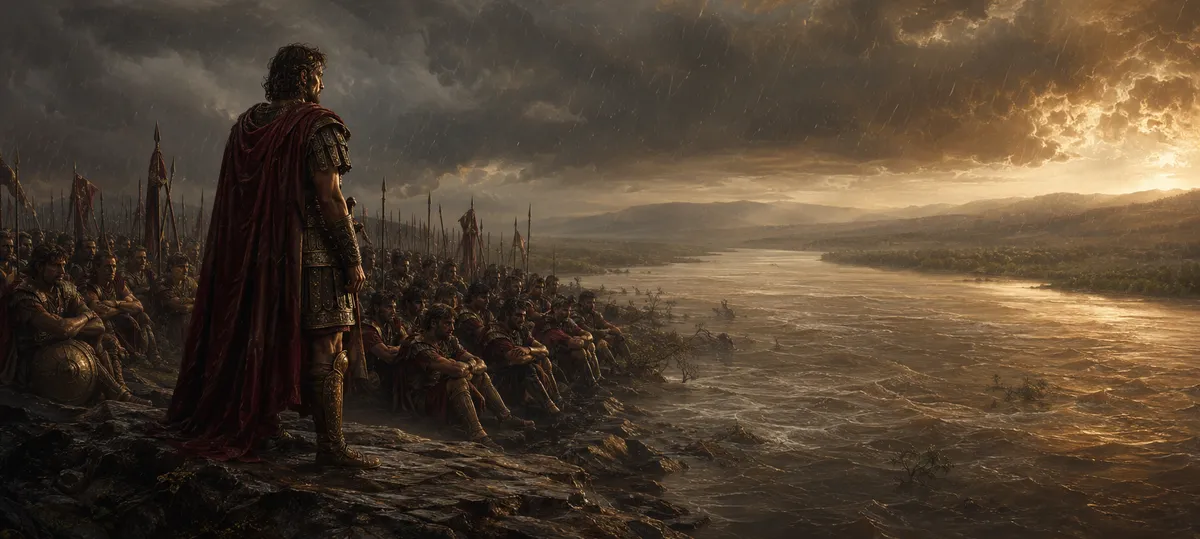
Alexander at the Hyphasis, 326 BCE - the finest motivational talk in antiquity, and why it bounced
Alexander the Great never lost a battle. He lost exactly one argument, to exhausted men standing in the rain, and the speech he gave to win that argument remains, twenty-three centuries later, the most complete syllabus of leadership rhetoric ever compressed into a single address. Every trope is present. The vision. The sacrifice. The legacy. The open door. It is magnificent, it is sincere, and it failed completely, which is precisely why it may be the most instructive leadership speech ever given. The lesson is simply not the one the speaker intended.
The room he walked into
Picture the scene. Eight years of campaigning and thousands of miles on foot, from Macedonia through Anatolia, Egypt, Persia, and Bactria, down into the Punjab. Behind the army lies everything with a name worth conquering. Ahead lies the Hyphasis river, swollen by a monsoon that, by Diodorus's count, has been falling for seventy consecutive days. Rot in the leather, rust on the iron, fever in the ranks. And drifting across the water come the rumors - Ganges kingdoms with armies counted in the hundreds of thousands, and war elephants by the thousands, waiting like a final boss nobody asked to unlock.
The soldiers do not riot. They do not desert. They do something far more devastating to a charismatic leader. They stop clapping. Arrian tells us the murmuring in camp grew until Alexander, sensing the mood curdle, summoned his officers to talk them back into the future.
What he said survives in Book 5 of Arrian's Anabasis, written roughly four and a half centuries after the fact. In other words, the minutes of this meeting were taken 450 years after it adjourned, by a devoted fan. Treat the exact wording as a reconstruction. The architecture, however, is timeless, and the architecture is the point.
What the speech contained
Move one - the inventory. He opens with a recitation of everything they have taken together. Ionia and the Hellespont, Egypt and Babylon, Susa and Persepolis, Media, Bactria, Sogdiana, and now India up to this very riverbank. It is stirring. It is also the sunk cost fallacy wearing a breastplate. Look how much we have already paid, runs the subtext, surely you would not throw away the receipt.
Move two - the shrinking map. Not far now, he insists. Just beyond lies the Ganges, and beyond that the Eastern Ocean, the actual edge of the earth, where all the seas connect and the whole world folds neatly into their hands. His geography was majestically wrong, but geography was never the deliverable. The horizon was. And the horizon is a terrible destination, because it relocates. Every startup employee who has been promised that profitability is one quarter away knows this river.
Move three - the warning. Turn back now, he argues, and the peoples behind us stir, the conquests unravel, everything won becomes everything at risk. This is fear wearing prudence's clothing, the burning platform speech two and a half millennia before consultants would laminate it.
Move four - the shared table. No man here toils more than I do, he says. I eat what you eat, I sleep as you sleep, my body carries wounds from every weapon a man can be hit with. Here, at last, something unimpeachably true. Alexander genuinely led from the front, first over walls, first into spears, scarred like a cutting board. This was the one slide in the deck nobody could dispute.
Move five - glory. Toil for noble ends, he tells them, is its own wage. They have surpassed the labors of Heracles and the wanderings of Dionysus, and it is a beautiful thing to live with courage and leave behind a fame that never dies. Purpose over perks, meaning over money, the whole modern literature on intrinsic motivation delivered in bronze, without a single laminated values poster.
Move six - the open floor. He closes by inviting anyone who disagrees to speak freely. Psychological safety, ancient edition. Hold that thought. We will see shortly what the warranty on that invitation looked like.
A field guide to the tropes
Run the speech through any modern leadership framework and it lights up like a diagnostics panel. Vision casting, in the grand Kotter tradition, except the vision was proprietary software the workforce had never agreed to install. Skin in the game, and genuinely so, which bought him a hearing but not obedience, a distinction every credible leader eventually discovers at the worst possible moment. Escalation of commitment, dressed as loyalty to past sacrifice, which is how organizations everywhere confuse momentum with strategy. Purpose-driven leadership, sincerely meant, delivered to an audience whose purpose had quietly become seeing their children before dying. And the open door, extended with full ceremony, to people who understood exactly how much weather was on the other side of it.
Coenus, patron saint of the honest deputy
The officers stood silent for a long time. Then Coenus, a scarred veteran commander, did the single bravest thing recorded at the Hyphasis. He told the truth in a meeting.
His counter-speech, as Arrian renders it, is the quiet masterpiece of the episode. If there is one thing a fortunate man should know, he says, it is when to stop. Of the Macedonians who set out, most are dead, invalided, or scattered in garrisons. The survivors ache for their parents, their wives, their children, for one look at home while wearing the wealth you gave them. Go back, mother a new army of fresh young men, and fight new wars with soldiers who still have wars in them. Greatness, he suggests, includes restraint. Success should observe a limit.
It is the finest statement of strategic moderation in ancient literature, and it was also, professionally speaking, a bold career move, since it consisted of being right, out loud, in front of the boss. Arrian notes that Coenus fell ill and died within days of the episode. Historians agree it was ordinary disease. The comedic timing, nevertheless, remains in questionable taste.
The sulk, the omens, and the giant beds
Alexander's response to the invited feedback was to storm off and shut himself in his tent for three days, a deliberate impression of Achilles sulking by the ships, on the theory that the army would panic and beg him to lead them anywhere. This is the original open-door policy - the door was a tent flap, and it stayed closed for seventy-two hours.
The army did not blink. So the master of the possible reached for the last tool in the kit. He performed the sacrifices for crossing the river and announced, with a straight face, that the omens were unfavorable. The gods, regrettably, said no. It was history's first documented "the data told us to pivot", and it worked beautifully, because it let everyone win while a chicken liver took the blame.
He then built twelve colossal altars to the Olympian gods on the riverbank and, according to Diodorus and Plutarch, ordered oversized beds, mangers, and weapons left behind so future visitors would believe an army of giants had camped there. Which makes the Hyphasis also the birthplace of the exit narrative. We did not retreat.
When he announced the turn home, the men wept, cheered, and crowded his tent calling down blessings on him. Sit with that. The loudest ovation of Alexander's career greeted the only order he never wanted to give.
What it teaches, once the sarcasm settles
First, a speech is a withdrawal, not a deposit. Rhetoric spends trust that was accumulated elsewhere, in shared bread and shared wounds, and even Alexander's account, after eight years of both, was overdrawn on the one currency that mattered - a reason to keep walking that belonged to the walkers.
Second, vision must be co-owned or it is not a vision at all. A future held only in the leader's head is just a hallucination with a logistics train. The men could not see the Eastern Ocean. They could see the rain.
Third, credibility earns you a hearing, not a yes. The truest part of the speech, the shared sacrifice, was also insufficient, which is a hard pill for every leader who believes that personal example is a substitute for consent.
Fourth, feedback invited is not feedback welcomed. If asking for dissent is followed by three days of theatrical silence from a closed tent, the organization learns the real policy instantly, and forever.
Fifth, knowing when to stop is a leadership discipline with no statues. Nobody sculpts the general who turned around. Except Alexander did, twelve altars' worth, because he understood that if stopping is inevitable, it should at least be staged as arriving.
And sixth, the most underrated moment of leadership at the Hyphasis belongs to Alexander after all, though not at the podium. In the end, gracelessly, theatrically, under divine cover, he yielded. He heard a truth he hated from people he needed, and he changed course. That is why they cheered. Weeks later, storming a Mallian town, he leapt alone over the wall ahead of his men and took an arrow through the chest, very nearly dying to prove a point to an audience that had already voted. Even the greatest leader in antiquity, it turns out, only learned the lesson partway.
Alexander never lost a battle. He lost one argument, to the people who loved him most, and it is the only defeat of his life that made everyone happier - the men, the historians, and eventually the map. Somewhere inside that sentence is the entire job description.
Sources - Arrian, Anabasis, Book 5, chapters 25 through 29, with supporting garnish from Diodorus Siculus, Plutarch, and Curtius Rufus. The speeches are ancient reconstructions, which is to say, better written than the originals and slightly less reliable.