Isochronism
On why your team keeps perfect time for three weeks and then invents a new calendar
There is a word for the thing every executive claims to want and almost none of them are willing to engineer. The word is isochronism, from the Greek for equal time, and it describes the single most demanding property a mechanical timekeeper can have - that its oscillator beats at the same rate regardless of how much force is pushing it.
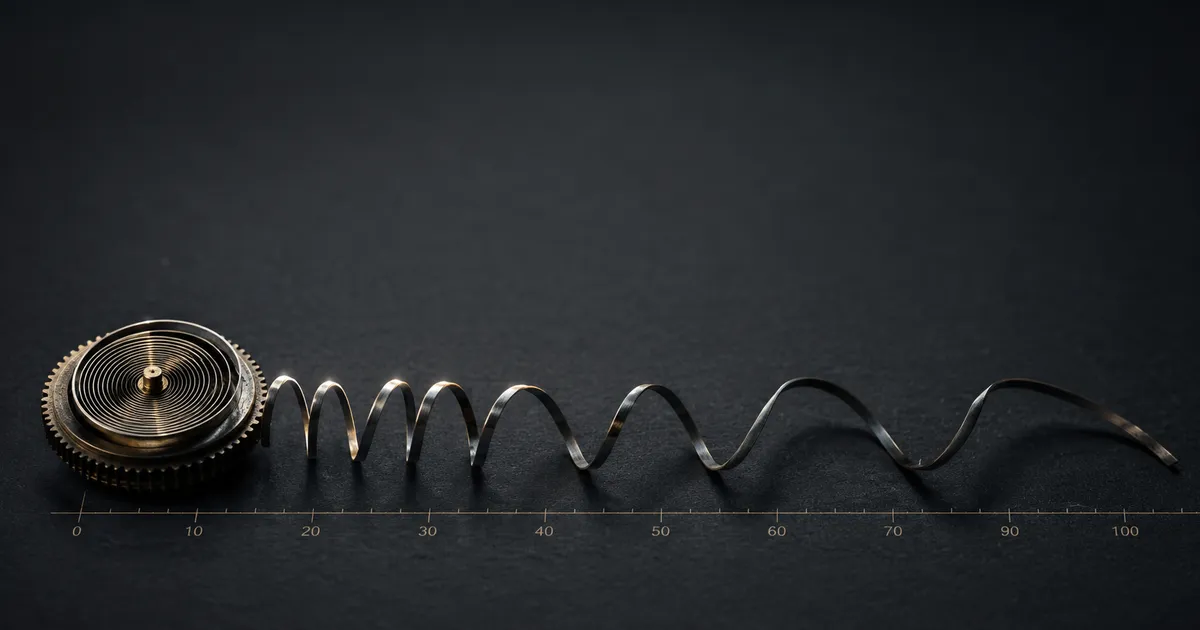
A watch does not receive a steady supply of energy. It receives a mainspring, which is a coiled strip of steel that is furious when fully wound and apathetic by Tuesday. Torque at hour one and torque at hour fifty are not remotely the same quantity. And yet a good movement keeps the same rate throughout, which means the timekeeping is somehow indifferent to the very force that drives it.
Understand that this indifference is not a gift of physics. It is a fight against physics, won incrementally over three centuries by people with very small screwdrivers and no patience for excuses.
Nature does not offer you consistency, only the appearance of it
Galileo is said to have watched a lamp swing in the cathedral at Pisa and concluded that a pendulum takes the same time to swing whether the arc is wide or narrow. It was a beautiful observation and it was wrong. A simple pendulum's period grows slightly with amplitude, an inconvenience called circular error, and Huygens spent real years of his life bending metal cheeks into cycloidal curves to suppress it. The balance spring has its own version of the same betrayal - it is only proportional in theory, so Breguet raised the outer coil above the plane of the spiral in 1795 so the thing would breathe concentrically instead of yanking the balance off centre with every beat.
The lesson arrives early and it stings. Consistency looks natural only after somebody has built the machinery that produces it. Wherever you find a system that performs identically under varying conditions, you are looking at an engineering achievement that has been polished until it resembles luck.
Which is why the phrase "we have a really motivated team" should be treated as a confession rather than a boast. Motivation is amplitude. Rate is what you sell. A team that only performs when freshly wound is not disciplined and not especially committed. It is unregulated. It is a lamp swinging in a cathedral, and somebody is timing it.
The quarter as a mainspring
Consider the shape of your own organisational torque curve, which you already know by heart even if you have never drawn it.
Week one of the quarter is bright and generous. The planning documents are crisp, the code is reviewed properly, the customer calls get written up the same day. Somewhere around week seven the review comments shorten to a single approving emoji. By the final fortnight the company has quietly redefined quality as anything that ships, discounting becomes a personality trait, the risk register goes unread, and a great many things are moved to next quarter with the phrase "for focus".
Then the mainspring is rewound at the kickoff, everyone applauds a deck, and the arc begins again at full width.
If you put a timegrapher on that, you would not describe the organisation as motivated. You would describe it as losing amplitude and gaining error, and you would send it back to the workshop.
The awkward part is that nobody in this cycle is behaving badly. The people are responding rationally to a design that transmits raw spring torque directly into the escapement and then acts surprised when the escapement misbehaves. The variance was designed in. The heroics are the symptom, not the remedy.
Three inventions your operating model does not have
Watchmakers did not solve this with an inspirational offsite. They solved it with hardware, and there are three pieces worth stealing.
The fusée. A tapered cone that the mainspring pulls against through a chain. When the spring is strong it works the narrow end of the cone and gets poor leverage. When the spring is weak it works the wide end and gets excellent leverage. The declining force is converted into constant delivery by geometry alone. The corporate equivalent is a system whose demands scale down as available energy declines - a work in progress limit, a definition of done that does not soften under pressure, an intake process that throttles rather than absorbs. Notice that the fusée does not exhort the mainspring to try harder. It compensates for it.
The remontoire. A small secondary spring, rewound constantly by the main one, which feeds the escapement directly. The precise part of the mechanism never touches the messy part. It sees a buffer. Every functioning engineering organization has some version of this and calls it slack, and every dysfunctional one calls the same thing waste and removes it in the name of efficiency, then spends the saving on incident reviews.
Stop work. The Maltese cross (or a Geneva stopwork for all your watch geeks out there) device that prevents the mainspring from being wound to its extreme, and prevents it from running down to its dregs. It uses only the middle turns, where torque is nearly linear. This is why a movement that physically runs eighty hours is sold as a seventy-hour reserve. The manufacturer declines to sell you the part of the curve where it cannot promise a rate.
Read that again, because it is the most radical idea here. A serious organization publishes a capacity lower than its maximum, on purpose, and refuses to trade on the ragged end of its own power curve. Meanwhile you have committed a hundred and ten percent of your engineering capacity and are calling the planned shortfall a stretch goal.
Being reliably wrong beats being occasionally magnificent (a.k.a. precision vs accuracy)
Here is the part that offends people, so I will be blunt about it.
A watch that loses twelve seconds a day, every day, without deviation, is an excellent watch. You move the regulator once and it is fixed forever. A watch that gains eight seconds on Monday and loses nine on Tuesday is not a watch. It cannot be regulated, because there is nothing stable to regulate. Its average error is nearly zero, and its average error is meaningless. That is the old discussion about accuracy vs precision. No need to reiterate - when you have to choose - and it is a when - you want the latter.
Now apply that to the team that delivers in six weeks when it said four, every single time. That team is a gift. Multiply by one point five and you have a functioning forecast. The team you cannot plan around is the one that hits the date brilliantly twice a year and vanishes into a fog of unforeseen complexity the rest of the time, and it is usually the one collecting the awards, because we reward amplitude and quietly suffer the variance.
Predictability is not the absence of ambition. It is the precondition for it. You cannot compound anything on top of a rate that changes underneath you.
The tourbillon problem
No discussion of horological virtue is honest without mentioning the tourbillon, a mesmerising cage that rotates the entire escapement to average out the effect of gravity in the vertical positions. It is the most admired complication in watchmaking and, in a wristwatch that spends its day swinging around on a moving arm, it solves a problem that has largely already solved itself. It is expensive, especially to service, it is visible through a window in the dial, and it is magnificent.
Your reorg is a tourbillon. So is the new framework, the renamed operating cadence, the fourth attempt at a values workshop. They are beautifully engineered responses to a variance you have not measured, chosen partly because they can be seen from the outside. The unglamorous alternatives - throttling intake, protecting slack, holding the definition of done in week twelve, publishing a capacity below your peak - do not photograph well and cannot be announced at an all hands with any real drama.
There is also an opposite failure that flatters us. Push a balance wheel past roughly three hundred and thirty degrees of amplitude and it begins to rebank, the impulse pin knocking against the outside of the fork, and the watch goes wildly, uselessly fast. Too much energy is not a virtue in a regulated system. It is a different fault with better press.
How the certificate is actually earned
To be called a chronometer under COSC, a movement is tested for fifteen consecutive days, at three temperatures, in five positions. Not on its best day. Not in the lab conditions it prefers. The certificate is a statement about the distribution, not the mean.
So here is a diagnostic worth more than most of what you spend on consulting. Take any measure of quality you claim to care about - defect escape rate, discount depth, time to first response, the proportion of decisions made with data. Plot it by week of the quarter, over four quarters. Do not look at the average. Look at the slope.
If the slope is flat, congratulations. Someone in your organisation has built a fusee and has probably never been promoted for it.
If it droops toward the end, you do not have a motivation problem, a talent problem, or a culture problem. You have an unregulated oscillator, and everything you are about to do to the people involved is a category error.
The balance wheel is not brave. It is not aligned to the mission. It has no personal stake in the fourth quarter. It simply beats at the same rate whether the spring is straining or nearly spent, because somebody took the trouble to make that true.
That is the whole discipline. Not intensity. Not passion. Equal time.