Hype Cycles - Collective Dunning-Kruger
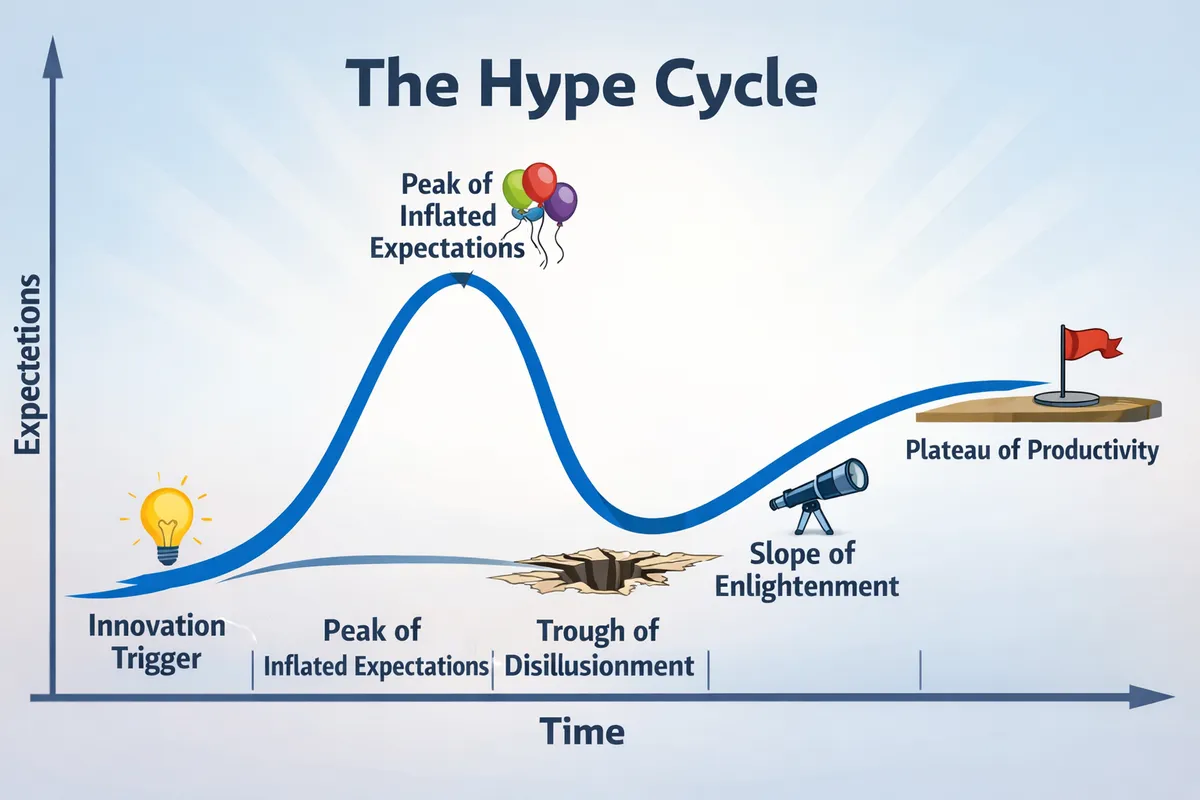
The Gartner Hype Cycle is a graphical representation that illustrates the maturation, adoption, and social application of new technologies. It begins with a “Technology Trigger,” followed by a “Peak of Inflated Expectations,” crashes into a “Trough of Disillusionment,” climbs up a “Slope of Enlightenment,” and eventually levels out at a “Plateau of Productivity.” It is basically the cultural learning curve of groups. This cyclical journey eerily mirrors the Dunning-Kruger effect, a well-documented cognitive bias where people with low knowledge overestimate their competence and those with greater expertise tend to underestimate theirs. When we view the Gartner Hype Cycle as a macro-level manifestation of the Dunning-Kruger effect, it becomes clear how collective overconfidence, underinformed excitement, and gradual maturity shape public and institutional responses to emerging technologies.
From Individual Bias to Collective Delusion
The Dunning-Kruger effect highlights a key psychological truth - ignorance begets confidence. When individuals first encounter a complex subject, their limited understanding can paradoxically lead to inflated self-assurance. This overconfidence peaks early-just like technologies on the Gartner curve. At the societal level, this becomes a collective delusion - early adopters, media pundits, investors, and tech evangelists enthusiastically embrace a technology, assuming it will revolutionize every sector overnight.
Example - Blockchain and Cryptocurrency
We see hype cycles clearly only in hindsight. In the late 2010s, blockchain was touted as a panacea - revolutionizing finance, logistics, voting systems, and even art. Startups raised billions based solely on vague blockchain connections. The public, with limited technical understanding, echoed exaggerated expectations. Predictably, the technology hit the “Trough of Disillusionment” as technical limitations, regulatory issues, and failed pilot projects surfaced. Now, in 2026, blockchain is quietly proving its worth in specific, focused areas like supply chain transparency and decentralized identity—not the sweeping disruption once prophesied.
Hype as Collective Overconfidence
The Peak of Inflated Expectations is the societal equivalent of standing atop Mount Stupid - a term used to describe the initial high-confidence, low-competence stage of the Dunning-Kruger curve. During this phase, the public and media are overly optimistic about a technology’s short-term impact, largely driven by incomplete information and overgeneralized success stories.
The Path to Enlightenment - Mitigating the Dunning-Kruger Effect
Hype cycles will always come and go as technology progresses. Understanding how the Dunning-Kruger effect fuels the Hype Cycle allows us to propose solutions to dampen the curve’s volatility and shorten the journey to true productivity. Some approaches include:
Promote Tech Literacy Early Broad-based education efforts -especially among journalists, investors, and policymakers-can reduce overreliance on buzzwords and encourage more critical evaluation of technologies. The goal is not to dampen enthusiasm but to ground it in reality.
Encourage Skeptical Optimism Critical thinking frameworks, such as Bayesian reasoning or pre-mortem analysis, help professionals better evaluate technological claims. By asking, “What could go wrong?” early on, teams can avoid the trap of overconfidence and design for resilience.
Include Diverse Stakeholders Early Technology hype often blooms in echo chambers of technologists and early adopters. Involving educators, ethicists, regulators, and end-users from the beginning introduces nuance and anticipates real-world barriers to adoption.
Invest in Independent Evaluation Bodies Just as peer review disciplines science, independent technology assessment organizations can offer nonpartisan evaluations that temper irrational exuberance. Gartner itself plays a role here, but deeper technical audits and public interest reviews are needed.
Cutting Through the Hype - A Cognitive Toolkit
To escape the pitfalls of the Hype Cycle, we must build cognitive tools and cultural norms that challenge premature certainty. Here’s how:
Apply “Second-Order Thinking”: Don’t just ask “What’s the benefit of this technology?” Ask “What are the second- and third-order effects if it’s widely adopted?”
Embrace “Epistemic Humility”: Acknowledge the limits of current knowledge and stay open to new data. Experts should model this humility to help set expectations.
Shift from Vision to Use Case - Instead of asking “What can this technology become?” ask “What is it actually doing today?” Grounding expectations in real outcomes reduces distortion.
Normalize Hype Reversion- Teach that disillusionment is not failure—it’s calibration. Technologies can climb out of the trough if we maintain realistic engagement.
Conclusion
The Gartner Hype Cycle reflects not just technological maturity but our collective cognitive bias toward overconfidence, very much aligned with the Dunning-Kruger effect. Recognizing this parallel empowers us to shift from reactive enthusiasm to thoughtful stewardship. By fostering tech literacy, embracing uncertainty, and institutionalizing critical evaluation, we can smooth the hype curve and guide innovation more effectively through the fog of optimism into the light of practical value. Ultimately, this awareness doesn’t stifle innovation - it protects it from its own illusions.