Going full circle
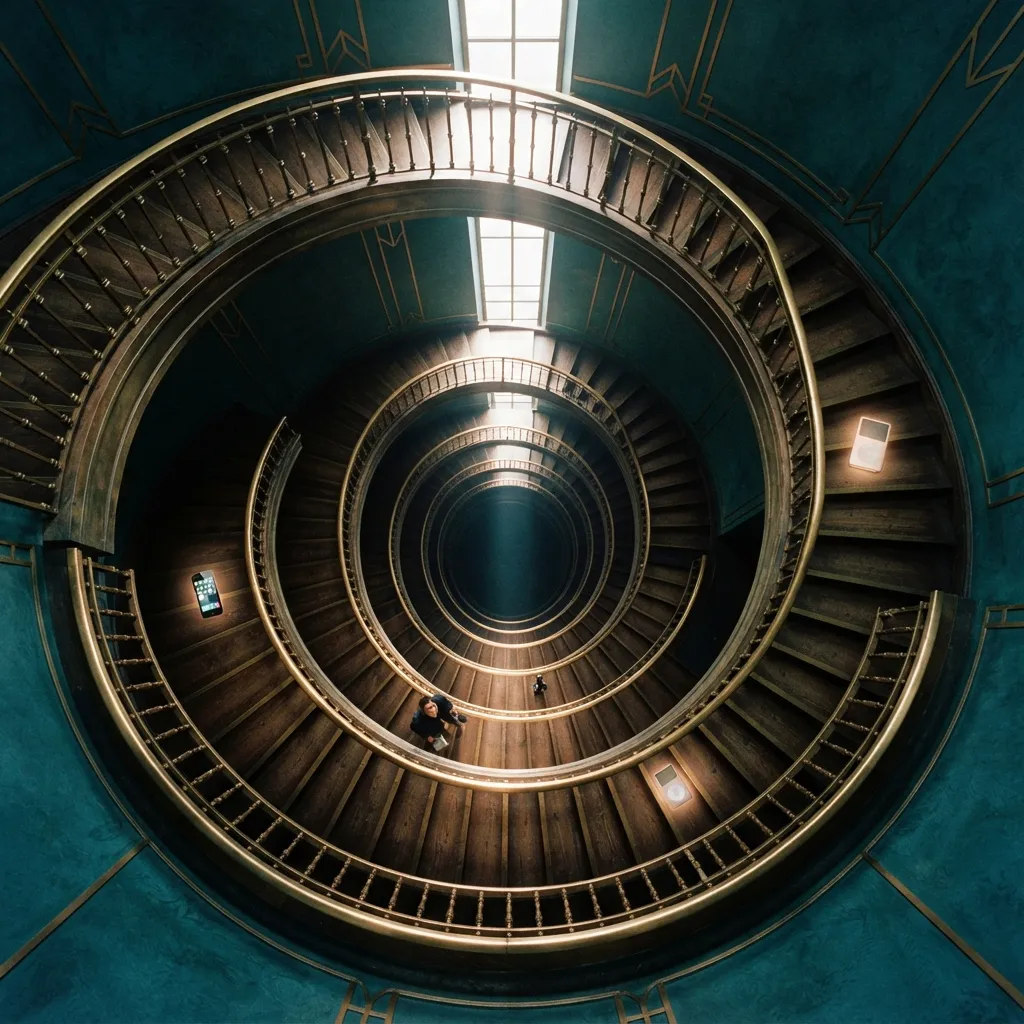
Progress is a spiral staircase, and seen from above it looks exactly like a circle
The Misconception
We like to think progress is an arrow. The old thing dies, the new thing wins, and the loser is filed in a museum next to the fax machine. Every keynote rests on this belief. So does every "X is dead" headline, and by now X has included the mainframe, the network perimeter, the college degree, vinyl, the command line and, on several occasions, hardware.
The cynics hold the mirror image of the same belief. Nothing really changes, it is all fashion, and architectures go up and down like hemlines.
Both camps are having a bad year. Consider four exhibits.
Technologies die. Concepts repeat.
Exhibit A - From iPod to Sudo
In 2001 the iPod did one thing, mostly because it could not do anything else. Then the phone swallowed it, along with the camera, the map, the wallet and most of our evenings, and in 2022 Apple retired the last iPod without a funeral.
In October 2026 a startup called New Matter unveiled Sudo - a music player with a click wheel, a headphone jack and no opinion whatsoever about your inbox, expected at about $250. People are already paying deposits for the right to own a gadget that plays music they own even if it can do less. The limitation has come back as a feature and, like most returning features, it costs extra.
Exhibit B - From moat to zero trust to moat again
For decades network security meant a moat. Hard shell, soft centre, and anyone on the internal network was family. Then laptops, cloud and remote work made the walls meaningless, and from 2010 onward the industry converted to zero trust, whose creed was "never trust, always verify". The perimeter was pronounced dead at roughly every conference for fifteen years.
Now look at how AI agents are deployed in 2026. Each one goes into a sandbox with default-deny networking, a short allowlist for outbound traffic and one powerful, gullible resident who must not be allowed to wander. Call it what you like, it is a wall with a drawbridge. The moat is back. There are thousands of them now, and for the first time the dragon lives on the inside.
Exhibit C - From hardware to software to hardware
In the mainframe era the value was in the iron, and software was the free stuff that came in the box. IBM was so sure of this that it let a small supplier called Microsoft keep the rights to the PC's operating system. For the next thirty years the lesson was that hardware is a low-margin commodity and software is where the value lives. By 2011 Marc Andreessen could announce that software was eating the world, and nobody argued.
Then the most valuable company on Earth turned out to be one that sells chips. Nvidia passed four and then five trillion dollars in 2025, and in early 2026 software stocks shed close to a trillion dollars in little more than a week, as investors wondered what a software business is worth once software writes itself. Hardware is where the value is. Again.
Exhibit D - From vocational education to higher education to vocational education
For most of history you learned a trade by standing next to someone who already knew it. The twentieth century swapped the workshop for the lecture hall, shop class was quietly dismantled, and "go to college" became the only respectable advice an adult could give a teenager.
Now enrollment at America's vocationally focused two-year colleges is up roughly 20 percent since 2020, the press has christened a "toolbelt generation", and parents with master's degrees are searching for what an electrician earns. (quite a lot, it turns out. Somebody has to wire the data centers.)
So progress is plainly not an arrow. But it is not a circle either, because not one of these returns lands in the place it left.
The Question
If we are so clever, why do we keep arriving back where we started?
And since all four exhibits seem to carry AI's fingerprints - is AI the hand that swings the pendulum, or is it just standing next to it looking guilty?
The Explanation
We do not solve trade-offs, we rotate them
Nearly every loop is a pendulum between two poles of a trade-off that cannot be solved, only chosen. General or specialised. Central or distributed. Trust or verify. Bundle or unbundle. Theory or practice. Own or rent.
Each generation optimises hard against the pain it knows, ships the fix, and thereby manufactures the opposite pain for a successor who was not in the room when the first decision was made. Hegel called this thesis, antithesis, synthesis. Engineers call it a refactor. Marketing calls it a launch.
Once you see the pattern, the exhibits multiply.
- Mainframe to PC to cloud - We escaped the central computer in the 1980s, rented it back in the 2010s and called it the cloud. Paying by the token for a slice of someone else's enormous machine is 1960s time-sharing with a nicer logo. Models that run on your own laptop are the return swing, already under way.
- Command line to GUI to prompt - We spent forty years building windows, icons and menus so that nobody would ever again have to type instructions at a blinking cursor. The most advanced interface of 2026 is typing instructions at a blinking cursor. The only difference is that now we say please. It is fitting that the iPod's heir is named after the terminal command for "do as I say".
- Monolith to microservices to monolith - We broke one big application into two hundred small ones, discovered we had merely distributed the mess, and started gluing it back together. Amazon's own video team wrote up a return to the monolith in 2023 that cut the cost of one service by about 90 percent.
- SQL to NoSQL to "just use Postgres" - A fifteen-year journey to the starting line.
- Bundle to unbundle to rebundle - We cut the cable to escape 200 channels and the adverts. We now pay for eleven services, several of them with adverts, and are being offered a convenient bundle. Jim Barksdale once reduced all of business to these two moves, and he was only half joking.
- Integrate to outsource to integrate - Ford's River Rouge plant took in iron ore at one end and pushed out cars at the other. Then came half a century of "focus on your core competence". Today the tech giants design their own chips and go shopping for power plants.
- Bespoke to off-the-shelf to bespoke - Software was once tailored for each customer, then sold ready-to-wear as packages and subscriptions. Now that a decent internal tool costs an afternoon and a prompt, the tailor is back in business.
- Spoken to written to spoken - Socrates grumbled that writing would ruin our memories. We wrote everything down anyway, for 2,400 years. Now we send voice notes, talk to our computers, and universities are reviving oral exams and handwritten papers because an essay can no longer be trusted to have an author.
- Electric to petrol to electric - Around 1900 roughly a third of American cars ran on batteries.
- Leeches - Yes, even leeches. American regulators cleared them as a medical device in 2004.
Abundance flips scarcity
There is a second engine under the first. Value lives wherever the scarcity is. Every technology wave makes something abundant, and money, prestige and attention then migrate to whatever is still scarce - usually the unglamorous thing the previous era had stopped noticing.
Smartphones made functions abundant, so focus became the luxury good. The cloud made connection abundant, so boundaries became precious. Software made distribution free, so compute and electricity became the bottleneck. Universities made degrees abundant, so the person who can actually fix the thing started naming their own price.
That is why the comeback is so often the "boring" side of the trade-off. It was never worthless. It was merely taken for granted.
So where does AI come in?
It depends on the loop, and it is worth sorting them before we blame the robot.
Start with the alibi. Several of these pendulums were already swinging before ChatGPT turned up in late 2022. Trade-school enrollment has been climbing since 2020, pushed by tuition bills and a pandemic. Vinyl has been rising since the late 2000s. Zero trust was itself the return swing of an older loop. The monolith revival predates coding agents. Circles are what trade-offs do, with or without a language model. For the phenomenon as a whole, AI is a correlation.
Loop by loop, though, it plays three different roles.
- The engine - In some loops AI is the direct cause. Hardware matters again because intelligence turned out to be a physical product, manufactured from chips, electricity and cooling water. The bottleneck for transformers is, quite literally, transformers. And the moat is back because zero trust verifies who you are and what you are allowed to do, while an agent that reads one poisoned web page can be talked into anything. Its identity checks out perfectly. Its intentions have been hijacked. When you cannot verify intent, you fall back on walls.
- The accelerant - In others AI pours fuel on a fire somebody else lit. The trades were recovering anyway. AI added the argument that you cannot prompt a burst pipe, plus a data-center boom that needs electricians more than it needs another dashboard. Moravec's paradox supplies the insult - what is hard for people (contract law, calculus) proved easy for machines, while what a toddler does without thinking (crossing a cluttered room, picking up a wet glass) remains hard. We spent a century telling children to work with their heads and not their hands, and then built a machine that is all head and no hands.
- The bystander with a motive - And sometimes AI is a coincidence the story finds irresistible. Nobody reserved a Sudo because of a language model. They did it because the phone became a slot machine with a music app attached. Even here, though, AI is starting to earn its place at the scene. When every feed fills with infinitely generated everything, a small finite library that you chose and own begins to look like wealth.
The roles differ, but one thing sits underneath all three. AI is the largest abundance shock in a generation, and it is aimed at the single resource that almost every modern institution assumed was scarce - competent thinking on demand. Degrees, software licences, written work, credentials, the trust we extend to a stranger on a video call - all were priced on that assumption. Any pendulum whose pivot was "thinking is expensive" has been shoved at the same moment.
So the best word is neither driver nor correlation. It is synchroniser. AI did not invent the pendulums - it shook the wall they all hang on. That is why 2026 feels as if everything is going full circle at once.
One last irony. AI is itself a full circle. Neural networks were proposed in the 1950s, written off in 1969, buried through two winters, and then came back to swallow the field that had buried them. The symbolic school tried to teach machines the way a university would, with rules and theory. The approach that won trained them like apprentices, by example, imitation and endless practice. The machines, it turns out, had a vocational education.
It is a staircase, not a circle
Look closely and no return lands where it started.
The moat is back, but it surrounds each agent instead of the whole castle, and it exists to keep the dragon in. Hardware is back, not as beige boxes but as the scarce raw material of intelligence. Vocational training is back, but the apprentice carries a tablet and may be wiring a data hall. The single-purpose player is back, but it streams, charges over USB-C and was chosen rather than imposed.
That last point is the signature of a spiral - the old constraint returns as a deliberate choice. The first time we did it because we had to. The second time we do it because we finally understand why it was a good idea. And the loops run deeper than they look. The medieval university was itself a trade school, built to turn out priests, lawyers and physicians.
None of this means the returning idea is right forever. The swing will overshoot, as it always does. Somewhere a consultant is already drafting a keynote called "The Sandbox Is Dead".
A short field guide
- Name the trade-off, not the trend - "Zero trust" and "the moat" are two positions on one dial. Ask where the dial is now and what is pushing it.
- Ask what just became abundant - Then go and stand next to its complement. That is where the value is heading.
- Read the obituaries - Whatever has just been declared dead is in rehearsal for its comeback tour.
- Keep someone who remembers why you left - They are cheaper than relearning it.
And if you are reading this in 2036 on a single glorious device that does everything, inside a network with no walls, having just been told that the real money is in software and that every child needs a philosophy degree - welcome back. We kept your seat warm. Mind the step. It is one floor higher than you remember.