Escapement, Yeast, and Trim - Three Ways to Stop Steering
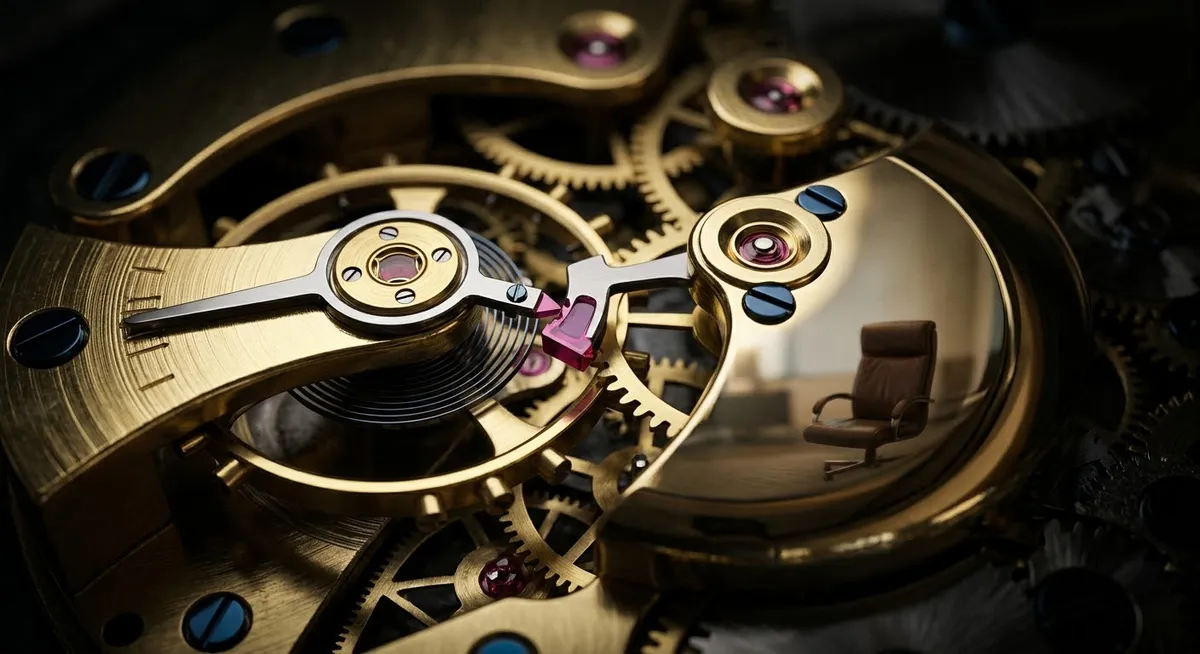
Escapement, Yeast, and Trim or Three Ways to Stop Steering
There is a particular kind of executive who is never not needed. Ask them how the quarter is going and they will tell you, with the weary pride of a field surgeon, that they are "in the weeds right now" - as though the weeds were weather rather than landscaping. They arbitrate every trade-off. They are copied on everything. Their calendar looks like a ransom note. And their organization, which cannot go four days without them, is offered as proof of how essential they are.
It is proof of something. Just not that.
A mechanical watch, a fermenter full of yeast, and an aircraft in trim all share a property that most companies do not. They keep doing the right thing while nobody is touching them. Not because they are simple, and not because they are lucky, but because somebody did the regulating in advance and then had the discipline to take their hands off. Three different fields, three different centuries, one identical insight - continuous intervention is what you pay when you skipped the design.
One - The Escapement, or Why Your Watch Is Not a Spring in a Box
The mainspring inside a mechanical watch has exactly one ambition, and it is not punctuality. It wants to release all of its energy immediately, in a single joyful convulsion, and then be finished. Left to its own devices it would unwind in under a second and tell you the time was "all of it, at once." Which, to be fair, is how most quarters end.
What stands between that spring and chaos is the escapement - a tiny toothed wheel and a pallet fork that let the gear train advance one increment, stop, and advance again. Tick. That is the whole trick. The escapement does not generate energy and it does not decide what time it is. It decides how fast energy is allowed to leave the system, and it makes that decision the same way every time, several times a second, for decades, without being asked.
Two things follow, and both are inconvenient.
The first is that cadence is a design object, not a personality trait. Most leaders regulate energy release manually - by being in the room, by being the person who says "not yet" or "go," by being the human pallet fork. It works, in the sense that a bucket brigade works. But a watch that runs only while you shake it is not a watch. It is a wrist. If your release cadence, your escalation thresholds, your decision rights, and your limits on work in progress live in your head rather than in the mechanism, then you have not built a company. You have built an impression of one, in which you are the load-bearing wall and also the tour guide.
The second is subtler. The escapement is the least glamorous component in horology. Nobody buys a watch for the pallet fork. Nobody has ever been promoted for the calm nonoccurrence of a crisis. The mechanism's entire value proposition is that it makes nothing interesting happen, evenly, forever - and that is precisely the kind of contribution our recognition systems are structurally incapable of seeing. We hand out medals for the rescue and not for the guardrail, then wonder why we have so many people who are magnificent in emergencies and mysteriously surrounded by them.
And note what the escapement does not do. It does not remove your job. Somebody still has to wind the watch. Winding is energy, context, capital, attention, direction. That is leadership. Reaching in to nudge each individual tooth is not leadership, it is a repetitive strain injury with a title.
Two - Yeast, or the Humility of the Boundary Condition
Here is a sentence that should be embroidered on more office walls. You do not ferment beer. Yeast ferments beer. You are catering.
The brewer's actual job happens before anything alive enters the vessel. Sanitize obsessively. Get the wort composition right. Oxygenate. Pitch a healthy culture at sufficient cell count. Hold the temperature in a narrow band. Then - and this is the part that separates brewers from anxious hobbyists - go away. For days. While the most important process in the building happens with no supervision whatsoever.
The hobbyist cannot do this. The hobbyist opens the fermenter to check. Every time they check, they let in contamination, disturb the protective blanket of carbon dioxide, and learn approximately nothing they could not have read off a thermometer. Their intervention is not care. It is anxiety wearing the costume of care, and it is measurably worse than absence.
The corporate translation is unflattering. Most management is lid-lifting. The status ping, the "just checking in," the review that adds a week and changes nothing, the surprise deep dive into a project that was fine - each one is a small breach in the seal, justified as diligence, priced as interruption.
Meanwhile the real lever went untouched. Yeast under stress does not stop working. It works badly in specific, diagnosable ways - too warm and you get fusel alcohols that taste like solvent, wrong pitch rate and you get esters nobody ordered, and none of it can be corrected later by caring very hard. You can taste the temperature of the fermenter in the finished beer. You can also taste a leader's anxiety in a team's output, and the flavor notes are remarkably consistent - defensive documentation, sandbagged estimates, decisions escalated for cover rather than for judgment, an unmistakable hint of solvent.
Then there is the last elegance, which is self-limitation. Yeast produces alcohol, alcohol eventually inhibits yeast, and fermentation attenuates on its own. The mechanism contains its own stopping condition. Almost nothing in corporate life does. Initiatives do not attenuate. Meetings do not attenuate. Reporting requirements have never once, in the recorded history of commerce, run out of sugar and gone quiet. If you want something to end, you have to design the ending in at the start, while everyone is still excited and no one wants to talk about death.
Three - Trim, or the Difference Between Strength and Fatigue
An aircraft out of trim is perfectly flyable. This is the whole problem.
Trim tabs relieve the pressure a pilot must hold on the controls so the aircraft maintains its attitude by itself. Set correctly, you can take your hands off and it holds. Set incorrectly, nothing dramatic happens - you simply have to push or pull constantly to stay level. And you can. For a while. What you cannot do is push constantly and navigate, and monitor fuel, and talk to air traffic control, and have any reserve left when something actually goes wrong. Out of trim does not cost you altitude. It costs you attention, and it takes the payment in a currency you do not notice spending until you need it.
There is your appraisal criterion, and it is a cruel one. The leader holding constant pressure on the yoke is not demonstrating strength. They are demonstrating an untrimmed aircraft and a tiring pilot, and those are the same sentence written by different departments. The heroic manager and the badly designed system are not opposites. They are a matched pair, and one is the reason the other gets promoted.
Trim also teaches the caveat, which matters more than the rule. It is not permanent. Burn fuel, drop the gear, change configuration, and you must trim again. Regulation is not a monument, it is a maintenance habit. Reorganize, double headcount, change market, and the escapement you built last year is now quietly wrong while everyone insists the process is working because it is written down.
And sometimes you do want your hands on the controls - takeoff, landing, turbulence, genuine emergency. Nobody sensible trims through a stall recovery. The tell is not whether someone hand-flies. It is whether they claim to be permanently on takeoff. Three years of continuous emergency is not an emergency. It is a climate, and you built it.
The Failure Modes, Since Regulation Is Not a Religion
Every mechanism in this essay can kill you, which is the honest part.
An escapement can seize. Process built for metering becomes process built for delay, and the change advisory board that once prevented outages now prevents change, ticking with tremendous regularity toward nothing. A fermenter can be infected - hire without selection, leave the culture unattended, and you get a vigorous, self-sustaining, thoroughly wrong flavor that no amount of later intervention removes. And trim can run away, which is the most corporate death of all. The metric that was supposed to hold the nose level keeps pitching it down, everybody can see the ground, and nobody has the authority to disconnect the system because the system is the strategy now.
So the discipline is not "set it and forget it." It is "set it, instrument it, and know exactly how you would switch it off."
The Test You Will Not Enjoy
Take two weeks off. Real ones, phone in a drawer.
If the organization stalls, you did not build a mechanism, you were the mechanism, and the tribute paid to your indispensability was an invoice. If it runs slightly better, that is also data, and the honest response is curiosity rather than a reorg on your first morning back. If it simply keeps ticking, evenly, boringly, and nobody quite notices you were gone - congratulations. You have done the highest form of the work, and there will be no applause, because the applause is reserved for people rescuing organizations from problems you spent years quietly making impossible.
The watchmaker is not in the watch. The brewer is not in the beer. The trim tab does not fly the plane. Build the escapement, hold the boundary conditions, relieve the control pressure - and then have the nerve to be uninteresting while it works.
Tick.