Drake Equasion for Careers
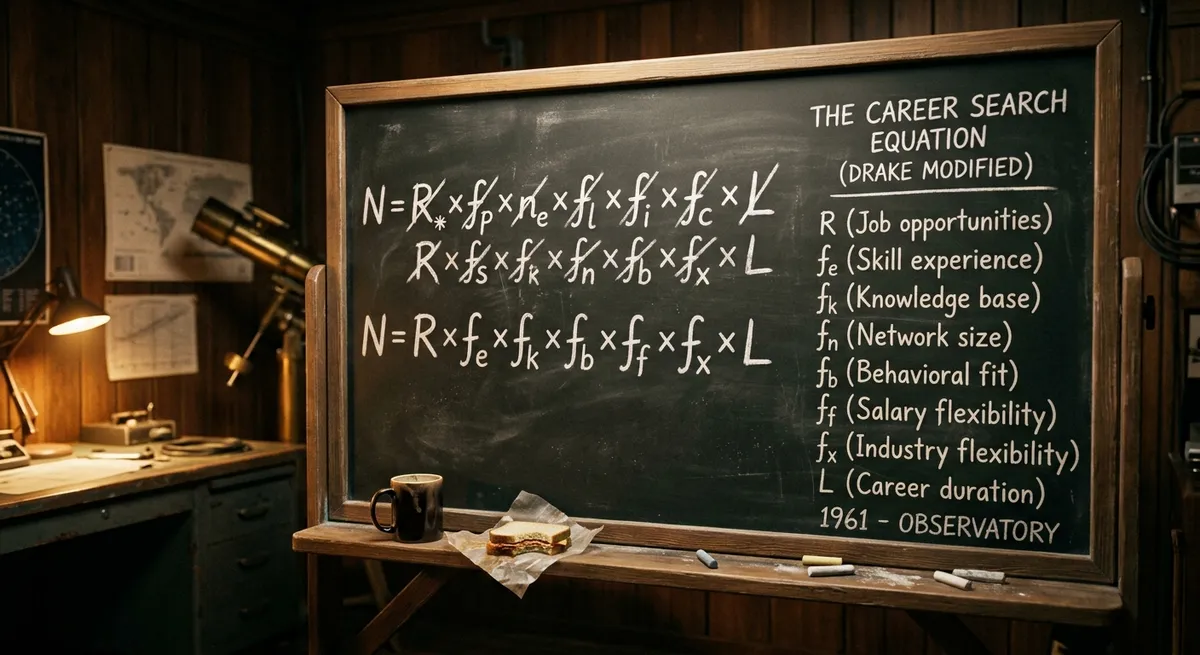
Or, why the universe is probably full of brilliant people nobody has heard of
Most people believe a successful career progresses linearly. You get the job, you land the promotion, you ship the thing, you make partner, you exit. One big bang, and then the light of your reputation travels outward forever.
This is why so many talented people stare at the night sky of LinkedIn and feel that peculiar loneliness. The sky is full of stars. Some of them are clearly inhabited by people doing interesting things. And yet, from where you are sitting, there is only silence. No signal. No contact. Where is everybody?
The mistake is not ambition. The mistake is thinking success is one number you either have or do not have, rather than a product of many smaller numbers, some of which were handed to you at birth and most of which you can nudge.
In 1961, a radio astronomer wrote an agenda on a chalkboard and accidentally invented one of the most famous formulas in science. That got me thinking - can the same trick tell us how many career-defining moments a person should expect in a lifetime, how much of that was decided before they could walk, and which lever is actually worth pulling?
A brief history of a very humble equation looking into a grand question
Frank Drake was 31, working at the National Radio Astronomy Observatory in Green Bank, West Virginia. The year before, he had pointed an 85-foot dish at two nearby stars and listened for anything that sounded deliberate. He called it Project Ozma, after the princess of Oz, because scientists in 1960 were allowed to be whimsical. He heard nothing, which was expected, and he was asked to convene a small meeting about whether listening was worth doing at all.
The guest list called for a group photo and probably a t-shirt with it afterwards. Carl Sagan, then 26. Melvin Calvin, who found out mid-meeting that he had won the Nobel Prize in Chemistry and was promptly handed champagne. Philip Morrison, who had helped build the atomic bomb and then spent the rest of his life trying to talk to aliens instead. John Lilly, who was convinced dolphins were trying to talk to us and whose presence inspired the group to name themselves The Order of the Dolphin.
Drake needed to organize three days of conversation among people who agreed on almost nothing. So he did what any decent host does. He wrote the questions on the board in the order they needed to be answered, and the questions happened to multiply (as you add probabilities ☺️).
N = R* × fp × ne × fl × fi × fc × L
The number of detectable civilizations in our galaxy equals the rate of star formation, times the fraction of stars with planets, times the number of habitable planets per star, times the fraction where life appears, times the fraction where that life gets clever, times the fraction where the clever life builds radios, times the number of years those radios stay on.
Drake never claimed to know the answer. The equation was the agenda, not a result. In 1961 only the first term could be estimated with any confidence, and the rest were educated shrugs. Sixty-five years later we have nailed down two more terms (planets are everywhere, and plenty of them are the right temperature) and the remaining four are still shrugs, just better-dressed ones. Depending on who you ask, N is somewhere between "we are alone" and "the galaxy is a crowded subway car", and both answers have respectable defenders.
The genius of the Drake equation is that it takes one unanswerable question and breaks it into seven answerable-in-principle ones. It converts awe into a to-do list. Which is exactly what your career needs.
The Drake equation for careers
Let W be the number of career-defining wins you should expect over a working life. A career-defining win is any moment after which your options are permanently larger than they were before. A promotion that changes your title but not your options does not count. A side project that gets you an offer you never applied for does. So does the stranger at a wedding who becomes your co-founder.
W = R × fe × fk × fn × fb × ff × fx × L
Eight terms. Like Drake, we will go in the order they must be answered, and like Drake, we will be honest about which ones are measurements and which ones are shrugs.
R - the rate of opportunities forming in your corner of the universe
This is star formation, and it is the term you had the least say in. R is set, overwhelmingly, by a lottery that was drawn before you were born. Which country. Which city. Which decade. Which family. A child born in 1995 to two software engineers in a city with a university and a venture fund is standing inside a nebula, with new roles, new companies and new problems condensing out of the gas every month. A child born the same year, with the same raw talent, in a part war-torn part of the world is standing in a void.
Nobody likes to put this term first, because it is embarrassing to the successful and discouraging to everyone else. But Drake put star formation first because everything else is a fraction of it, and the same is true here. The brilliant dish pointed at an empty patch of sky hears nothing. The honest move is not to pretend the lottery did not happen. It is to notice that R is the one term you can change by moving, which is why every great migration in human history was, among other things, a mass re-rolling of R.
fe - the fraction of those opportunities your education makes legible
Education is the planet-finding telescope. It does not create opportunities, it reveals them, and it reveals different ones depending on the instrument. A degree is partly knowledge, partly a password, and partly a map that shows you doors you did not know were doors. The uncomfortable part is that fe is heavily pre-loaded by R. The quality of the school (or more importantly the teachers you meet) at age seven, whether anyone at home had been to university, whether the dinner table included words like "internship" or "equity" - all of that is in the lottery ticket. The good news is that fe keeps moving all your life. The most expensive education is the one you stop at 22.
fk - the fraction you actually know how to do
Credentials and knowledge are not the same number, and the gap between them is where careers quietly die. fk is the habitable zone of your real skills, the fraction of visible opportunities that are not too hard, not too easy, and genuinely within reach. It is the term people most enjoy improving, because improving it feels like progress and comes with certificates, badges and cheerful announcements. Just remember that a planet in a perfect orbit around a star nobody is looking at is, for all practical purposes, a rock. Knowledge is necessary and spectacularly insufficient.
fn - the fraction you hear about through people
Here is the dirty secret of astronomy. Most discoveries are not made by the telescope. They are made by someone at the next desk mentioning something odd in their data. fn is your personal network, and it is the single most lopsided term in the whole equation. Some people are born into a network. Their parents' friends run things. A summer job is a phone call. For everyone else, fn starts near zero and is built, slowly and slightly awkwardly, by walking into rooms without a specific reason, asking people what they are working on, and then actually listening. Weak ties beat strong ones here. The acquaintance who knows a different galaxy is worth more than the friend who orbits your own.
fb - the fraction where they already know who you are
A civilization can be brilliant and never build a radio. A person can be brilliant and never be findable. fb is personal brand, a phrase that makes thoughtful people wince, so let us define it without the wincing. It is the fraction of opportunities where, when your name comes up, the other person has already heard it attached to something good. That is all. It is not shouting. It is leaving a trail of artifacts - essays, code, talks, a reputation for a specific kind of competence - at a frequency the receiver is tuned to. The "just do good work" crowd pretends this term does not exist. The influencer crowd pretends it is the only one. Both are shrugs dressed as certainty.
ff - the fraction you can afford to say yes to
This is the term polite conversation leaves out. Opportunities have a price of admission, and it is usually paid in runway. The unpaid internship. The startup that cannot pay for six months. The year of retraining. The move to the expensive city where R is high. The ability to turn down the safe offer while waiting for the right one. ff is the fraction of opportunities you can financially survive attempting, and at the start of a career it is almost entirely a function of family. A parent who can cover rent for a year is not a footnote. In this equation that parent is a multiplier applied to every other term. People who had ff near one at 22 tend to remember their careers as a series of brave decisions. People who had it near zero remember a series of sensible ones. Both are telling the truth.
fx - the fraction you actually execute
Complex life appearing on a habitable planet is, as far as we know, the rarest step in the cosmic chain. It is also the rarest step in careers. Seeing the opportunity, being able to afford it, being qualified for it, and then doing the thing are separate events, and the last one has a dismal conversion rate. Everyone has a draft. Everyone has a half-built project, a pitch deck for a company that exists only in a Notes app, an email they meant to send. fx is the fraction of attempts that leave the lab. The honest shrug here is enormous, and it is also the term least correlated with the birth lottery. Rich or poor, well-connected or not, most people ship about one attempt in ten.
L - the number of years you stay in the game
Drake always said L mattered most and was known least. A civilization that broadcasts for a century and then nukes itself contributes almost nothing. One that broadcasts for a million years dominates the galaxy's statistics even if it is alone. The same arithmetic governs careers. Burnout, boredom, and the slow drift into a job that pays just enough to never leave all shorten L. The person with mediocre values for every other term and an L of forty years will, on average, accumulate more career-defining wins than the comet who flames out at 32. Longevity is not a consolation prize. It is a multiplier applied to everything else, and it is the term the lottery touches least.
Let us run the numbers, badly, in the proud tradition of Drake ☺️
Take two people with identical talent and identical work ethic. Call them Planet A and Planet B.
Planet A was born in a dense city to parents who went to university and could cover a year of rent for them.
- R, 60 meaningful opportunities a year drift by
- fe, education makes 40 percent of them legible, so 24
- fk, 60 percent are within real skill, so about 14
- fn, they hear about half of those through people, so 7
- fb, in a quarter of cases someone already knows their name, so about 1.8
- ff, they can afford to attempt 80 percent, so about 1.4
- fx, they execute on 1 in 10, so 0.14
- L, 30 years
W ≈ 4.2 career-defining wins.
Planet B was born in a quiet town (not considering the worst case here) to parents who did not finish school and could not help with rent.
- R, 15 opportunities a year
- fe, 20 percent legible, so 3
- fk, the same 60 percent, so 1.8
- fn, hears about 15 percent through people, so 0.27
- fb, nobody knows the name yet, 5 percent, so 0.0135
- ff, can afford to attempt 30 percent, so 0.004
- fx, the same 1 in 10, so 0.0004
- L, 30 years
W ≈ 0.012 career-defining wins.
Read that again. Same talent. Same effort. One expects about four wins and the other's chances are a rounding error - basically going a lifetime without a single one. Three hundred and fifty times apart, and not one of the terms that differ is a character flaw. This is the Fermi paradox of careers, solved. The galaxy is teeming with intelligence and you hear almost none of it, because signal requires a chain of eight things to all go right, and the first several links are forged before the civilization is old enough to hold a spoon.
Now the hopeful part, because Drake was an optimist and so am I - what use is there to grumble against your circumstances beyond yourself - make something about the ones that are in your hands. Watch Planet B move the terms the lottery does not own.
- Move to where R is 40 instead of 15 (a city, a different industry, an online field where geography matters less)
- Spend ten years building fn from 15 percent to 40 percent by being the person who asks what everyone is working on
- Leave a trail of public work until fb rises from 5 percent to 25 percent
- Build a modest cushion so ff rises from 30 percent to 60 percent
- Raise fx from 1 in 10 to 3 in 10 by shipping ugly things on purpose
- Stay in the game for 40 years instead of 30
W climbs to roughly 3. Not Planet A's 4.2, and not with Planet A's ease, but the same order of magnitude. The lottery decides your starting galaxy. It does not get a vote on fx or L, and those two terms, compounded over decades, are worth more than the luck of the draw.
What the equation is really for
The Drake equation has never found an alien. It has, however, organized sixty-five years of searching, funded several telescopes, and ended more than one dinner-party argument by replacing "I feel like we are alone" with "which term do you think is small?"
That is its gift to careers too. The next time you feel the great silence, do not ask whether you are talented. That is the N question, the unanswerable one. Ask the Green Bank question instead. Which term is small? Were you born in a dead galaxy, and have you considered moving? Is your education showing you the wrong doors? Do you know things, or do you have certificates? Does anyone outside your orbit know what you do? Can you afford to say yes, and if not, what cushion would change that? Are you drafting instead of shipping? Are you about to quit?
Pick one term. Make it less of a shrug. Ideally pick one the lottery does not own.
Frank Drake pointed his dish at the sky in 1960 and heard nothing. He kept listening for the rest of his life. He died in 2022 at 92, still convinced the signal was out there, still cheerfully unable to prove it.
Understand your Drake equation and choose the terms you can influence before blaming the universe. Stay optimistic.