Did AI Kill Agile?
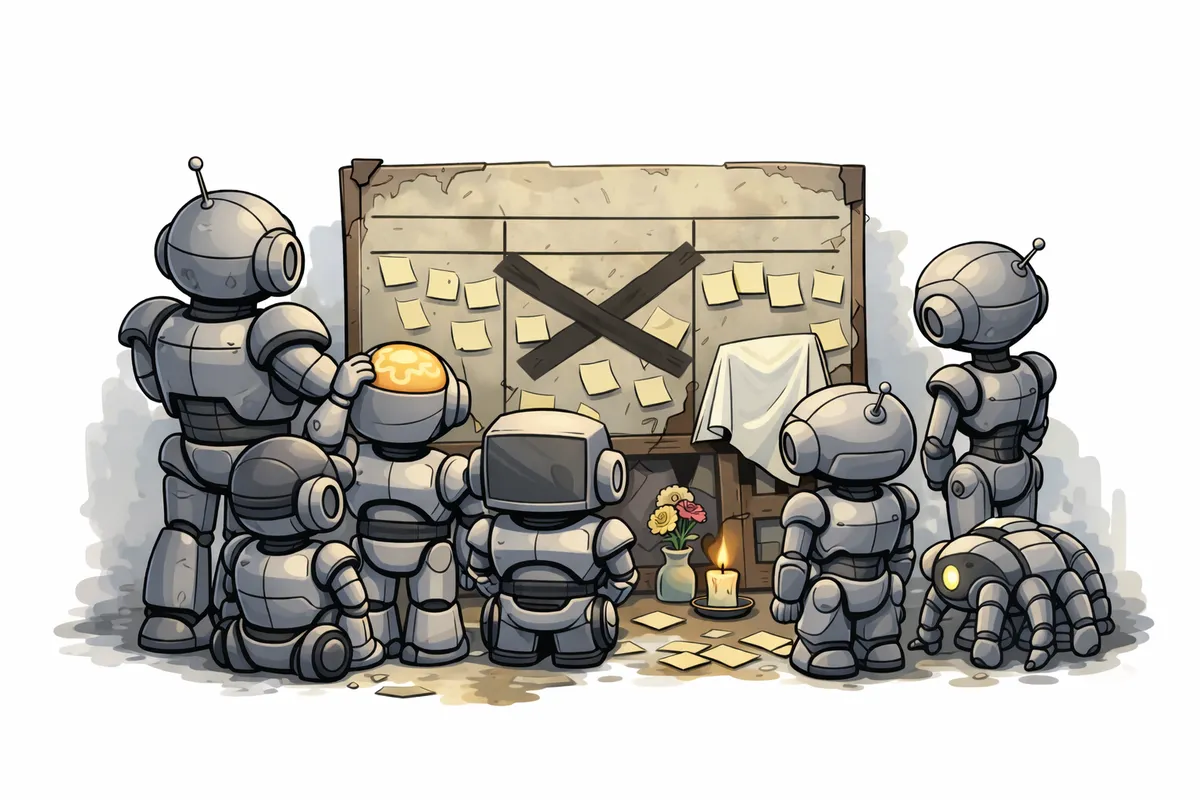
For two decades, Agile has been the dominant story we told ourselves about how modern software gets built. Small teams. Fast feedback. Continuous learning. Humans collaborating closely with users to discover what to build next.
Then AI showed up.
Not as a better Jira plugin.
Not as a faster stand-up facilitator.
But as something more unsettling - a system that can design, build, test, refactor, and ship—often without waiting for human consensus.
So it’s fair to ask the uncomfortable question:
Did AI kill Agile?
Or did it simply expose what Agile had already become?
What Agile Was Supposed to Be
Agile began as a rebellion.
Against:
- Big upfront design
- Rigid phase gates
- Centralized control
- Pretending we knew the future
Its core insight was simple and radical: software development is a learning problem, not an execution problem.
So we optimized for:
- Short cycles
- Human conversation
- Adaptation over prediction
- Teams thinking, not just doing
Agile assumed scarcity:
- Scarce information
- Scarce feedback
- Scarce ability to change code cheaply
That assumption mattered.
Because Agile only makes sense when humans are the bottleneck.
What Agile Became
Over time, Agile hardened into process.
- Ceremonies replaced conversations
- Velocity replaced outcomes
- Backlogs replaced curiosity
- “Agile transformations” replaced learning
Most teams today aren’t learning fast.
They’re executing rituals efficiently.
Ironically, Agile scaled best where its original constraints were weakest - large organizations optimizing predictability, not discovery.
By the time AI arrived, Agile was already brittle.
AI Breaks Agile’s Core Assumption
AI doesn’t just speed up Agile tasks.
It removes the bottleneck Agile was designed around.
AI can:
- Generate working code in seconds
- Explore multiple designs in parallel
- Run experiments continuously
- Refactor without fatigue
- Simulate users
- Detect patterns humans miss
This collapses iteration cost dramatically.
When iteration is cheap:
- Sprints feel slow
- Backlogs feel artificial
- Planning feels ceremonial
- Stand-ups feel, well, adorable
Agile optimized for human learning speed.
AI operates at machine execution speed.
That mismatch is existential.
The Real Thing AI Killed
AI didn’t kill Agile practices. It killed Agile’s center of gravity.
Specifically:
- The idea that teams need structured cadence to learn fast
- The idea that humans must manually translate intent into code
- The idea that uncertainty is primarily resolved through meetings
When AI can generate, test, and revise faster than teams can discuss, the discussion stops being the engine.
Why “AI + Agile” Is a Trap
Many organizations respond by saying:
“We’ll just use AI within Agile.”
That sounds reasonable - and misses the point.
This is like saying:
"We we will equip all harvest workers with a robotic arm to hold their sickle. We don't need these huge combine harvesters."
You get local efficiency gains. You miss the system-level shift.
AI doesn’t fit neatly into:
- Sprint boundaries
- Story point estimation
- Predefined roles
- Static roadmaps
Because AI changes how decisions are made, not just how fast work gets done.
What Comes After Agile
What replaces Agile isn’t a framework.
It’s a different mental model.
From Iteration to Continuous Exploration
No sprints. No batches.
Instead:
- Always-on experimentation
- Rapid hypothesis generation
- Continuous deployment by default
The unit of progress isn’t a story. It’s validated change.
From Teams to Systems
Humans don’t "build everything" anymore.
They:
- Set intent
- Define constraints
- Validate outcomes
- Steer direction
AI does the bulk of execution.
The team becomes a control system, not a production line.
From Planning to Steering
Roadmaps assume we choose a path and follow it.
AI systems work better when we:
- Define goals
- Monitor signals
- Adjust in real time
Think navigation, not planning. Autopilot, not itinerary.
From Process to Judgment
When execution is cheap, taste becomes expensive.
The most valuable skills shift toward:
- Product judgment
- Experimenting with new features quickly through data on user behavior
- System design
- Deciding what not to build
These were always important. Now they’re dominant.
Agile’s Final Gift
Agile isn’t useless. But it may be complete.
Its greatest contribution isn’t Scrum or Kanban. It was the idea that:
Building software is learning under uncertainty.
AI doesn’t invalidate that idea. It amplifies it. It gives us the ability to accumulate validated learning faster.
Agile taught us to adapt.
Now we have to practice it-without the framework that once defined it.
So… Did AI Kill Agile?
Not exactly.
Agile was a spotlight showing us a way. AI just turned on the lights.
What’s coming next won’t be called Agile. It won't have certifications. It won’t have ceremonies.
It will feel uncomfortable. Messy. Fast.
And very familiar to anyone who remembers what Agile was trying to be in the first place.