Coffin Corner
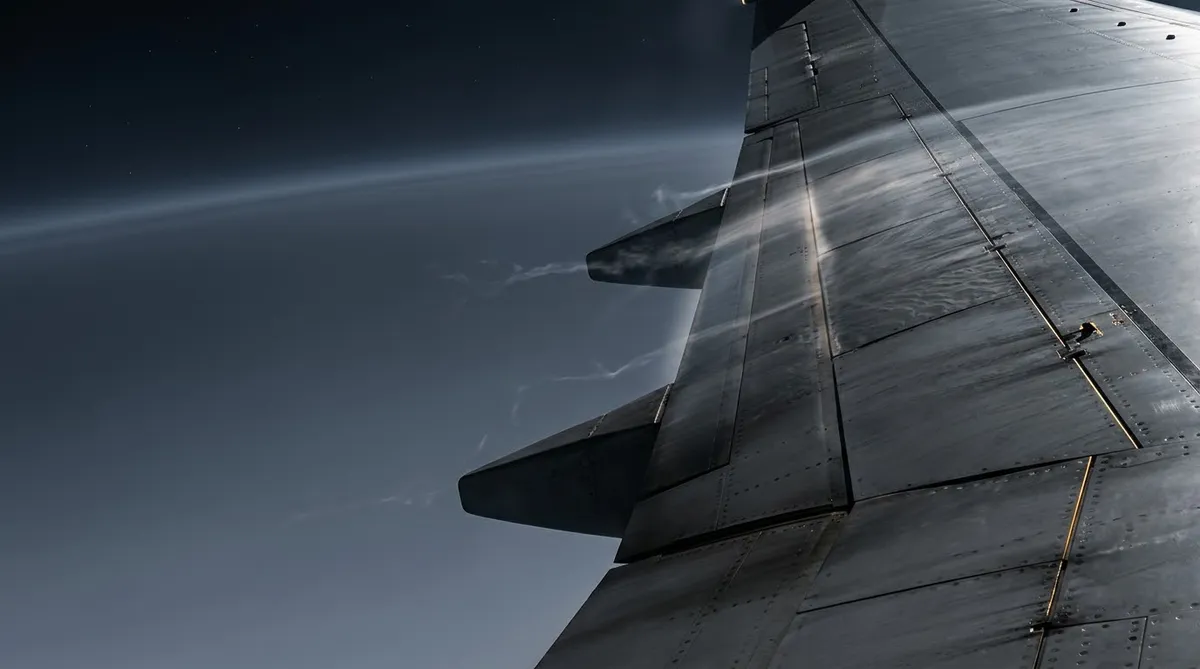
At around seventy thousand feet, a U-2 pilot flies with a handful of knots between the speed below which the wing stops working and the speed above which the wing stops obeying. Both walls are made of air. Both are fatal. The men who flew it named the place where those walls converge the coffin corner, which tells you roughly everything about how test pilots handle branding.
Scaling companies live there too, and unlike the pilots, most of them do not know the number.
The physics, briefly and without flattery
Climb, and the air thins. To hold the same weight aloft, the wing must move faster through fewer molecules, so the true airspeed required to stay flying keeps rising. That is the floor, and it comes up to meet you.
Now the ceiling. The high-speed limit is not the speed of sound. It is critical Mach - the speed at which airflow over some small unhappy patch of the wing first goes supersonic locally, while the aircraft as a whole is still comfortably subsonic. Thin air forces the wing to a higher angle of attack to make the same lift. Higher angle of attack accelerates the air harder over the upper surface. Which means the local sonic point arrives at a lower flight speed. The ceiling comes down.
Read that again, because it is the whole argument. The same condition that raises the floor lowers the ceiling. You are not squeezed by two independent problems. You are squeezed by one problem wearing two hats.
Cross the ceiling and a shock wave forms on the wing. Flow separates behind it. The airframe shudders. Elevator authority bleeds away because the control surface is now sitting in air that has stopped taking messages. The nose tucks under as the centre of pressure marches aft, and the intuitive response - pull back - deepens the tuck. Pull harder and the wing, already at high angle of attack in thin air, hands you the other wall instead.
Also worth noting - at high Mach the wing's maximum lift coefficient quietly degrades, so even the floor is less fixed than the textbook implies. And thrust available shrinks with altitude, so whatever margin you have left, you have it slowly.
There is exactly one dependable recovery. Descend. Spend the altitude, buy back the air.
The translation
| In the air | In the company |
|---|---|
| Altitude | Valuation, headcount, the story you tell |
| Air density | Gross margin and the density of real demand |
| Lift | Customers who actually want the thing |
| Angle of attack | Effort required per unit of growth |
| Stall | Irrelevance |
| Critical Mach | The limit of your control authority |
| Buffet | The shudder everyone feels and nobody names |
| Thrust available | Cash you generate rather than raise |
| Load factor | How many things you are changing at once |
| Descent | Narrowing the portfolio on purpose |
The low-speed wall is the one every founder fears and every board understands. Below a certain rate of motion, a company stops generating lift. Capital drifts elsewhere, the best engineers take the call from the recruiter, partners stop returning emails, and the market performs the cruellest trick in commerce - it forgets you are still open. Irrelevance is not a gentle death. It is just a quiet one.
The high-speed wall is the one almost nobody instruments, because from inside it feels like winning. The tell is not that things go wrong. Things go wrong at every speed. The tell is that pulling the controls does nothing. Leadership announces a priority. Eight weeks later the priority is a slide. Decisions get made twice, in different rooms, with different outcomes, and both rooms are certain. Pricing depends on which representative answered the phone. Nobody can recite the roadmap, including the person who owns it. Headcount is being added faster than culture can be transmitted, so the company is now a federation of alumni from three previous companies conducting a polite war of dialects.
And then the Mach tuck. The instinctive fix at this point is more oversight - more reviews, more process, more governance, a steering committee for the steering committees. Pulling back on a company past its control limit steepens the descent. The extra process consumes the exact coordination capacity that was already the binding constraint. Congratulations, you have added weight to solve a lift problem.
Service ceiling and the lie of the absolute ceiling
Aviation distinguishes the service ceiling, where the aircraft can still manage a token climb of about a hundred feet a minute, from the absolute ceiling, where it can do nothing but hold what it has.
Most companies in the corner have mistaken their absolute ceiling for a cruise altitude. The evidence is simple. Ask how many of the last eight quarters took absolutely everything the organisation had. A business at its absolute ceiling can hit the plan exactly once, heroically, and then discovers that heroism is not a renewable resource and neither are the people who supplied it.
There is an entire consulting genre devoted to helping you fly at the absolute ceiling. It is priced accordingly.
Nobody flies into the corner. They zoom into it
The corner is rarely reached by cruising. It is reached by trading kinetic energy for altitude - a zoom climb. Raise a round, convert the cash into a valuation, staff to the new number, and arrive at an altitude the airframe cannot sustain in level flight. Sitting up there feels magnificent, which is unfortunate, because feeling magnificent is not aerodynamic.
In 2004 two pilots took an empty regional jet up to forty one thousand feet, more or less to say they had. Both engines flamed out. Neither would restart. They glided into a neighbourhood short of the runway and did not survive. The aircraft was capable of that altitude in the narrowest technical sense. Nobody had sold them the difference between capable and survivable.
The portfolio version is more familiar. Product four exists because product three was not going to make the number. Product five exists because the acquisition came with it and killing it would look like an admission. Product six exists because a large customer asked nicely during a quarter that needed saving. Now six products share one salesforce, one brand, one pricing page and one finance team, and each one adds a degree of angle of attack to a wing that was already working hard.
The technical term for the shudder that precedes departure from controlled flight is buffet, which is also, precisely, what the company was doing to adjacent markets on the way up. Language is occasionally honest.
Descending on purpose
The reason companies do not descend is not analytical. It is emotional and it is well documented in the aviation record - the correct recovery feels exactly like surrender. You must push the nose toward the ground while every instinct and every passenger screams for altitude. Crews have held the stick back all the way down, into the water, believing they were saving themselves.
So here is what pushing forward looks like on a Tuesday.
Write both walls on one page. Your floor is the growth rate below which recruiting, capital and distribution stop functioning. Your ceiling is the rate at which output per person began falling, which you can find by comparing your last four cohorts of hires against what shipped. Most leadership teams can quote neither number and will defend both passionately.
Find the lines that are alive only because of altitude. One question does the work. Would we start this today, with this team, at this price, knowing what we now know. If the answer is no, it is not a product. It is a souvenir.
Ration attention before margin. A company can carry a low-margin line for years. It cannot carry a line that consumes the two best engineers and every Thursday the chief executive has. Money is the constraint you report. Attention is the constraint that kills you.
Choose the level-off altitude before you start down. A descent without a nominated altitude is not a descent. It is a fall with paperwork.
Do not turn while you are in the corner. Bank sixty degrees and load factor doubles, which raises stall speed by about forty one percent. The organisational equivalent is repricing, reorganising, replatforming and rebranding in the same quarter, and it will find you the floor considerably faster than you found the ceiling. Narrow first. Turn later. In thicker air, a turn is just a turn.
Rebuild the stick shaker. Someone must be able to say the airframe is shuddering without being told they lack ambition. In most companies this warning system was disabled during a planning meeting for being insufficiently commercial, and everyone remembers who.
Say the word out loud. We are going from eleven products to four, deliberately, to recover margin and control, and we are levelling at this altitude. Announce it or the organisation will invent a worse story, and the worse story will leave the building carrying your best people.
Watch angle of attack, not airspeed. Growth rate is a lagging vanity metric. The leading indicators are all measures of effort per unit of lift - acquisition cost, sales cycle length, discount depth, escalations per account, executive hours per new logo. When those climb while growth holds flat, you are not cruising. You are hanging on the edge of the wing and calling it altitude.
Go early. Every action above is available to you at three percent shudder and unavailable at thirty. After the buffet you are not choosing. You are reacting, in thin air, with degraded controls and a diminished supply of thrust.
What it looks like from outside
Identical to a crash, for about two quarters. The chart falls, the revenue line contracts, the trade press writes the obituary and a competitor's marketing team enjoys the best month of its year.
The difference between a controlled descent and a fall is not visible in the first derivative. It is visible only at the level-off, and it is audible beforehand in exactly one way - whether you named the altitude before you started down. That is the entire tell, and it is why the announcement is not communications hygiene. It is the evidence.
Two quarters, incidentally, is roughly the attention span involved. Which is the closest thing to good news in this article.
The point
Every airframe has a coffin corner. It is not a defect, it is a consequence of having a shape. Every company has one as well, set by its margin structure, its coordination capacity, its market's real density and the honest limit of how much complexity its people can hold in their heads at once.
The U-2 pilots survived seventy thousand feet by knowing their numbers to the knot and treating a few knots with something close to superstition. Nobody has ever written a triumphant headline about choosing a smaller sky. Which is presumably why so many companies choose the ground instead, and do it at the very top of a genuinely impressive chart.