Burton vs. Pilsen
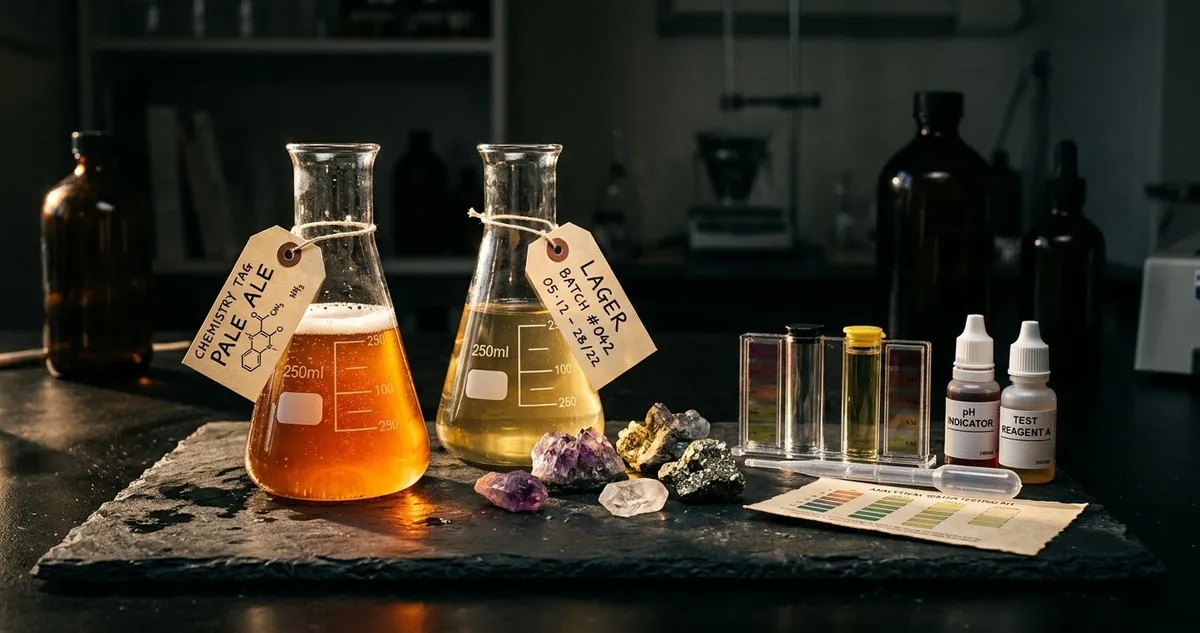
Burton vs Pilsen - Why Your Imported Playbook Tastes Like Pond Water
There is a version of business history in which two towns in the nineteenth century held a competition to see who could brew the better beer, and Burton upon Trent won, and then Pilsen won, and the lesson is that you should try harder.
That version is wrong in an interesting way. Burton and Pilsen did not brew different beers because one of them was cleverer. They brewed different beers because they were standing on different rocks. And the rock, it turns out, was not a detail. The rock was the recipe.
Two towns, one impossible swap
Burton sits on Triassic sandstone shot through with gypsum. Its well water arrives loaded with calcium sulphate at concentrations that would make a modern water treatment engineer file a report - historically something in the range of six to eight hundred parts per million of sulphate, with calcium in the high two hundreds. Drink it and you notice. Brew with it and something strange and wonderful happens. Sulphate does not add flavour of its own so much as it sharpens the perception of hop bitterness, drying the finish and stripping the beer down to something linear and emphatic. Calcium drops the mash pH into the range where enzymes actually work, helps proteins drop out, and makes the yeast behave. The result is the crisp, brittle, gloriously bitter pale ale that Bass and Allsopp shipped to India and then, more profitably, to everyone.
Pilsen sits on the opposite end of the periodic table's social ladder. Bohemian water there is famously, almost comically soft - single-digit calcium, sulphate you could round to nothing, negligible alkalinity. It is water with no opinions. Which is exactly why, in 1842, a bad-tempered Bavarian named Josef Groll could take English-style pale malt, a truckload of Saaz hops, a Bavarian bottom-fermenting yeast and the cold sandstone cellars under the town, and produce a golden lager whose delicacy would have been obliterated anywhere else. Put that same grist and that same aggressive hopping rate into Burton water and you get something astringent, metallic and punishing. Put Burton's pale ale recipe into Pilsen water and you get a flabby, vague beer that tastes like it forgot why it came.
Same instructions. Different substrate. Opposite outcomes.
This is the whole of the argument, and everything below is just the accounting.
The playbook is the recipe. Your company is the water.
Every few quarters a company decides to install someone else's operating system. Squads and tribes from Spotify. The culture deck from Netflix. Six-page narratives and the empty chair from Amazon. Objectives and key results, laundered from Intel through Google and arriving at a forty-person startup like a hand-me-down coat with the shoulders still built for someone else.
None of these practices are fake. That is what makes the failure mode so durable. The practices are real, well documented, and demonstrably worked somewhere. What does not travel is the water - the tenure distribution, the capital structure, the cost of a bad decision, the number of people who can say no, the regulatory latitude, the customer concentration, the physical proximity, the twelve years of shared context that let a two-word Slack message carry a paragraph of meaning.
Amazon's six-pager is not a document format. It is a document format resting on a workforce that has been trained for years to read critically in silence, in an organisation where writing something down is the only way to get resources, and where being wrong in writing is survivable. Import the template into a company where nobody reads and being wrong in writing is a performance review event, and you have not adopted a practice. You have created a new genre of fiction.
Netflix's freedom and responsibility model floats on an unusually strong current in the water - very high individual market value per employee and a famously blunt severance norm. Take the freedom, decline to fund the responsibility half, and you have simply told people to do whatever they want with no way to correct them. That is not a culture. That is a Tuesday.
Yeast travels. Water does not.
Notice what Groll actually imported. He brought yeast, he brought a kilning technique, he brought a mashing method. Those things fit in a wagon. He did not bring water, and he did not bring caves.
That distinction is the single most useful diagnostic available when someone waves a deck at you.
Portable things tend to be artefacts and mechanisms with few dependencies. A written template. A code review checklist. A decision log format. An interview scorecard. A definition of done. These are yeast. They can be carried, and they will mostly do their job in an unfamiliar room.
Non-portable things are anything whose function depends on a property of the environment rather than a property of itself. Anonymous upward feedback depends on whether retaliation is cheap. Rapid autonomous shipping depends on the cost of a rollback. Small teams owning full stacks depends on a platform mature enough to be owned. Radical candour depends entirely on whether the person receiving it can afford to be candid back. These are water. Carry them anywhere and they change into something else in transit, usually something worse.
The failure is almost never in the choice of practice. It is in mistaking water for yeast.
Burtonisation, or the moat that turned out to be a formula
Here is the part of the story that ought to be printed on the wall of every strategy team.
For a few decades Burton's water was a genuine competitive advantage, and a completely accidental one. Burton brewers did not go there for the gypsum. They were there for older reasons, exporting strong dark ale to the Baltic, and when that trade collapsed under early nineteenth century tariffs and blockades they pivoted to the India trade and the pale ale that a London brewer had already pioneered. Only then did it emerge that the local geology happened to be perfect for the thing they had just been forced to start doing. This is what most competitive advantage looks like from the inside before the narrative team gets to it.
Then chemistry caught up. Once brewers understood that the magic was calcium sulphate, the advantage could be reduced to an instruction - add gypsum. By the later nineteenth century breweries everywhere were Burtonising their water, and the moat drained overnight. What survived at Bass was not the aquifer. It was the trademark, the distribution, the reputation and the sheer scale.
Any advantage that can be written down as a formula will be. If your edge survives being explained, it was never the chemistry. It was something harder to copy that you have possibly not identified yet.
And note the asymmetry that made Burtonisation so easy in the first place. Adding minerals to soft water is trivial and cheap. Removing them from hard water required twentieth century technology - ion exchange, and later reverse osmosis. Pilsen could become Burton for the price of a sack of gypsum. Burton could not become Pilsen for love or money.
Organisations run the same asymmetry and almost never price it. Adding a process, an approval gate, a committee, a mandatory review, a compliance step - all cheap, all fast, all defensible in the meeting. Removing one is a political campaign with casualties. Most companies are hard water that once had a choice.
The decoction problem, or steps that outlive their reasons
Bohemian brewers used decoction mashing, a laborious business of pulling portions of the mash, boiling them and returning them, sometimes three times over. There was a real reason. The malt of the era was poorly modified and needed the physical and thermal violence to give up its starch.
Then malting improved. The reason expired. The step did not. Decoction persisted for generations after it became technically unnecessary, defended as tradition, as character, as the way we do things, and occasionally as a genuine flavour contribution that nobody could quite isolate.
Your company has decoction steps. The weekly report nobody reads that exists because a departed executive once asked a question in 2019. The two-week release train that exists because deployments were once genuinely dangerous. The approval from a role that no longer has the information to approve anything. The all-hands format designed for a headcount you passed three years ago.
The diagnostic is not "is this practice good" but "is the condition that created this practice still true". Those are different questions and only one of them is uncomfortable.
Your water report
Before importing anything, get an analysis. Brewers do not guess. They send a sample to a lab and get numbers back, and then they adjust in a specific order because some variables gate others. Here is the organisational equivalent, roughly in the order worth testing.
1. Alkalinity, which is to say decision latency. In brewing, alkalinity governs mash pH, and mash pH gates every enzyme downstream. Get it wrong and nothing else you do matters. The organisational analogue is how many people must agree before a thing happens, and how long that takes. Measure it concretely - pick five recent decisions of similar size and count the humans in the chain and the calendar days elapsed. Almost every imported practice implicitly assumes a number here. Spotify's model assumes a low one. Your assumption is probably wrong by a factor of four.
2. Calcium, which is to say the boring hygiene layer. Calcium does unglamorous work in a mash - enzyme stability, protein coagulation, yeast flocculation. Its organisational counterparts are documentation quality, data reliability, tooling that works, and whether anyone can find anything. Practices that look like culture failures are frequently substrate failures. Teams do not skip writing design docs because they lack discipline. They skip it because the last four are unfindable.
3. Sulphate, which is to say what your incentives sharpen. Sulphate does not add flavour, it accentuates the bitterness already present. Compensation, promotion criteria and public recognition work the same way. They amplify whatever behaviour is already there rather than creating new behaviour. Ask what your current system makes more vivid. Then ask whether the practice you are importing was designed for a system that amplified something else.
4. Chloride, which is to say roundness and retention. Chloride accentuates fullness and body, the sense that a beer holds together. The analogue is trust, tenure and psychological safety, the things that let terse communication work and let disagreement stay cheap. A hard-edged practice imported into a low-chloride organisation reads as hostility rather than rigour.
5. Iron and manganese, which is to say the parts-per-million poisons. Iron produces a metallic off-flavour at concentrations you would otherwise round to zero. Organisations have exact equivalents. One senior person whose behaviour everyone routes around. One metric that quietly inverts a whole team's priorities. One founder habit that nobody names. No process import survives contact with these, and no amount of gypsum masks them.
6. The cellars, which is to say the constraints you cannot buy this quarter. Pilsen's cold sandstone caves were not a choice. They were geography, and lager without them was not possible until artificial refrigeration arrived. Your equivalents are capital, runway, headcount, contractual obligations and the calendar. If a practice requires a cellar you do not have, the honest options are to build the cellar, choose a different beer, or wait for the technology. Pretending is not on the list.
What competent adoption actually looks like
The brewers who thrived did not choose between copying and refusing to copy. They did the harder third thing. They took the mechanism, understood what it was doing chemically, and then adjusted their own substrate deliberately to make it work. Burtonisation is not cargo cult behaviour. It is the opposite. It is someone asking what the water is doing and then doing that thing on purpose.
So the sequence is not complicated, only unpopular.
Get the analysis before the recipe. Identify which variables are load-bearing and which are decorative, and accept that the decorative ones are the ones consultants photograph. Fix alkalinity before you tune flavour ions, because decision rights gate everything and incentives only sharpen what already exists. Change one variable at a time and taste the result, because a brewery that adjusts six ions simultaneously has learned nothing regardless of the outcome. Audit for decoction steps annually and hold a small, respectful funeral for each one. And when you find an advantage you cannot explain, resist the urge to write it down for the industry conference.
The recipe was never the beer. The recipe plus the place was the beer. Everybody knows this about brewing, which is why nobody expects a Bohemian lager to come out of Staffordshire limestone, and yet the same people will fly a VP in from a company forty times their size and expect the machine to arrive intact in his luggage.
It will not. But the offsite has already been booked, the water has not been tested, and the deck looks fantastic.