Building Agentic Governance Framework in Organizations
Hard choices no framework will make for you
Frameworks don't fail technically
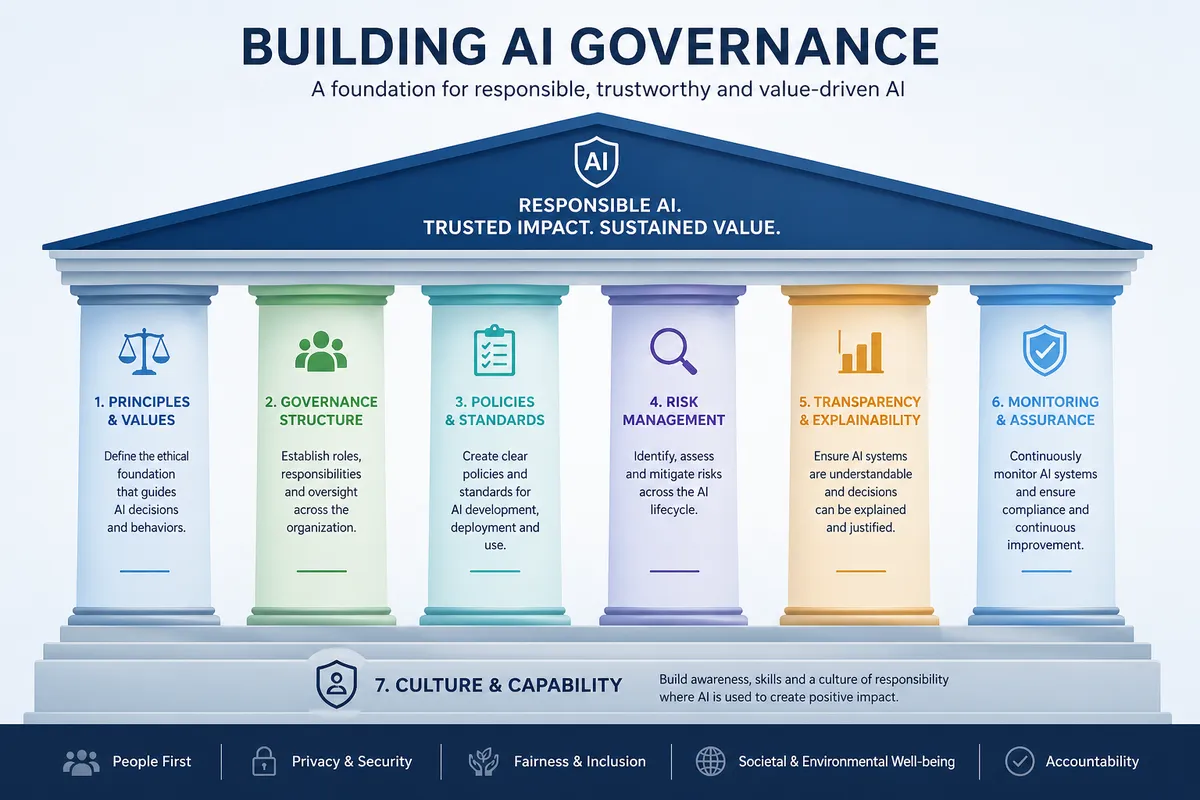
Walk into any large organization in 2026 and you will find an AI governance framework. It will be on a slide. It will have a pyramid, or a wheel, or six layers with tidy icons. It will mention identity, observability, risk tiering, and human oversight. It will be, on its own terms, correct.
It will also, in most cases, be failing.
Governance frameworks rarely fail because they are technically wrong. They fail because they collide with how organizations actually work - with the politics of who owns what, the pressure to ship, the asymmetry between the team that wants to deploy an agent and the committee that would slow it down. A framework diagram does not describe a working governance program. It describes an intention. The distance between the two is the entire game.
This piece is about what it takes to close that distance. Not which boxes to draw, but which choices the boxes conceal - and why the choices, not the boxes, are the real work.
1. Discovery is the first act of governance
Every agentic governance program begins in the same place, whether or not its designers realize it - with an inventory problem.
You cannot govern what you cannot see. And most organizations cannot see what they have. According to IBM's 2025 Cost of a Data Breach report, roughly two-thirds of organizations lack a formal AI governance initiative at all. A 2026 Gravitee survey found that only about a quarter of organizations have full visibility into how their AI agents communicate with each other. The average enterprise now operates dozens of deployed agents, and the number grows every quarter as individual teams stand up automations without central review.
The uncomfortable truth about discovery is that it is politically expensive. A real inventory will surface duplicate work, shadow systems, unsanctioned tools, and projects someone's boss blessed over a drink last year. Each finding is a small conflict. Governance programs that try to skip the conflict - by publishing a policy first and asking teams to self-report - produce registries that are always 40% incomplete and always 40% wrong in the other direction.
The first design decision in any serious governance effort is whether discovery is mandatory, automated, and continuous, or whether it is voluntary. Voluntary discovery produces a clean wall chart. Automated discovery produces a governance program.
2. Most of your agents shouldn't be agents
The second hard conversation is about whether half of what you have built should exist at all.
"Agentic" has become a marketing term. The result is a proliferation of systems called agents that are really deterministic workflows wearing a language model's costume. Each of them inherits every risk of an agent - prompt-injection surface, non-determinism, hard-to-audit behavior, runtime cost - while delivering almost none of the flexibility that justifies the risk.
Governance programs that do not force this question produce ever-longer registries. Programs that do force it shrink the problem by half before they spend a dollar on controls. The discipline is simple - if the logic is deterministic, make it a tool. If the task can be described by a flowchart, it should not be reasoning. Agents are for problems that genuinely require adaptive planning against open-ended inputs. Everything else is a function call in a trench coat.
A tool can be tested exhaustively, permissioned narrowly, and audited in bytes per call. An agent must be monitored behaviorally, protected against adversarial input, and observed across long reasoning chains. Converting an agent into a tool is not a demotion. It is a governance victory - fewer things to monitor, fewer surfaces to attack, fewer decisions for a model to hallucinate.
The organizations that scale AI well are not the ones with the most agents. They are the ones with the most intentful usage of agents.
3. Before controls, give agents names
The third move is boring and structural, and most programs get it wrong - every agent needs its own identity.
The temptation - almost universal in early AI deployments - is to run agents under shared service accounts, employee credentials, or blanket OAuth tokens. It is fast. It is easy. It is, in the long run, catastrophic. Once an agent inherits a human's credentials, it inherits every permission that human has, and there is no forensic path back to which action was taken by the machine and which by the person.
The numbers make the stakes clear. Analysts expect non-human and agentic identities to exceed forty-five billion by the end of 2026 - more than twelve times the size of the human workforce - while only about one in ten organizations reports a strategy for managing them. California's Assembly Bill 316, which took effect on January 1, 2026, forecloses the "AI did it" defense in liability claims. If an agent causes harm and you cannot produce the identity under which it acted, the liability attaches to you anyway. You will answer for an action you cannot reconstruct.
Distinct agent identities enable everything else in the governance stack. They let you scope permissions. They let you rotate credentials. They let you audit behavior. They let you retire cleanly. Without them, every other control is built on sand.
4. Risk tiering that actually has teeth
Almost every AI governance framework includes a risk tier. Low, medium, high. Internal copilots get lighter controls - customer-facing and financial systems get heavier ones. This is easy to draw and hard to enforce.
Two pathologies tend to show up. The first is tier drift - under pressure to ship, systems get classified as "medium" when they belong in "high," because the controls for high-risk systems would delay launch. The second is tier inflation - conservative reviewers classify everything as "high" to protect themselves, which makes the framework functionally meaningless - if everything is high-risk, nothing is. Both pathologies are symptoms of the same underlying problem - there is no enforcement teeth behind the tiering.
A tiering scheme works only if three things are true. The classification is made against an objective schema - data sensitivity, blast radius, reversibility, regulatory exposure - not a reviewer's gut. Controls are automatically applied based on tier, not manually requested. And the system enforces the classification at runtime, not just at design time. If an agent at tier two suddenly starts touching tier-one data, something stops it.
The test of a risk framework is not how it looks on a slide. It is whether it ever says no.
5. Human-in-the-loop only works if humans can refuse
Every governance framework promises human-in-the-loop for high-stakes actions. Customer communications. Financial transactions. Irreversible changes. Low-confidence outputs. Anomalies.
In practice, most of these checkpoints are theater.
The failure mode is predictable. Reviewers are overloaded. The queue grows faster than anyone can service it. Review becomes rubber-stamping - three seconds of glance, an approval, the next one. The agent proceeds, the human has been "in the loop," and the audit trail shows compliance. What it does not show is that the human saw nothing.
This pattern has a cost measured in real incidents. When the New York City small-business chatbot told shop owners they could refuse cash and landlords they could discriminate based on rental assistance, there were humans nominally in the loop at multiple levels - product managers, city officials, subject-matter reviewers. None of them caught the errors before the public did. The review was present. The review was not real.
Meaningful human-in-the-loop has a different shape. Triggers are narrow enough that the queue is manageable - high risk or low confidence, not every action. Reviewers are given the context they need to actually evaluate the output, not just a pass/fail button. Decline rates are tracked; if approval runs at 99%, the review layer is not functioning. And reviewers are protected, politically and operationally, when they say no. A review function whose rejections always get overturned from above is not a review function.
The honest question is not whether a human is in the loop. It is whether the human can, under realistic conditions, stop the action. If the answer is no, the loop is cosmetic.
6. Central, federated, or the honest in-between
Every organization at some point faces a structural question about its AI governance - does it live in the center, distributed through the business units, or both?
Central governance is clean. One registry. One policy engine. One team that owns the standards, the tooling, and the runtime controls. It is also the architecture most likely to become a bottleneck. Business units route around the center the moment it slows them down, which re-creates the shadow-AI problem the governance program was meant to solve.
Federated governance is resilient. Each domain runs its own orchestration, its own controls, its own lifecycle. It is also the architecture most likely to produce twelve incompatible registries, twelve slightly different risk schemas, and twelve audit logs that cannot be joined. At scale, federation without central standards is not governance. It is parallel governance programs that cannot see each other.
The honest answer - and this is in almost every mature framework, though rarely implemented cleanly - is hierarchical orchestration with federated execution. The center owns the standards, the registry, the policy engine, and the audit spine. Domains own the orchestrators, the agents, and the day-to-day operations. The center is the constitution; the domains are the states. Each has authority the other does not.
The mistake most programs make is starting with the end state. Full federation on day one produces chaos because there are no standards yet to federate against. The practical path is to start hierarchical - one registry, one policy engine, one central team - and design deliberately for federation as the organization scales. Avoid over-engineering early. A governance platform that cannot evolve is not a platform.
7. Lifecycle is the half of governance nobody builds
Most governance programs are built around onboarding. How an agent gets approved, classified, permissioned, and deployed. This is the half of the lifecycle everyone wants to discuss.
The other half - monitoring, ownership continuity, retirement - is where governance actually lives or dies.
Agents drift. The underlying model gets updated. The prompt gets refined. The tools it calls change their APIs. The data it was trained to expect gets restructured. A year after deployment, an agent is rarely doing the thing it was approved to do. Without ongoing evaluation against the original quality and safety thresholds, the approval decision becomes a historical artifact rather than an ongoing state.
Ownership rots. The engineer who built the agent changes teams. The product manager who sponsored it leaves. The VP who funded it retires. Two years in, the agent is still running, still calling production systems, and nobody can answer who owns it. Orphaned agents are the single most common failure mode in mature AI environments.
Retirement is harder than anyone expects. Pulling an agent out of production means understanding what depends on it, what replaces it, what data it should stop being able to see, and what audit artifacts need to be preserved. Most organizations have never retired an agent cleanly. They have turned some off and hoped nothing important broke.
A governance program that cannot answer "how does this agent leave the system" is not actually governing. It is only deploying.
8. The stack is layered because the layers do different work
The governance stack that shows up in most frameworks has roughly six layers - policy, training and enablement, build and registry, runtime and orchestration, data access, and audit and oversight. These are not arbitrary.
Policy is where the rules are defined - what must be true of every agent, what must never be true, what standards apply to what risk tier. Training is how humans in the organization learn to operate under those rules. Build and registry is where agents get created, permissioned, and catalogued. Runtime is where policy becomes enforcement - where the policy engine evaluates each planned action before it executes. Data access is the boundary at which the organization's information meets its agents, with classification, least privilege, and contract-based consumption. Audit is how everything above can be reconstructed, questioned, and improved.
The temptation in every governance program is to over-invest in one layer and assume it covers the others. Policy-heavy programs produce documents nobody reads and rules nobody enforces. Runtime-heavy programs build beautiful policy engines that have no policies to execute. Audit-heavy programs produce meticulous logs of things that should never have been allowed in the first place.
The layers are layered because they do different work. Policy without runtime enforcement is theater. Runtime enforcement without policy is anarchy that happens to be logged. Audit without policy and runtime is a record of failure with nothing attached. The work of governance is not choosing a layer. It is staffing and operating all of them as a system.
Gartner's 2025 research found that organizations deploying structured AI governance platforms were more than three times as likely to achieve high effectiveness as those relying on policy-first approaches. The market has drawn the same conclusion, with spending on AI governance platforms projected to exceed a billion dollars by 2030. The reason is not that policy is wrong. The reason is that policy alone, without architecture behind it, has consistently failed.
9. The political economy matters more than the architecture
Here is the part that rarely appears in governance frameworks, because it is uncomfortable to put on a slide - none of this works without organizational power.
A governance function that cannot block a deployment is not a governance function. A risk tier that can be talked down by a senior stakeholder is not a risk tier. A policy engine that allows exceptions on verbal approval is not a policy engine. A committee that reviews everything after the fact is not a committee - it is merely a witness.
Most AI governance programs are quietly set up to lose these fights. The governance team reports to the wrong executive. The engineering team owns the platform on which governance would enforce. The business owners have P&L authority - the governance team has a dotted line to legal. When a high-stakes deployment hits a governance objection, the escalation path runs through someone whose incentives favor shipping.
The organizations that govern AI successfully tend to share three unglamorous traits. Governance has a named owner at the executive level - not a committee, an accountable individual. Governance controls are enforced in the platform itself, not in a review meeting, so that bypassing them requires a deliberate act rather than simple inattention. And there is a clear, documented appeal path for blocked deployments - because a governance function with no appeal is unsustainable, but one with no friction is useless.
The best technical framework in the world does not survive an organization that is not willing to say no. And the most flawed technical framework, deployed inside an organization that takes governance seriously, will eventually be fixed. The variable is not the diagram. It is the will behind it.
The question to sit with
If you have read this far, the instinct is to translate the list into a project plan. A discovery sprint. An identity project. A risk tiering workstream. Each of those is useful. None of them is the actual work.
The actual work is sitting with an uncomfortable question before the project plan gets written:
Is our organization, honestly, willing to let a governance function block a deployment that the business wants to ship?
If the answer is yes, the framework will follow, because the political economy will support it. If the answer is no, the framework will be built anyway, and it will fail, because no architecture survives a culture that refuses to use it.
The agentic governance problem is not solved by drawing better boxes. It is solved by deciding, at the top of the organization, that some things are worth slowing down for - and then building the architecture, the identity layer, the runtime enforcement, and the audit spine that let that decision translate into action on the ground.
Everything else is a slide.